





Choosing the right ATS (application tracking system) can determine whether your recruiting team operates efficiently or struggles with administrative delays. Selecting the right platform can reduce costly software friction, prevent top-tier candidates from dropping out of your pipeline, and directly lower your cost per hire. Discover what you should look for when choosing an ATS. Explore key evaluation criteria, important enterprise considerations, and our vendor evaluation checklist to make a data-driven purchasing decision.
What Should I Look For When Choosing an ATS?
When choosing an ATS, prioritize four main criteria over vendor feature lists alone, as those lists may not reflect operational effectiveness. Focusing on these key pillars ensures the software promotes recruiter adoption and delivers real recruiting ROI, rather than becoming an unused expense.
- Your Budget: Consider your budget and ensure you receive a comprehensive cost breakdown that includes the base subscription, implementation fees, and any additional costs, such as premium features. Calculate the total annual ATS cost using the formula provided.
Total Annual ATS Cost = (Per-User Monthly Fee x Number of Recruiters x 12) + Implementation Fee + Add-On Costs
- Data Migration and Implementation: Data migration and implementation in an ATS can be problematic, often due to unclear processes and inadequate training. Important questions include how candidate data is imported, how historical data is handled, and whether dedicated support is available.
- Your Organization's Actual Hiring Needs: When choosing an ATS, organizations should identify their specific hiring needs by answering questions about the volume of open roles, geographic hiring locations, the use of external agencies, the technical proficiency of hiring managers, and integration with existing HR systems. These answers will help narrow down suitable ATS vendors, as different companies have different requirements based on their hiring scale and complexity.
- Core Recruitment Features: The system should automate your repetitive manual work. Look for these specific capabilities:
- AI Candidate Matching: The platform should automatically parse resumes and score candidates against your job description.
- Centralized Recruitment Pipeline Management: Your team needs a visual, drag-and-drop Kanban board to track candidate progression.
- Automated Communication: The software should support personalized email sequences to candidates as they progress through stages.
- Candidate Sourcing Extensions: A dedicated browser extension should let recruiters import profiles directly from LinkedIn into the talent pool with one click.
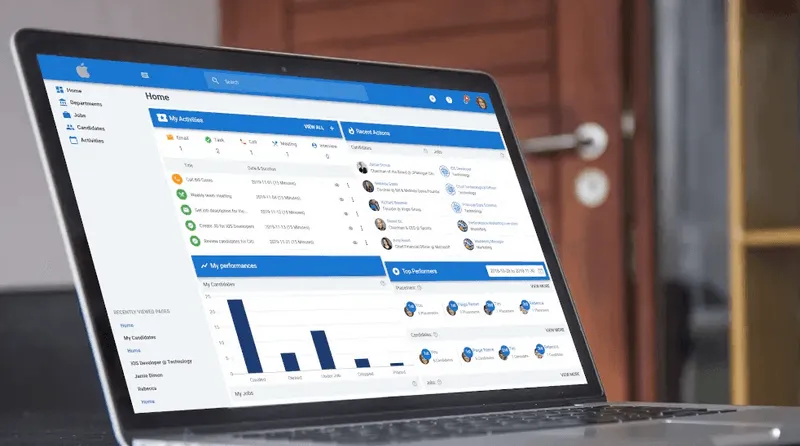
Manatal ATS builds these exact tools directly into the platform to eliminate your manual overhead. The system automatically indexes your entire talent pool, making past candidates instantly searchable with advanced filters and AI-powered recommendations.
Key Criteria for Evaluating ATS Platforms
Evaluating Applicant Tracking Systems (ATS) requires an objective framework that goes beyond vendor marketing. Independent review platforms (such as G2, Capterra, Forbes Advisor, and GetApp) utilize structured scoring methodologies based on verified user feedback across eight core dimensions:
- Ease of Use: Measures user interface intuition, navigation, and learning curve. Low ease-of-use scores may contribute to poor adoption.
- Feature Set & Functionality: Assesses the depth and quality of advertised tools such as resume parsing, pipeline customization, and scheduling, rather than just a long list of features.
- Value for Money: Evaluates whether the utility received justifies the cost, focusing on total feature inclusion in the base price rather than just the subscription headline rate.
- Quality of Support: Scores responsiveness, resolution rates, and channel availability. Critical for enterprise buyers managing operational risk at scale.
- Ease of Implementation: Reflects deployment speed, IT involvement, and data migration timelines.
- Integration Capabilities: Assesses connections with external tools (HRIS, payroll, background checks) and the availability of an open API for custom configurations.
- Reporting & Analytics: Evaluates data depth, ranging from basic metrics to advanced dashboards for source-of-hire, pipeline conversion, and recruitment ROI.
- Data Security & Compliance: Verifies vital certifications (SOC II Type 2, ISO 27001) and compliance with international privacy regulations (GDPR, CCPA, PDPA).
Manatal has been independently reviewed and recognized across each of these platforms. Verified reviews are available at G2, Forbes Advisor, and Software Advice.
Enterprise ATS vs. Standard ATS Plans
The difference between a standard and an enterprise ATS lies in their ability to handle organizational complexity. Standard ATS plans are typically suitable for smaller companies with limited hiring needs, while enterprise ATS platforms cater to larger organizations with more complex requirements. As organizations grow, standard ATSs face challenges such as job slot limits, data silos due to a lack of an open API, and insufficient reporting capabilities.
Here is a practical comparison using Manatal's pricing plan structure as a reference point:
ATS Pricing Models and Cost Considerations
Understanding how vendors structure their pricing is as important as understanding the headline cost. The pricing model determines how costs scale as the team grows, and some models introduce significant budget variability that is difficult to forecast.
When evaluating any vendor, organizations should ask directly, "What would the contract cost if the team doubles in size within 12 months?” If the answer requires re-pricing the entire agreement, that variable should be reflected in the financial analysis.
How to Build a Business Case and Budget
Securing approval for a new ATS is not solely an HR decision. It typically requires sign-off from finance, IT, and senior leadership. A well-constructed business case addresses the following three questions before stakeholders raise them.
- What is the cost of the current process? Calculate the recruiter's time spent on manual tasks such as CV sorting, interview scheduling, and status updates. Multiply by the average hourly cost per recruiter. Add cost-per-hire data and current time-to-fill averages. This figure becomes the cost-of-inaction baseline against which the ATS investment is measured.
- What specific problems will this ATS solve? Specificity is essential. A statement such as "improve recruitment" does not constitute a business case. A statement such as "reduce average time-to-fill from 34 days to 22 days by automating CV screening and interview scheduling" is a business case because it establishes a measurable outcome against which success can be evaluated.
- What is the projected return on investment within 12 months? A realistic ROI model considers the following: Faster time-to-fill reduces the productivity loss associated with unfilled roles; improved candidate experience increases offer acceptance rates; and reduced manual administration redirects recruiter time toward higher-value activities such as sourcing and stakeholder engagement. Recruiters should be included in the evaluation process. They are the primary users of the platform, and a system that the recruiting team resists using will deliver no measurable return regardless of its technical capabilities.
Conclusion
Companies should conduct a structured trial with multiple team members when evaluating an applicant tracking system (ATS) like Manatal. By letting recruiters and hiring managers test the system for a week, companies can determine if it improves their hiring process. This approach helps ensure the ATS will be beneficial in the long term, as it affects every hire and can lead to faster recruitment and higher-quality candidates, delivering stronger ROI than making hasty decisions.
Get in touch to discover how Manatal can help you streamline your recruitment process or start a free 14-day trial to start making a lasting difference for your business.
Frequently Asked Questions
Q: What hidden costs should we look for when choosing an ATS?
A: Look closely at implementation fees, data migration overages, and mandatory training packages. Many vendors advertise a low baseline subscription rate but charge extra for essential modules like advanced reporting, custom API integrations, or SMS candidate communication. Always request a full cost breakdown to calculate your actual total cost of ownership. Transparent platforms like Manatal eliminate this risk by bundling these core capabilities into clear, predictable per-seat pricing.
Q: What are the most critical factors to consider when choosing an ATS for multi-location hiring?
A: You must verify the system’s support for localized job board distributions, multi-currency pricing, and varied regional data privacy laws. The platform needs to allow separate, customizable pipeline workflows for different branches, something Manatal accommodates by enabling flexible workflow structures across different team permissions.
Q: What are the key criteria for choosing an enterprise ATS rather than a standard SMB plan?
A: Enterprise scale requires advanced data governance, complex user authorization tiers, and deep infrastructure flexibility. Look for dedicated single sign-on (SSO) capabilities, unrestricted API access for custom internal tool configurations, and isolated cloud data storage, features explicitly partitioned into advanced tiers such as Manatal's enterprise plans.
Q: What data security benchmarks represent important factors in choosing an enterprise ATS?
A: An enterprise platform must prove operational risk management through verified compliance certifications. Ensure the vendor holds strict data governance credentials and fully complies with local privacy mandates. For instance, Manatal maintains global standards such as SOC 2 Type 2, GDPR, and CCPA to protect large volumes of sensitive candidate background data.
.webp)







.webp)

.webp)


.webp)


