




According to the U.S. Department of Labor, a bad hire can cost up to 30% of that employee's first-year earnings. [1] Factor in indirect costs like lost productivity, damaged team morale, and the time spent restarting your search, and the CareerBuilder survey found that employers estimated the average cost of a bad hire at nearly $17,000. [1] The interview is your best opportunity to catch warning signs before they become costly problems. This guide walks you through the most common interview red flags recruiters encounter and how to handle them without jumping to conclusions.
Interview Red Flags: What Counts for Employers
For employers, interview red flags are patterns of behavior, inconsistencies, or communication gaps that signal a candidate may not be the right fit for the role, team, or company culture.
What turns a moment into a genuine signal is the combination of pattern, relevance, and impact:
- Does the behavior repeat across questions?
- Does it affect core integrity or role capability? (e.g., A rambling answer from a data analyst is noise; the same from a customer success manager is relevant.)
Five Core Interview Red Flag Categories
According to a survey of 625 U.S. hiring managers, the most concerning behavior from job candidates is dishonesty. 63% of hiring managers identified it as the biggest red flag. [2] This brings us to our primary category:
1. Credibility and Honesty Red Flags
A 2025 FlexJobs Job Search Trends Report found that one in three people have lied on their resume. [3] Watch for inconsistencies between their resume and verbal answers (e.g., job titles, dates, or scope of authority).
- Vague / Borrowed Credit: Inability to explain how they accomplished a goal or shifting stories when probed.
- Evasiveness: Overly defensive or vague responses when asked about employment gaps.
- Abstract Ownership: Claiming full credit for team achievements without providing specific contributions.
Quick Probe: Ask direct follow-ups like "Walk me through the exact steps you personally took on that project" or "What specific role did you play in that outcome?" Strong candidates get concrete when pushed; weak ones stay abstract.
2. Communication and Engagement Red Flags
Focus on how the candidate presents information and interacts:
- Rambling Non-Answers: Talking at length to run out the clock on difficult questions.
- Lack of Curiosity: Asking zero questions about the team, role, or company metrics.
- Poor Active Listening: Repeatedly answering a different question than the one asked.
3. Attitude, Respect, and Culture Add Red Flags
Pay attention to how candidates treat everyone involved in the hiring process:
- Unconstructive Blame: Trash-talking past employers or managers instead of offering constructive reflection on past challenges. A survey by The Creative Group revealed that 62% of executives view badmouthing a former employer as a deal-breaker. [2]
- Dismissiveness: Disrespectful behavior toward schedulers, coordinators, or receptionists.
- Arrogance vs. Confidence: Confident candidates back claims with facts and stay curious; arrogant candidates talk over the interviewer and assume they know it all.
4. Reliability and Professionalism Red Flags
Professionalism during the interview reflects how they will operate on the job:
- Repeated last-minute rescheduling or unexcused lateness.
- Missing agreed-upon materials or trial tasks.
- Unexplained ghosting between interview rounds.
5. AI-Era Interview Red Flags (2026)
Authenticity is a major challenge in modern recruitment. Gartner predicts that by 2028, 1 in 4 candidate profiles worldwide will be fake. [4] Watch out for:
- Proxy Candidates: Someone off-camera feeding answers or taking the interview on their behalf.
- Scripted AI Answers: Reading text off-screen (detectable via rapid eye tracking, latency before responding, or a robotic cadence that collapses when asked to improvise).
- Identity Mismatches: Video feeds or details that do not align with background documents.
Read more on our guide: How to identify fake candidates
How to Identify Red Flags in an Interview
1. Standardize Early Screening
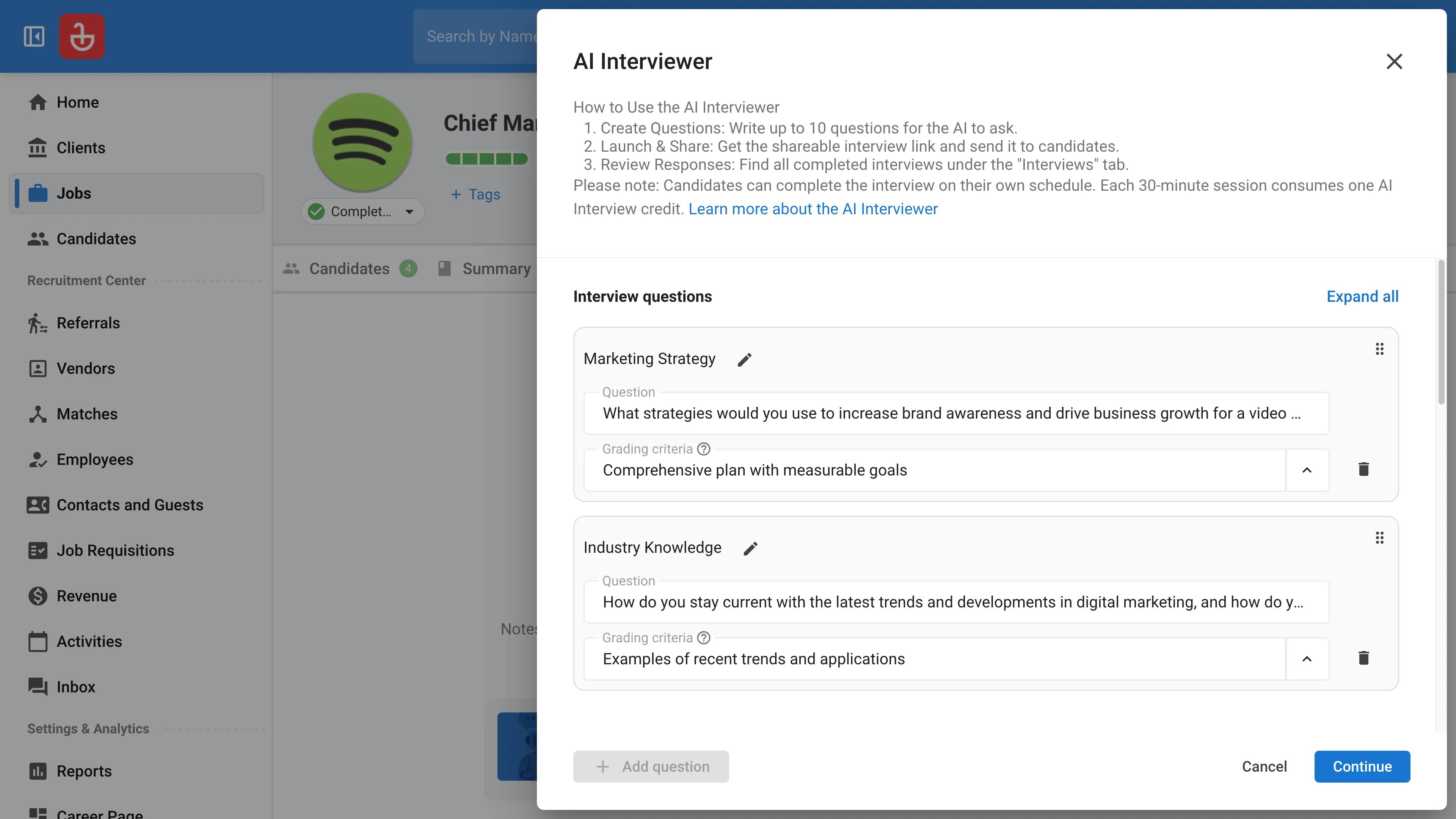
Unstructured interviews frequently mask red flags like inconsistency or exaggeration because interviewers rely on subjective charm and inconsistent questions. Standardizing this stage creates an objective baseline that isolates candidate risk factors. Manatal’s AI Interviewer helps standardize the initial interview process by generating role-specific questions based on your job descriptions and using consistent evaluation criteria across candidates. This provides a more structured way to compare responses while helping recruiters identify areas that may warrant further review before candidates move to the next stage.
{cta}}
2. Probe In Real-Time
When a red flag appears in a live interview (or video call via Zoom/Google Meet), ask an unscripted, highly specific follow-up question on the spot to test if the candidate can improvise without a script or proxy. Dig deeper into specific metrics, project timelines, or personal responsibilities to separate authentic experience from memorized answers.
3. Review Recorded Evidence
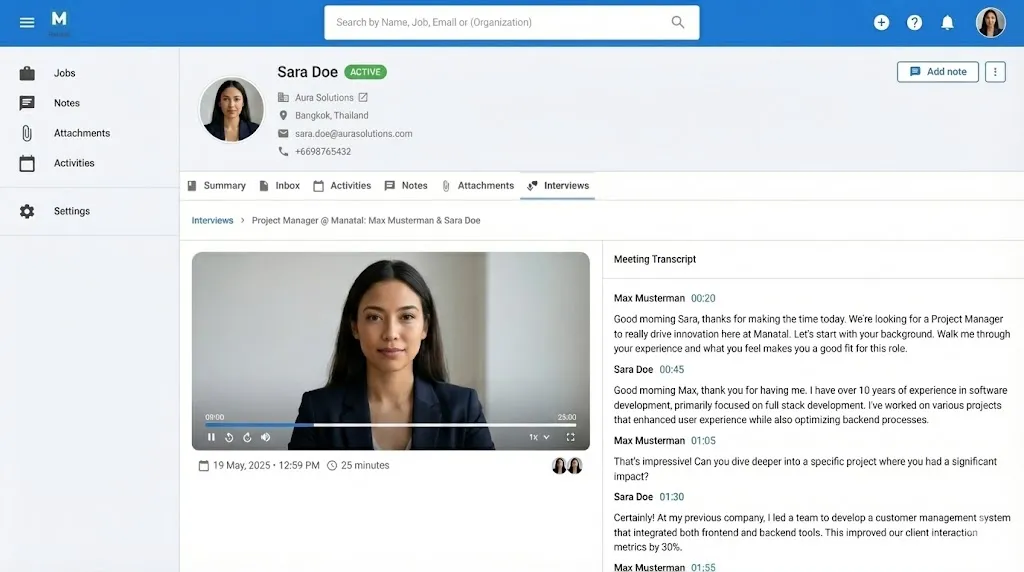
Avoid relying solely on subjective memory or gut instinct. Manatal’s AI notetaker transcribes, summarizes, and records live interviews. Hiring managers can review interview recordings and transcripts and compare candidate responses side-by-side inside the ATS. This creates a reliable audit trail and allows non-interviewing team members to review key moments without forcing candidates into redundant interview rounds.
4. Confirm via Skills Tasks & Reference Checks
Validate claims externally using candidate assessment tools, pre-employment skills assessment tests, and background checks before making a final decision. Combining practical skill tests with past performance verification helps verify that a candidate’s actual capabilities match what is presented on paper.
5. Make Defensible, Human-Led Decisions
Log scores on shared recruiting scorecards. Require a second interviewer’s independent read before rejecting a candidate over a single red flag. Collaborative scoring keeps the final decision fair, data-driven, and legally defensible while preventing individual misinterpretations.

Interview Red Flags vs. Candidate Nerves
Before acting on a signal, filter it through three quick questions:
- Capability/Integrity or Comfort? A shaky voice is comfort (nerves); a contradicting career history is integrity.
- One-Off or Pattern? Dropping a train of thought once is nerves; dodging specifics three times is a pattern.
- Role Relevance? Limited small talk doesn't matter for a backend developer, but it matters for a sales leader.
Guardrail: Protected characteristics, accents, neurodivergent traits (like reduced eye contact), and cultural communication differences are not red flags. Evaluating them as such creates hiring bias and legal risk.
Conclusion
Spotting interview red flags early helps you hire with confidence. When you combine structured interviews, skills assessments, and awareness of common red flags, you reduce the risk of costly mistakes and build teams that perform. Manatal’s ATS helps recruitment teams standardize early screening, capture objective candidate data, and make defensible hiring decisions.
Start Your Free Trial with Manatal Today.
Frequently Asked Questions
Q: What is the biggest red flag in an interview?
A: Dishonesty. Inconsistencies between a resume and a candidate's answers, or claimed ownership of work they cannot describe, undermine everything else, because if you cannot trust the account, you cannot assess the candidate. See the credibility and honesty section above for how to test it.
Q: What are common interview red flags to avoid?
A: The most common are resume-versus-answer inconsistencies, vague or shifting accounts of past work, no questions from the candidate, badmouthing former employers, repeated unreliability across the process, and, increasingly, signs of scripted or proxy-assisted answers on video. Standardizing early video evaluations through Manatal AI Interviewer helps detect these inconsistencies early and objectively.
Q: What are the top 3 common job interview mistakes candidates make?
A: The three that recruiters flag most often are failing to research the company or role, giving vague answers that dodge specifics, and speaking negatively about past employers instead of reflecting constructively. Using Manatal’s custom interview scorecards allows hiring teams to consistently track and flag these behaviors across candidates.
Q: How do recruiters differentiate nerves from red flags?
A: Look for patterns over time. Nervous candidates usually relax as the conversation progresses, whereas genuine red flags (like evasiveness or hostility) persist throughout the entire interview. Reviewing call recordings and automated transcript summaries in Manatal makes it easier to spot persistent behavioral patterns after the interview.
Q: What is the 30-60-90 day rule in an interview?
A: The 30-60-90 refers to a plan for a candidate's first 30, 60, and 90 days on the job. Asking a candidate to outline one is a way to test whether they understand the role and can think past the interview, and a thin or generic plan can itself be a mild signal about preparation.
Citations
.webp)







.webp)

.webp)


.webp)


