





Most hiring teams have a list of tactics, such as posting the job, asking for referrals, checking LinkedIn, and screening resumes. Without a recruitment strategy that ties those actions to a goal and measures what's working, hiring stays slow and inconsistent with no clear explanation. In this article, we will look at how to build a strategy across four dimensions: quality, efficiency, fairness, and foresight. We also include a way to measure which parts of your strategy are actually working.
What Is a Recruitment Strategy?
A recruitment strategy is the documented plan for how your organization attracts, evaluates, and hires talent to meet its workforce goals. It covers three things: your sourcing channels, your evaluation methods, and the metrics you use to judge success.
How to Build a Recruitment Strategy
Quality: Structured and Skills-Based Hiring
Skills-based hiring evaluates candidates on demonstrated ability, not proxies like degree pedigree or job titles. And structured interviews score every candidate against the same rubric, before anyone discusses the candidate as a group. Recruiting functions that excel at this process see a 24% increase in quality of hire.[1]
- Build a role scorecard: List the three to five must-have skills before you open the role, and score every candidate against it, not your gut reaction.
- Replace one screening round with a skills test: A work-sample task or a platform like TestGorilla shows you more than a resume can.
- Standardize your interview questions: Ask every candidate the same five to seven questions, scored before the group discusses the candidate.
Efficiency: Channel Mix and Candidate Experience
Posting everywhere slows you down, with more applicants than you can evaluate well. Skills-based hiring alone cut time-to-hire for 82% of employers and hiring costs for 74%,[2] since a tighter process moves faster, not just better.
- Pick three to four channels per role type: A broad network like LinkedIn for most roles, niche or sponsored boards for hard-to-fill ones.
- Cut a step from your funnel: Merge stages, like a recruiter screen and hiring manager screen, where they don't add distinct signal.
- Set a response-time SLA: Commit to a window, such as 48 hours between stages, and track whether you actually meet it.
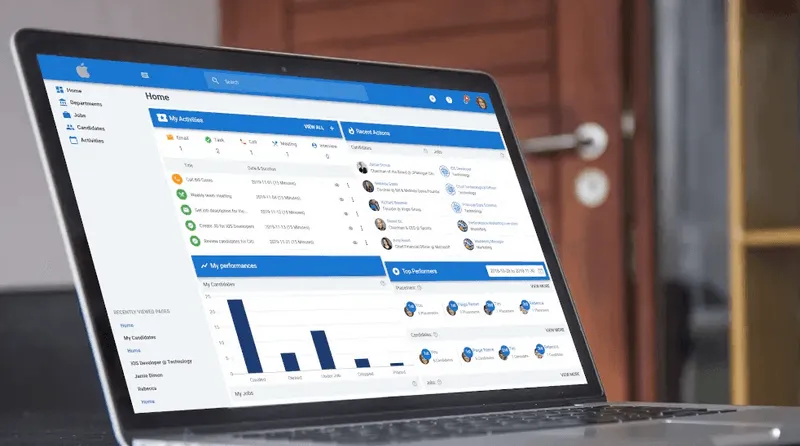
Without clear metrics, a recruitment strategy often wastes time and budget on underperforming channels. Manatal’s Reports and Analytics addresses this visibility problem by tracking over 20 prebuilt KPIs directly inside the ATS. These metrics, including time-to-hire and source benchmarking, show exactly which methods perform best. Teams can then use this data to quickly shift resources to what works.
{{cta}}
Fairness: Consistency and Compliance
A rubric applied consistently reduces bias and creates a record you can point to if a hiring decision is ever challenged. It's about making your decisions defensible and repeatable.
- Apply one rubric to everyone: the same questions and criteria for every candidate remove room for a single interviewer's mood to decide the outcome.
- Keep scorecards on file for every candidate: Maintain records for all applicants, not just the one you hire, to ensure a documented, criteria-based record if a decision is ever questioned.
Foresight: Workforce Planning
Most recruiting is reactive: a role opens, and the search starts from zero. Foresight means you're already a step ahead, so time-to-fill drops without any extra sourcing effort.
- Forecast the next two to four quarters: pull your headcount plan from the business and start sourcing before requisitions land.
- Keep a warm talent pool for recurring roles: stay in light touch with strong runner-up candidates instead of starting cold each time.
- Define the ideal candidate profile before opening the role: decide what "good" looks like before you're under pressure to fill the seat quickly.
Adoption Reality Check
TestGorilla's 2025 research found that 85% of employers are now using skills-based hiring, up from 81% the year before.[3] It's not limited to senior roles, either. NACE's Job Outlook 2025 survey found that 64.8% of employers use skills-based hiring practices specifically for entry-level hires,[4] and more than half of those employers apply it always or most of the time, not as an occasional exception.
If your process still leans entirely on resumes and unstructured interviews, you're behind most of the market, not ahead of a trend. The adoption curve has already tipped; the question now is how well you implement it, not whether you should.
Quick-Win Tactics
If you need immediate moves while you build out the full strategy, start here:
- Refresh your job descriptions around outcomes and skills: Replace vague requirements like "5+ years experience" with the specific skills the role actually needs. Lead with what the person will do in their first 90 days, not a list of tools and buzzwords.
- Turn on employee referrals: Referred candidates tend to be faster to hire and better fits, and the channel costs little to run. A modest bonus, paid after the new hire passes their probation period, is usually enough to keep the pipeline active.
- Use one professional network well: A well-maintained LinkedIn presence, with active sourcing and quick responses, outperforms a scattershot approach across five platforms. Spend the time you'd have split across multiple boards on faster follow-up instead.
Measure and Reallocate
Most teams can tell you how many roles they filled last quarter. Few can tell you which channel, method, or process change actually drove that result, so budget and effort stay spread thin across everything instead of being concentrated on what performs.
Track a small number of levers per dimension, not a full KPI catalog:
- Quality: quality-of-hire, early attrition
- Efficiency: time-to-hire, cost-per-hire, source performance
- Fairness: pass-through rates by stage
If one sourcing channel consistently produces candidates who pass through your pipeline and stay past their first year, put more budget there. If a channel produces volume but weak retention, cut it, even if it's the one you've always used. The point is to reallocate effort toward what's actually working and away from what isn't.
Do this review on a set schedule, monthly for high-volume roles, quarterly for everything else, rather than only when hiring feels slow. By the time hiring feels slow, you've usually already lost weeks to a channel or step that wasn't pulling its weight.
Conclusion
A recruitment strategy is a balance of four goals: quality, efficiency, fairness, and foresight, backed by measurement that tells you what's actually working. Build your process around those four dimensions, track the few metrics that matter for each, and reallocate effort based on real results instead of habit. Pick one dimension where you're weakest, quality, efficiency, fairness, or foresight, and put the how-to steps above into practice this quarter. The four-dimensional process works best as a full system, but even one dimension done well will move your hiring numbers.
Ready to put this into practice? Start for free with Manatal and see how Reports & Analytics helps you track what's working from day one.
Frequently Asked Questions
Q: What are the best recruiting strategies?
A: The best recruiting strategies rely on data-driven sourcing, skills-based assessments, and a streamlined candidate experience. These methods focus on quality over quantity by targeting specific channels and removing redundant stages from the hiring funnel. Manatal’s ATS supports this approach by providing the analytics and pipeline visibility needed to optimize these workflows.
Q: What are the three inclusive recruitment strategies?
A: Three inclusive recruitment strategies are using gender-neutral job descriptions, anonymizing resumes to hide identifying details, and utilizing structured interview scorecards. These steps help mitigate unconscious bias and ensure candidates are evaluated solely on their merits.
Q: What are the four steps in the recruitment strategy?
A: The four steps in a recruitment strategy are defining requirements, sourcing candidates, screening applicants, and selecting the hire. This structured lifecycle guides talent acquisition teams efficiently from initial workforce planning to the final job offer. Manatal’s applicant tracking system serves as an integral solution by centralizing, managing, and automating all four of these stages within a single platform.
Q: What are the main recruitment methods or strategies?
A: The main recruitment methods include internal promotions, employee referral programs, online job boards, and direct sourcing through professional networks. Companies typically combine these channels to balance cost, speed, and candidate quality across different role types. Manatal’s Reports and Analytics feature allows users to gain visibility into which channels deliver the best return on investment.
Citations
.webp)







.webp)

.webp)


.webp)


