





In hospitality recruitment markets, employers continue to face challenges recruiting experienced and leadership-level talent in 2026. Talent shortages, leadership gaps, and competition for skilled candidates remain common, particularly for management and specialized roles. [1] This issue extends beyond HR, impacting overall business performance. The article targets HR managers and recruiters in hospitality, offering a hospitality recruitment roadmap adaptable to the industry's challenges in 2026, such as high turnover, seasonal demands, complex shifts, and a rapidly changing labor market.
The 2026 Hospitality Recruitment Market
According to WTTC projections, travel & tourism is expected to create 91 million new jobs by 2035.
Hospitality alone could face a global shortage of approximately 8.6 million workers. This indicates sustained demand for hospitality professionals throughout the next decade.
- Around 65% of U.S. hotels report ongoing staffing shortages, indicating that labor scarcity is no longer a temporary post-pandemic issue but a long-term operational challenge. [2]
- European hospitality businesses are still missing approximately 10% of their required workforce on average [3]
- Organizations are investing more heavily in the following: Internal promotions, Career development, Upskilling programs, Employee engagement initiatives to reduce turnover [4]
- Hospitality employers are increasingly using temporary and contract workers, seasonal recruitment, workforce agencies, and on-demand labor to manage uncertainty, peak travel periods, and labor shortages more effectively. [5]
- Large international events are generating significant hiring demand, such as the FIFA World Cup 2026, international conferences, tourism festivals, and entertainment events. [6]
Hospitality Recruitment: A Step-by-Step
Step 1: Multi-Channel Sourcing Built for Hourly Workers
To successfully hire line cooks, employers should tailor their application processes since hourly hospitality workers often apply to these openings on the go. Using local community platforms like Facebook groups and WhatsApp recruiting can effectively source candidates without advertising costs.
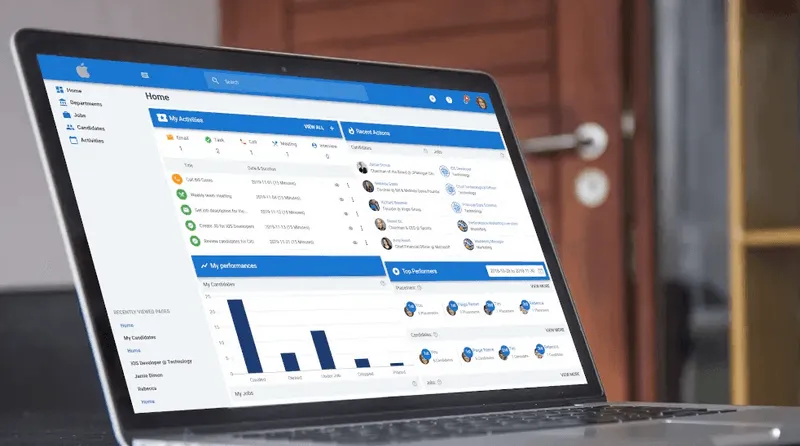
With Manatal, you can seamlessly amplify these efforts: use the Premium Job Board Posting feature to distribute your open roles across multiple channels at once, and instantly connect with applicants via the integrated SMS tool to capture their attention right on their mobile screens.


{{cta}}
Step 2: Hospitality-Specific Assessments
In the hospitality industry, a resume rarely guarantees on-the-floor performance. Therefore, the screening process must be tailored to the specific nature of each role:
- Front-of-House Roles: Customer-facing positions require situational judgment assessments. For example, presenting candidates with a written scenario regarding an unhappy guest reveals more about their service orientation and composure than years of standard hotel experience.
- Back-of-House Roles: For culinary positions, practical kitchen trials are the industry standard. Candidates must be compensated for these shifts because unpaid trials are illegal in many jurisdictions and signal a poor company culture that deters top talent.
- Core Competencies: Soft skills assessments should focus on three core areas: communication clarity, stress tolerance, and receptiveness to feedback. These traits determine whether a new hire will succeed during the demanding first 90 days of hospitality work.
Structured recruitment assessments reduce hiring bias. When all candidates answer identical situational questions and are evaluated on the same rubric, hiring decisions are fairer, more legally defensible, and more consistent across all properties.
Step 3: Collaborative Hiring Between HR and Property-Level Department Heads
Corporate HR manages the ATS and job postings across every property in a hotel group or restaurant chain. Executive chefs, housekeeping supervisors, and F&B directors handle scheduling and final hiring decisions at the property level. These two groups rarely share a system. HR posts a "Front Desk Agent" role without realizing that the property's actual gap is bilingual staff for the night shift. A single shared pipeline closes that gap.
- Property-Level Visibility: A shared pipeline lets a housekeeping supervisor at one property see applicants the moment they clear a basic availability screen, without waiting for corporate HR to forward resumes by email. During peak season, when a single property can receive over 100 walk-in applications in a week, this visibility prevents strong candidates from going cold before a department head ever reviews them.
- Guest Portal for Department Heads: Corporate admins can invite an executive chef, front office manager, or spa director into Manatal as a guest, scoped to their own department and property only. A chef at the Miami property never sees applicants for the front desk role at the Chicago property, and vice versa.
- Trial Shift Tracking: Hospitality hiring runs on working interviews more than any other industry. A kitchen brigade decides on a line cook after one trial shift, not one interview. Department heads can log trial shift outcomes directly against the candidate profile, so the decision to hire or pass is in the same record HR already tracks, rather than a verbal handoff at the end of a shift.
- Referral Routing by Department: Hospitality hiring relies more on referrals from existing staff than on posted job ads, particularly for chef and sommelier roles sourced through culinary school networks.
Step 4: Accelerated Onboarding to Prevent Pre-Start Ghosting
According to the U.S. Bureau of Labor Statistics, the accommodation and food services sector consistently records one of the highest employee turnover rates among all industries. To reduce candidate ghosting in hospitality, employers should implement a structured pre-boarding process immediately after the offer is accepted, within 24 hours. This package should include:
- The employee's work schedule for the first one to two weeks, including shift times and the assigned department.
- First-day reporting information, such as reporting location, arrival time, manager or supervisor contact details, and check-in procedures.
- Visual dress code guidelines with examples of acceptable uniforms, grooming standards, footwear requirements, and name badge instructions.
- Property-specific information, including employee entrance, locker facilities, staff cafeteria, parking, or public transportation guidance, and required onboarding documents.
- A brief welcome message from the department manager or hotel leadership to strengthen employee engagement before the first shift.
Seasonal Labor: Planning for the Peaks
Hospitality recruitment is highly affected by seasonal changes, requiring a swift increase in workforce during peak times. According to Eurostat (the statistical office of the European Union) data, peak-season occupancy in tourist accommodations is 68% above the annual average. However, employment volume only rises by 11% during those same peak months. This massive discrepancy mathematically forces operators to scramble for temporary labor to prevent a total collapse in service delivery.
1. Build Dedicated Workflows for Seasonal and Temporary Visas
When a hospitality business relies on international talent to weather peak seasons, timeline management is everything. Standard recruiting workflows are rarely equipped to handle the rigid, bureaucratic demands of immigration compliance.
- H-2B Visas (U.S.): These non-agricultural temporary visas are tightly bound by annual numerical caps. Because obtaining labor certification, filing petitions, and processing visas takes months, recruiters must initiate planning 75 to 90 days before the target start date. [7]
- Working Holiday Visas (Global): Programs in Australia, New Zealand, and several European nations operate under distinct, strict eligibility and work-authorization requirements. For international operations, ownership of immigration compliance should be assigned to a dedicated specialist rather than bundled into general recruiting tasks
2. Factor Predictive Scheduling into Workforce Forecasting
Predictive scheduling laws (frequently enacted as “fair workweek” mandates) are expanding rapidly across major U.S. municipalities and states, including San Francisco, Seattle, Chicago, New York City, Philadelphia, and the State of Oregon.
- The Legal Mandate: These regulations require employers to provide hourly service workers with stable schedules well in advance, penalizing sudden, last-minute shift changes with mandatory premium pay.
- The Recruiter’s Role: Talent acquisition teams must collaborate with hiring managers months before the busy season to build highly accurate labor forecasts. This ensures that scheduling systems and employment contracts are locally compliant before the rush begins.
3. Audit Candidate Screening Processes Prior to Each Hiring Cycle
The pressure to fill hundreds of open roles in a matter of weeks can lead to rushed screening practices that inadvertently violate localized "ban-the-box" and fair-chance hiring laws.
- The Risk: A vast patchwork of state and local jurisdictions strictly regulates when and how an employer can inquire about an applicant's criminal background during the hiring process.
- The Strategy: Before launching a seasonal hiring drive, HR leadership must audit all employment applications, ATS questionnaire flows, and third-party background-check protocols to ensure full alignment with regional laws.
4. Enforce Strict Documents Quality Control to Mitigate Form I-9 Risks
High-volume, rapid onboarding is the ultimate breeding ground for administrative errors. In the rush to get seasonal staff onto the floor, onboarding paperwork is frequently compromised.
- The Consequences: Form I-9 paperwork errors remain among the most common compliance violations uncovered during Immigration and Customs Enforcement (ICE) audits.
- The Cost of Carelessness: Civil penalties for administrative I-9 mistakes are substantial, ranging from approximately $288 to $2,861 per non-compliant form. [8]
- The Safe Path: Implement mandatory, bite-sized refresher training or structured digital checklists for the onboarding team immediately prior to the seasonal surge to ensure 100% accuracy in employment eligibility verification.
The Hospitality Candidate Checklist
A structured screening process helps hiring managers assess both service capability and scheduling fit before investing time in a full interview. Use the checklist below, adapted from industry hiring best practices, during your initial candidate conversation to identify potential concerns early and maintain consistency across every applicant.
Availability Pre-Screen (Required Fields)
- Available days: Mon / Tue / Wed / Thu / Fri / Sat / Sun
- Earliest available start time
- Latest available finish time
- Available for public holidays: Yes / No
- Available December 24 to January 3: Yes / No
- Earliest start date
Competency Scoring (0 to 3 Scale)
- Customer conflict scenario response: Does the candidate acknowledge the guest's frustration before solving the problem?
- Multi-tasking scenario: Can the candidate describe how they manage three concurrent priorities without becoming disorganized?
- Feedback reception: When asked how they handle criticism, do they default to defensiveness or to curiosity?
- Culture fit: Does the candidate ask any questions about team structure, training, or growth?
Hospitality-Specific Checks
- Food safety certification: held / in progress / none
- Right to work documentation status
- Has the candidate disclosed availability constraints not covered in the pre-screen?
In-House ATS vs. External Recruitment Agencies
Recruitment agencies typically charge 15%–25% of a candidate's first-year salary for standard placements, while executive search engagements often range to 35%, depending on the role and search model. [9] For high-volume frontline roles, organizations often compare the cost of agency fees with internal recruitment resources and Applicant Tracking Systems (ATS). The relative cost-effectiveness of each approach depends on hiring volume, turnover rates, recruitment capacity, and the specific costs involved.
How to Choose a Hospitality Recruitment Agency
When using an external recruiter, focus on evidence of hospitality expertise and long-term hiring success.
- Check hospitality specialization. Ask what percentage of placements are in hotels, restaurants, resorts, or hospitality operations, not broader tourism or leisure sectors.
- Ask about retention, not just placements. A successful placement is only valuable if the employee stays. Ask whether the agency tracks retention rates and long-term hiring outcomes.
- Review guarantee terms carefully. Replacement guarantees typically range from 30–90 days. For senior roles, negotiate longer coverage where possible.
- Clarify pricing for multiple hires. If you expect ongoing hiring across several locations, ask about volume discounts or preferred-client rates.
Typical fee ranges
- Contingency search: 15–25% of first-year salary, paid upon successful placement. [10]
- Retained search: 25–35% of first-year salary, usually paid in stages throughout the search. [10]
- Temporary staffing: uses an hourly markup of 25% to 40% above the worker’s pay rate. [10]
Conclusion
The hospitality industry does not have a talent shortage. It has a talent retention problem and a recruiting infrastructure problem. The workers are there. The process of reaching them, quickly screening them, and keeping them long enough to make a difference breaks down. Fix the process, and the shortage becomes manageable.
Start a 14-Day Free Trial of Manatal to see how hospitality HR teams reduce time-to-fill and manage seasonal hiring at scale.
Frequently Asked Questions
Q: How do hospitality recruitment agencies find candidates?
A: Hospitality recruitment agencies source candidates from various avenues. These include industry networks, specialized job boards, social media, hospitality schools, career fairs, and pre-screened professional databases. They also leverage referrals from past placements and maintain relationships with industry professionals who may not be actively job searching but are open to new opportunities.
Q: What types of positions do hospitality recruiting agencies typically fill?
A: Hospitality recruiting agencies typically fill a wide range of positions, including executive roles (general managers, directors of operations), department heads (F&B directors, executive chefs, rooms division managers), specialized positions (sommeliers, revenue managers), front-of-house staff (servers, bartenders, front desk agents), back-of-house personnel (line cooks, housekeeping staff), and corporate hospitality roles (regional managers, corporate trainers).
Q: How long does the recruitment process usually take?
A: The recruitment process usually takes between 2 and 6 weeks, depending on the position level and specific requirements. Entry-level positions might be filled within 1-2 weeks, while executive searches can take 4-8 weeks or longer. Factors affecting the timeline include position complexity, market conditions, geographic location, and the speed at which clients provide feedback on candidates.
Q: What should I expect in terms of fees and contracts?
A: In terms of fees and contracts, most hospitality recruiting agencies work on a contingency basis, charging 15-25% of the candidate's first-year salary, paid only when a successful placement is made. Executive search firms may request a retainer fee upfront. Contracts typically include replacement guarantees ranging from 30-90 days, detailed fee structures, and expectations for both parties regarding communication and timelines.
Q: Can hospitality recruiting agencies help with temporary staffing needs?
A: Yes, hospitality recruiting agencies can help with temporary staffing needs. Many agencies offer flexible staffing solutions, including temporary workers for seasonal demands, event staffing, interim management during transitions, and temp-to-perm arrangements. Some specialize exclusively in temporary placements, while others offer this as part of their full-service recruiting portfolio to help properties manage fluctuating staffing requirements throughout the year.
Citations:
.webp)







.webp)

.webp)


.webp)


