





The United States is the largest staffing market in the world, according to Staffing Industry Analysts, which generated $184 billion in revenue in 2024 and is projected to grow a cumulative 10% between 2025 and 2030.[1] That growth sits on a persistent hiring problem: in testimony to the House Small Business Committee, SHRM reported that about 68% of HR professionals find it hard to recruit full-time employees, and 53% report it has gotten harder than a year ago.[2] That gap between open roles and available talent is what a recruiting business gets paid to close, and closing it starts with choosing between the two agency models. If you are figuring out how to start a recruiting business, this guide is for you.
How to Start a Recruiting Business in 8 Steps
Launching an agency requires establishing your legal entity, tech stack, and outbound sales system before placing candidates. Follow this 8-step execution sequence to set up operations, secure clients, and generate cash flow.
Step 1. Choose Your Business Model and Niche
Generalist agencies struggle to build authority against established competitors. According to AIHR, standard contingency placement fees average 15% to 25% of a candidate's first-year base salary.[3] Assuming a 20% placement fee for specialized mid-to-senior roles in the $80,000–$150,000 salary range yields predictable $16,000–$30,000 placement invoices while maintaining accessible candidate pools.
How to Run It: Open U.S. Bureau of Labor Statistics (BLS) Occupational Outlook or O*NET OnLine to identify technical sectors with projected growth above 8% (e.g., Cloud Infrastructure, Healthcare Management). Validate market demand on LinkedIn Jobs by querying specific skill sets (e.g., title:"DevOps Engineer") to confirm that open job listings outnumber available talent. Cross-reference compensation data in the Robert Half Salary Guide to ensure target titles hit the $80,000–$150,000 baseline.
Step 2. Form Your Legal Entity and Secure Insurance
Operating as an unregistered entity leaves personal assets exposed to legal liability and prevents you from passing corporate vendor procurement checks.
How to Run It: Submit incorporation paperwork for an LLC or C-Corp using your state's Secretary of State business portal or a legal registration service like ZenBusiness or LegalZoom. Immediately generate a federal tax ID via the free IRS Online EIN Assistant. Before signing clients, obtain General Liability and Errors & Omissions (E&O) insurance coverage through providers like Hiscox or Next Insurance.
Step 3. Establish Fee Agreements and Client Terms
Drafting contract terms from scratch during client negotiations creates friction and delays deal execution. Pre-building execution-ready templates ensures you can lock in clients the moment an opportunity opens.
How to Run It: Log into an e-signature platform like PandaDoc or DocuSign and build a standard Contingency Placement Agreement. Configure core clause variables: 20% placement fee based on first-year base salary, Net 30 billing terms, a 60-day pro-rated replacement guarantee, and a 12-month candidate ownership protection clause.
Step 4. Deploy Your Sales Pipeline
Managing target client accounts and candidate workflows across disjointed spreadsheets leads to lost leads and duplicated data entry. Unifying applicant tracking and client management into a single platform allows you to capture corporate client profiles directly from LinkedIn into your CRM database.
How to Run It: Open Manatal Recruitment CRM and build your client deal pipeline stages (e.g., Prospect, Intro Call, Proposal Sent, Signed Client, Active Requisition). Next, install the Manatal People-Match AI Chrome Extension. Navigate to any target client company profile on LinkedIn, open the extension side panel, and click Create Organization to automatically extract company and decision-maker details directly into your CRM sales pipeline.
Step 5. Launch a Domain-Hosted Career Portal
A custom career portal hosted on your web domain establishes brand authority and automates inbound candidate intake directly into your ATS pipeline.
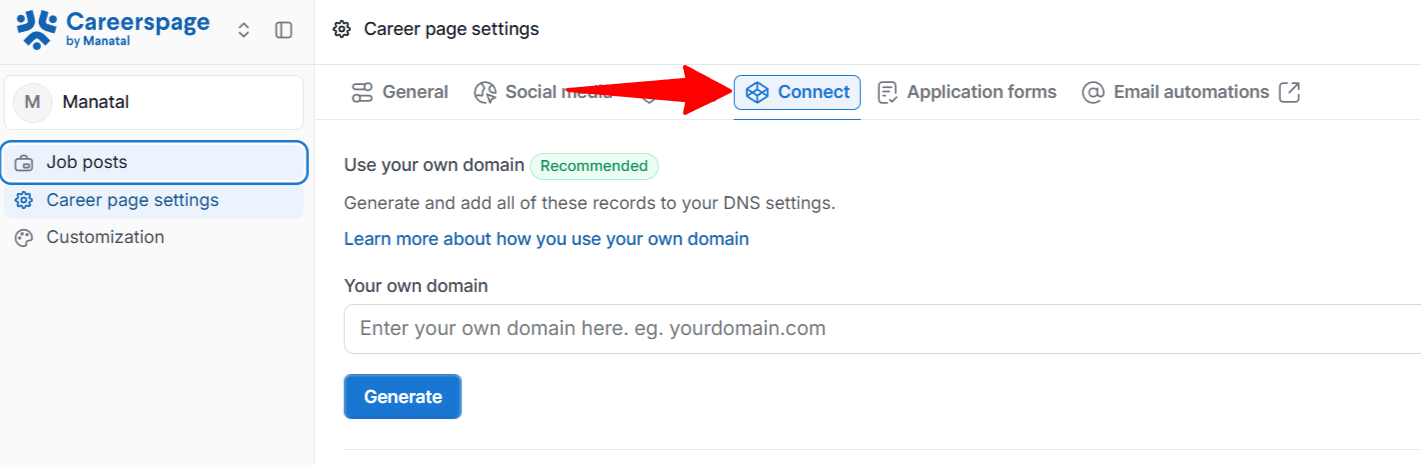
How to Run It: Register your domain on Cloudflare or GoDaddy. Inside Manatal, navigate to Career page settings and open the Connect tab. In the Use your own domain field, enter your preferred subdomain (e.g., careers.youragency.com) and click Generate to create your unique DNS records. Log into your DNS provider, add the generated records, return to Manatal, check the I've added these records box, and click Verify to launch your branded portal.
{{cta}}
Step 6. Build Target Client Lists and Outbound Sequences
Relying on incoming leads slows initial agency revenue. Outbound business development targeted directly at hiring managers creates a predictable stream of open requisitions.
How to Run It: Open LinkedIn Sales Navigator and build a lead list using parameters: Current Title: ("VP of Engineering" OR "Director of Talent"), Company Headcount: 50–200, and Geography: United States. Export the list into Apollo.io or Hunter.io to pull verified direct work emails. Import contacts into Instantly.ai or Lemlist and execute a 3-touch email cadence (Day 1: Cold value pitch; Day 3: LinkedIn profile visit/connect; Day 7: Anonymized candidate profile highlight).
Step 7. Qualify Job Orders and Sign Clients
Working unvetted job orders wastes sourcing bandwidth on unfillable roles or disengaged hiring managers. Conducting a structured qualification intake call ensures the client is committed to hiring.
How to Run It: Embed a meeting link from Calendly or HubSpot Meetings into your email sequence. On the intro call, run a 5-point qualification checklist: salary approval, interview panel timeline, candidate evaluation criteria, direct feedback SLA (within 48 hours), and fee agreement terms. Immediately dispatch your pre-built PandaDoc agreement during or immediately after the call.
Step 8. Finalize Placements, Invoice, and Manage Cash Flow
Converting placed candidates into cash flow requires structured invoicing and proactive payment collection. If offering contract staffing, managing payroll gaps is essential to maintain working liquidity.
How to Run It: Connect accounting software like QuickBooks Online or Xero to your business bank account. Upon candidate offer acceptance, generate a digital invoice with Net 30 payment terms. For contract staffing models with weekly contractor payroll obligations, link your accounting software to invoice factoring services like Bluevine or FundThrough to advance up to 90% of invoice values upfront.
Legal And Financial Setup in the U.S.
Registering a recruiting business typically takes a few days. The foundational setup remains the same whether placing permanent or temporary candidates:
- Form a legal entity, usually an LLC or S-Corp; the SBA explains how the structures differ on taxes and liability.
- Get an Employer Identification Number free from the IRS.
- Open a business bank account so personal and company money never mix.
- Buy general liability insurance, and add professional liability if clients require it.
- Prepare a client fee agreement with guarantee clauses, candidate terms, and an NDA template.
Staffing agencies take on more. Because you employ the workers you place, you add workers' compensation, payroll tax registration, and correct worker classification under the Fair Labor Standards Act.
The Department of Labor treats misclassifying employees as contractors as a serious violation, so settle this before your first placement. Some states also require staffing firms to register or bond, so check your state's rules.
There is generally no federal license to place candidates in permanent roles, though some verticals carry their own rules. Licensed fields like healthcare add credentialing requirements, which our guide to starting a healthcare staffing agency covers.
Startup Costs and Cash Flow Management
Direct-hire agencies require minimal upfront capital because you do not fund worker payroll. Your primary expenses are software subscriptions (ATS, CRM, sourcing tools), entity formation, insurance, web hosting, and job board access. Itemize these costs individually rather than relying on a lump-sum estimate.
On the other hand, staffing agencies require substantial working capital. You must pay temporary workers weekly while clients pay on net-30 to net-60 terms. Cover this cash flow gap using dedicated cash reserves or payroll funding/invoice factoring, ensuring you factor funding fees into your client margins.
Revenue Models and Execution
- Direct Hire: Charge a standard percentage of the candidate's first-year base salary, paid either upon start (contingency) or in staged milestones (retained).
- Staffing: Bill clients a set hourly rate above the worker's pay rate and retain the margin.
First-year agency survival depends on defining a narrow market niche and executing an integrated sales-and-sourcing process, not on maximizing software spending.
How to Win Your First Clients
Client acquisition requires a direct outbound sequence. Target companies with active job postings in your niche, then reach hiring managers using a multi-channel cadence (personalized social message followed by direct email referencing a specific candidate). Use initial sales calls to uncover hiring pain points and role urgency, then secure a signed agreement with defined fees and replacement terms. Solo founders can read our independent recruiter guide to structure legal entities, select fee models, and manage commercial and candidate pipelines in one system.
Conclusion
Starting a recruiting business rewards focus over spending. Pick one model, own one niche, keep your legal and financial setup clean, and run a small connected tool stack. Put most of your energy into signing clients and filling roles.
The founders who clear year one operate like a team of several from one system, then reinvest their first fees into growth.
Manatal gives new agencies an ATS, recruitment CRM, AI sourcing, and a branded career page in one platform. You can run client development, sourcing, and placements without juggling disconnected tools. Start for free and build your workspace before your first outreach call.
Frequently Asked Questions
Q: How much does it cost to start a recruiting agency?
A: A lean perm-recruiting launch is low-cost, since your main expenses are software, entity formation, insurance, and a website. A staffing agency costs much more, because you must fund weekly worker payroll before clients pay their invoices. Budget by line item, as the startup costs section above lays out.
Q: How hard is it to start a recruiting business?
A: The barrier to entry is low; you can register and open in days. The bar to succeed is high, and it has little to do with paperwork. The hard parts are winning clients and, for staffing, managing cash flow.
Q: How do recruiting agencies make money?
A: Perm placement agencies charge a percentage of the hire's first-year salary, as a contingency fee on start or a retained fee in stages. Staffing agencies charge an hourly rate above the worker's pay and keep the markup on every hour worked.
Q: Do you need a license to start a recruitment agency in the US?
A: For permanent placement, there is generally no federal license required. Staffing agencies take on employer obligations instead: correct worker classification, payroll tax registration, and, in some states, agency registration or bonding. Regulated verticals like healthcare add credentialing rules, which our healthcare staffing guide covers.
Q: What's the difference between a recruiting agency and a staffing agency?
A: A recruiting or placement agency fills permanent roles and charges a fee based on salary; the client employs the hire. A staffing agency places temporary or contract workers who stay on its payroll and bills the client an hourly rate. A single system with an integrated ATS and CRM like Manatal can manage both pipelines effectively.
Citations
.webp)







.webp)

.webp)


.webp)


