




Recent industry research shows that AI adoption in recruitment has accelerated, with 67% of hiring managers and recruiters now using AI-powered hiring tools in their workflows, up from 35% in 2023. [1] This guide will help you master ChatGPT for recruiting with high-impact prompts and stay ahead in the 2026 talent market.
How to Write an Effective Recruiting Prompt
To get the most out of generative AI, you need a structured framework. An effective prompt establishes a clear persona, defines precise boundaries, and builds a comprehensive workflow. Spending just a few extra seconds to structure your input will elevate the quality of your AI-generated recruiting materials.
[Role Context] + [Specific Task] + [Tone / Format Constraint] + [Value- Add Outputs]
- Unstructured prompt: "Write a job description for a marketing manager."
- High-performing prompt:
"You are an HR professional and talent acquisition strategist at a [Your Industry/Company Type, e.g., B2B SaaS] company. Your task is to write a highly optimized job description for a [Location, e.g., Singapore-based] [Job Title, e.g., Marketing Manager] with [Experience Level, e.g., 5+ years of experience] in [Key Specializations/Skills, e.g., demand generation and SEO].
Please execute the following advanced steps:
- Engaging Hook: Craft an inspiring, candidate-centric intro that highlights growth potential instead of just listing company facts.
- SEO Optimization: Seamlessly integrate high-intent industry keywords throughout the text to maximize search visibility on job boards without keyword stuffing.
- Format and Length: Organize the job description into three distinct, scannable sections (Overview, Responsibilities, and Requirements). Keep the entire JD under [word count, e.g., 400 words] with a direct, professional tone.
- Bonus Multi-Channel Asset: At the very end, generate a high-converting [Social Post Word Count, e.g., 70-word] [Social Media Platform, e.g., LinkedIn] announcement post copy designed to drive applications, complete with engaging formatting and relevant hashtags."
7 Prompts for ChatGPT Recruitment
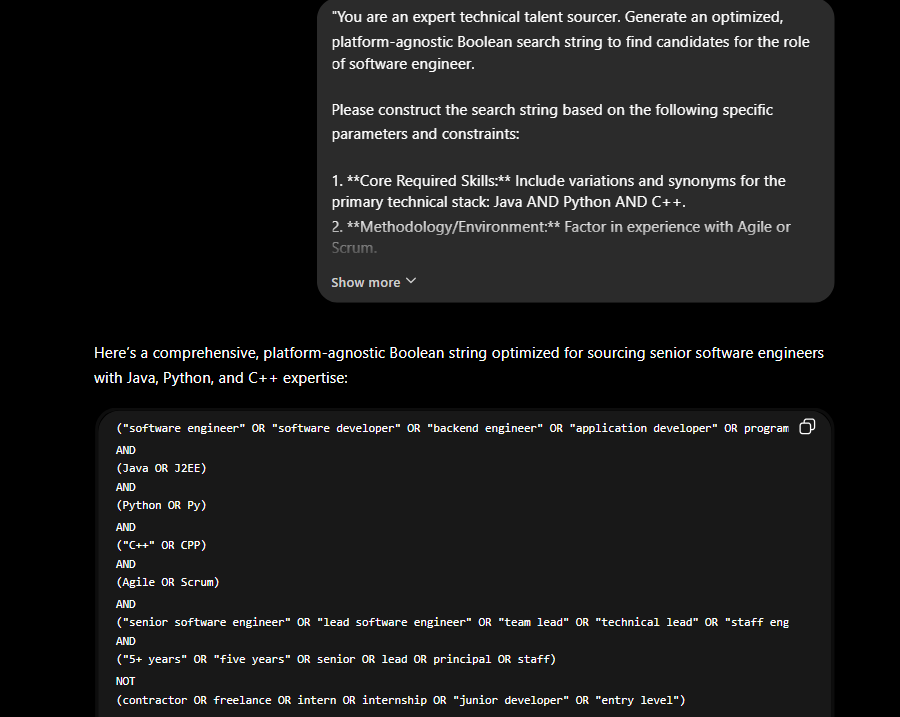
1) Creating Boolean Search Strings
Using an expert prompt with ChatGPT can help generate precise syntax, structure complex logic, and produce error-free strings suited for major sourcing platforms.
Example Prompt:
"You are an expert technical talent sourcer. Generate an optimized, platform-agnostic Boolean search string to find candidates for the role of [Job Title, e.g., Software Engineer].
Please construct the search string based on the following specific parameters and constraints:
- Core Required Skills: Include variations and synonyms for the primary technical stack: [Core Skill 1, e.g., Java] AND [Core Skill 2].
- Methodology/Environment: Factor in experience with [Methodology/Framework, e.g., Agile] or its equivalents (e.g., Scrum).
- Seniority Indicators: Include keywords that reflect at least [Number, e.g., 5] years of experience, using common seniority titles (e.g., "Senior," "SR," or "Lead") to identify the correct target level, rather than relying solely on numerical strings.
- Exclusion Criteria (NOT): Explicitly exclude unrelated variations that cause false positives, such as [Excluded Terms, e.g., intern, contractor].
- Output Format: Provide the final result as a single, copy-pasteable string with proper nesting parentheses and capitalized operators (AND, OR, NOT). Also, provide a secondary, shortened variation optimized specifically for platforms with strict character limits like LinkedIn standard search."
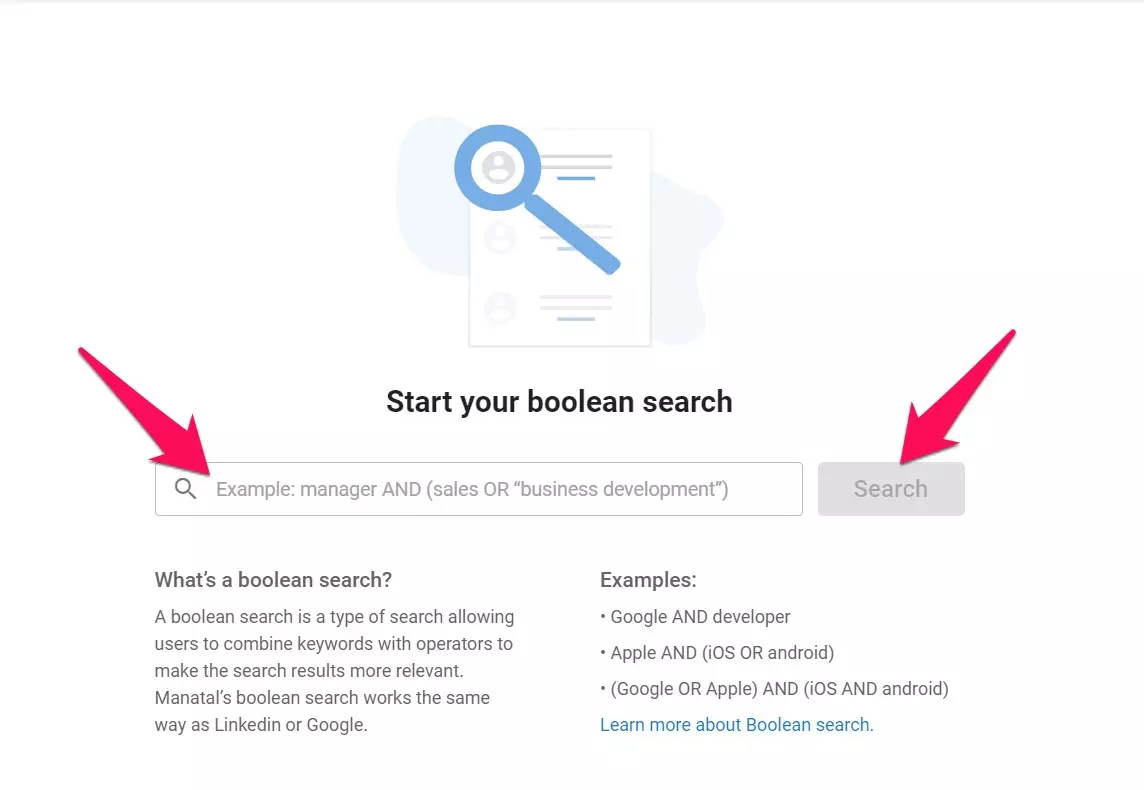
Manatal's recruitment platform offers a robust advanced search engine with full Boolean logic, including operators such as AND, OR, NOT, and exact-phrase quotation marks. Allowing users to efficiently filter and identify top talent directly within their ATS, eliminating the need to switch between tools.
{{cta}}
2) Create Psychometric and Training Assessments
ChatGPT facilitates the creation of psychometric tests and training assessments by generating customized, high-quality questions tailored to specific roles, competencies, and training goals. This process saves time and supports various question formats to effectively evaluate soft and hard skills for recruitment, onboarding, or internal development.
Example Prompts:
Role: Act as an expert industrial-organizational (I-O) psychologist and senior talent acquisition strategist.
Task: Help me design a comprehensive candidate assessment strategy that balances psychometric testing (for cultural add, cognitive ability, and behavioral traits) with practical training/technical assessments (for role-specific hard skills).
Context:
- Target Role: [Insert Job Title, e.g., Senior B2B Content Strategist]
- Core Responsibility: [Insert 1-2 core duties, e.g., Scaling organic traffic & managing a content team]
- Key Hard Skills Required: [Insert technical skills, e.g., SEO auditing, Data Analysis, SQL]
- Key Soft Skills/Traits Required: [Insert traits, e.g., High emotional intelligence, collaborative leadership]
Please provide the output structured across the following sections:
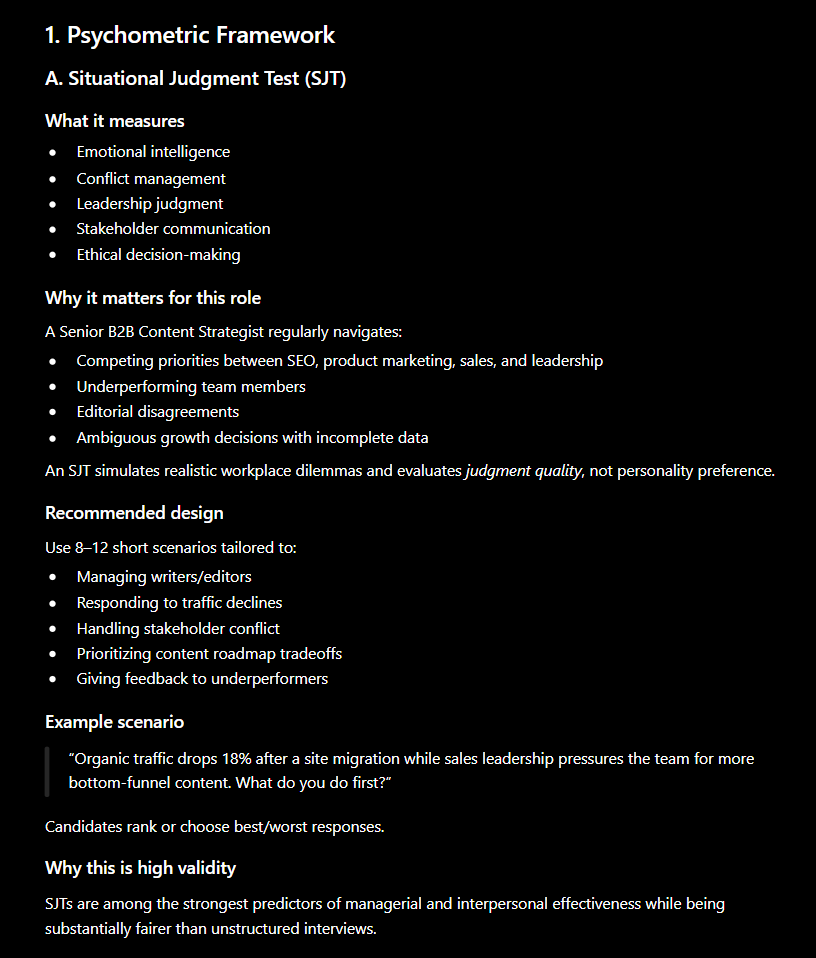
- Psychometric Framework
Recommend specific types of psychometric evaluations (e.g., Situational Judgment Test (SJT), cognitive aptitude, personality profiling) that align with our desired soft skills. Explain what each test measures and why it matters for this specific role. - Training & Technical Assessments
Suggest 1-2 practical, bias-free assessment exercises or work-sample tests (e.g., case studies, technical assignments, simulated training tasks) to evaluate their technical competence. - The Recruitment Funnel Integration
Map out exactly where in the hiring process these tests should be administered (e.g., top-of-funnel filtering vs. post-first interview deep dive) to prevent candidate drop-off and ensure a stellar candidate experience. - Evaluation Matrix & Scoring Guide
Create a simple, objective rubric or scoring framework that our hiring managers can use to evaluate assessment performance fairly and minimize subjective bias. - Candidate Communication Templates
Provide a brief, encouraging email draft we can send to candidates that explains the value of these assessments and sets clear expectations for completion.
Ensure your recommendations are legally compliant, inclusive, and explicitly tailored to the provided role.
3) Streamline Resume Screening
Manually screening a large volume of resumes can be time-consuming, error-prone, or biased due to variations in formatting, language, and subjective assessments. Using ChatGPT for recruiting streamlines this process by analyzing and summarizing candidates’ qualifications, experience, and skills, allowing for quick, consistent evaluations.
Example Prompt:
"You are an objective AI recruiting assistant specializing in unbiased talent screening. Your task is to evaluate the provided candidate's resume against our strict job requirements.
Please evaluate the data objectively using the following framework:
Requirement Mapping: Compare the candidate's history against these core criteria: [Insert Target Role, e.g., Project Manager], [Required Tech Stack/Certifications], and [Minimum Years of Experience].
Structured Summary: Provide a concise, bulleted summary detailing only their relevant project experience and technical skills that directly align with our requirements.
Objective Alignment Score: Rate the candidate's alignment with the role on a scale of 1 to 5 (with 5 being a perfect technical match). You must justify this score with explicit data from the resume.
Anomalies and Highlights: Note any clear strengths (e.g., specific saved budgets or scale managed) or potential areas for further exploration (e.g., missing mandatory certifications). Avoid making assumptions; rely strictly on the text provided below.
[Insert Job Requirements Here] [Insert Candidate Resume Text Here] "
Instead of you bringing candidate data to ChatGPT, the Manatal MCP integration gives ChatGPT (and Claude) secure, direct read/write access to your Manatal ATS. Your AI assistant queries your live candidate database, pulls full profiles, checks team notes, and generates output, all without you copying a single line of text.
.png)
4) Developing Narratives Around Recruitment Data
Talent acquisition metrics provide valuable insights, yet converting them into compelling narratives can be difficult. ChatGPT assists recruiters by analyzing trends, highlighting key insights, and framing data to craft persuasive narratives for reports and proposals, thereby enhancing clarity and impact.
Example Prompt:
"You are a strategic talent acquisition director. Your task is to analyze the provided recruitment data and translate it into a compelling, 3-paragraph executive narrative for our quarterly business review with senior leadership.
Please structure the narrative using the following specific framework:
- Paragraph 1: Executive Overview & Wins: Synthesize the positive data points, with an explicit focus on [Insert Positive Metrics, e.g., average time-to-fill dropping from 42 to 31 days and a 15% increase in offer acceptance rates]. Contextualize what these wins mean for the business in terms of operational efficiency and market competitiveness.
- Paragraph 2: Friction Point Diagnosis: Address the areas of concern, specifically focusing on [Insert Negative Metrics, e.g., a 10% increase in candidate drop-off during the final interview stage]. Analyze the potential root causes of this trend without making definitive assumptions, framing it as a critical area for operational optimization.
- Paragraph 3: Strategic Recommendations: Conclude with [Number, e.g., 2-3] clear, forward-looking strategic action items designed to sustain the positive momentum while correcting the identified friction points.
Tone: Analytical, objective, and executive-ready. Avoid conversational filler.
[Insert Raw Recruitment Metrics Data Here]"
Transforming raw numbers into strategic narratives is much easier when you don't have to manually compile spreadsheets. Manatal’s Reports and Analytics feature automates this process by providing dashboards that track your entire recruitment funnel.
5) Generate Keyword-Rich Job Descriptions
While anyone can ask an AI to generically spit out a job description, standard prompts usually result in flat content that fails to rank or attract top-tier talent. To cut through the noise, recruiters need to guide the AI with specific parameters. With the right structure, ChatGPT can add high-intent industry terms and create a highly optimized, searchable job description tailored to your market.
Example Prompt:
"You are an expert HR professional and talent acquisition strategist in the [Specify Industry, e.g., B2B SaaS] sector. Write a highly optimized job description for a [Job Title] based in [Location] requiring [Number] years of experience.
Please execute the following steps:
- Engaging Hook: Craft an inspiring, candidate-centric introduction that highlights growth potential and company impact.
- SEO Keyword Optimization: Seamlessly integrate high-intent industry keywords, specifically targeting [Keyword 1], [Keyword 2], and [Keyword 3], to maximize organic visibility on major job boards without keyword stuffing.
- Format and Length: Organize the output into three clear, scannable sections: Overview, Responsibilities, and Requirements. Keep the entire text under [Word Count, e.g., 400 words] using a direct and professional tone."
You can leverage Manatal’s AI engine to boost hiring efficiency with the job description generator in multiple languages. Manatal also comes with ready-to-use job description templates, making it even easier for you. Just copy and make adjustments to fit your open roles and company style.
6) Write Effective Recruitment Emails
Using generic emails can result in low engagement and negative experiences for candidates. ChatGPT simplifies the creation of professional, personalized email drafts for candidates, hiring managers, and clients, reducing the risk of delays and miscommunication.
Example Prompt:
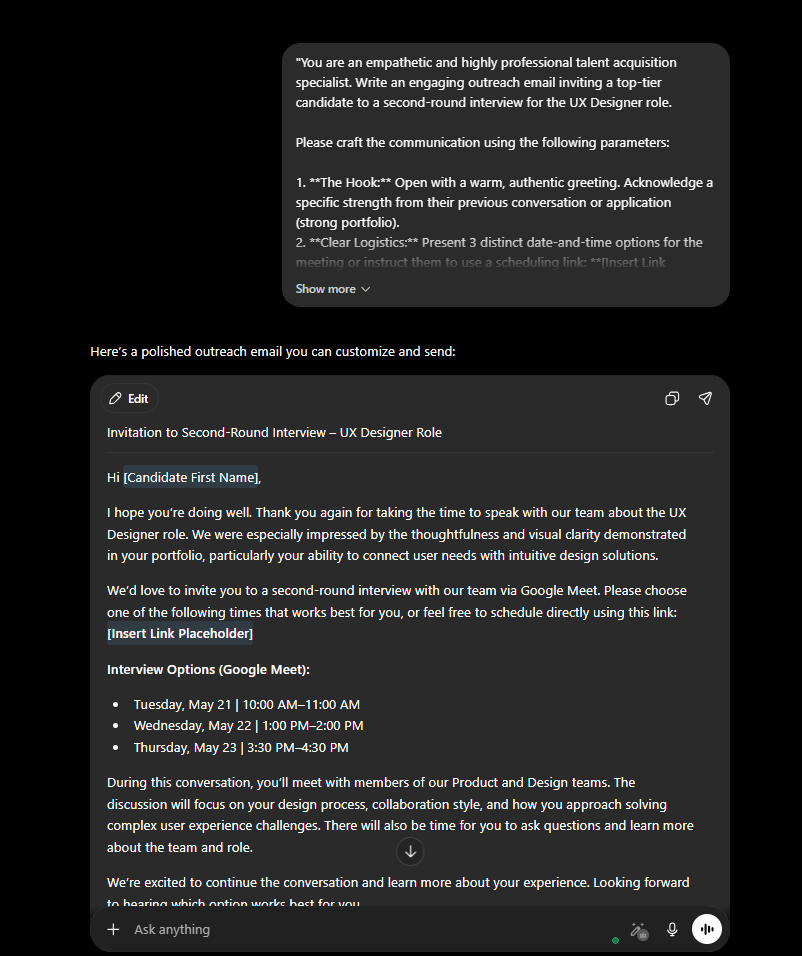
"You are an empathetic and highly professional talent acquisition specialist. Write an engaging outreach email inviting a top-tier candidate to a [Interview Stage, e.g., Second-Round Interview] for the [Job Title, e.g., UX Designer] role at [Company Name].
Please craft the communication using the following parameters:
- The Hook: Open with a warm, authentic greeting. Acknowledge a specific strength from their previous conversation or application (e.g., their strong portfolio or excellent technical screening).
- Clear Logistics: Present [Number, e.g., 3] distinct date-and-time options for the meeting or instruct them to use a scheduling link. [Insert Link Placeholder]. Specify the platform being used: [Meeting Platform, e.g., Google Meet].
- Setting Expectations: Include a brief 2–3-sentence overview of what the interview will entail (e.g., who they will meet with and the core focus of the discussion) to reduce candidate anxiety and help them prepare.
- Tone and Length: Maintain an encouraging, professional, and accessible tone. Keep the email concise and scannable, using bullet points for the logistics to ensure a clear call to action."
7) Create Engaging LinkedIn Posts
Recruiters face challenges with LinkedIn content strategy due to intense competition and numerous job postings, which makes it difficult to convey their organization's values and culture. ChatGPT can help create engaging, targeted posts to attract potential candidates.
Example Prompt:
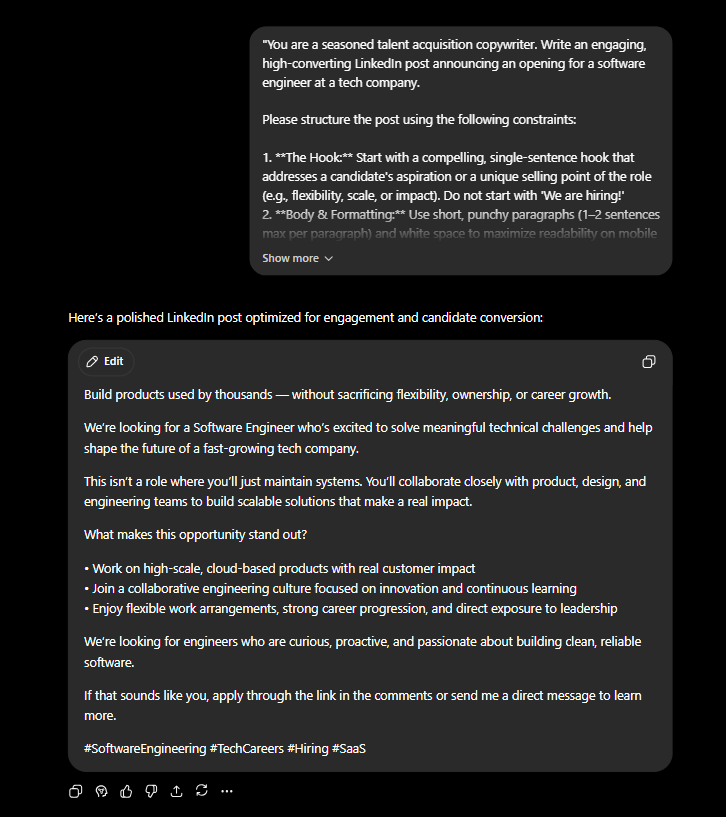
"You are a seasoned talent acquisition copywriter. Write an engaging, high-converting LinkedIn post announcing an opening for a [Job Title] at [Company Name].
Please structure the post using the following constraints:
- The Hook: Start with a compelling, single-sentence hook that addresses a candidate's aspiration or a unique selling point of the role (e.g., flexibility, scale, or impact). Do not start with 'We are hiring!'
- Body & Formatting: Use short, punchy paragraphs (1–2 sentences max per paragraph) and white space to maximize readability on mobile screens. Use bullet points to highlight the top 3 unique perks or challenges of the role.
- Call to Action (CTA): End with a clear, direct directive guiding interested candidates to apply via the link in the comments or send a direct message.
- Tone & Tags: Maintain an authentic, professional, yet energetic tone. Include 3–4 highly relevant industry hashtags at the very bottom."
Recruiter ChatGPT Prompt Cheat Sheet
Bookmark this section. These five prompts cover the highest-impact recruiting tasks you run every week. Copy and customize them directly.
How to Verify ChatGPT Outputs
ChatGPT might fabricate information with confidence. It can invent statistics, cite studies that do not exist, and produce Boolean strings that look correct but return zero results. These rules apply every time.
- Verify any statistic before publishing. If ChatGPT cites a figure, trace it to a primary source. Do not use it if you cannot find the original.
- Test every Boolean string before sourcing. Run it on the platform and check whether the results match your intent. Strings typically need one or two refinements.
- Read generated assessments before sending. ChatGPT occasionally produces trick questions with incorrect “correct” answers, especially in technical quizzes. A subject-matter expert should review any assessment before it reaches candidates.
- Do not trust job descriptions at face value. Salary benchmarks, required certifications, and visa requirements change. Every generated description needs human review before posting.
- Run a second prompt to stress-test outputs. After generating important content, ask ChatGPT: “What are three potential weaknesses or inaccuracies in what you just produced?” It will often surface problems you would have missed.
Case Study: Using ChatGPT in Recruitment
TopKnack (Boutique Recruiting Firm)
Jasmine Cheng, founder of TopKnack, leverages ChatGPT to streamline candidate sourcing and prep. Her ChatGPT recruiting prompt saves significant time while maintaining a human touch. She prompts ChatGPT to generate complex Boolean search strings that meet specific criteria (e.g., target industries, company size, location), drastically cutting down her sourcing time. Cheng also uses ChatGPT to produce initial job descriptions and compile lists of interview questions for technical roles, which she then fine-tunes to meet her clients’ needs. This AI assistance saves her “at least 10 hours a week” without replacing the human element of her role. [2]
VIQU (IT Recruitment Agency, UK)
The UK-based recruiting firm VIQU has integrated ChatGPT into its workflow to improve efficiency and content quality. According to Managing Director Matt Collingwood, ChatGPT can draft polished job ads/descriptions based on the firm’s standard templates, resulting in far fewer client revisions and even higher candidate response rates to postings. VIQU’s team also relies on ChatGPT to create intricate Boolean search queries for talent sourcing, a big time-saver, especially for junior recruiters still learning manual Boolean logic. Additionally, many of VIQU’s clients have begun using ChatGPT-generated interview questions (tailored to the skills in a job spec) during their hiring process, finding those AI-crafted questions helpful in evaluating candidates’ technical competencies. [3]
Conclusion
ChatGPT recruiting is a powerful approach that saves time and enhances performance across hiring tasks. However, every output needs human judgment before it enters your hiring workflow, and manually writing prompts for every candidate is slow. Manatal integrates AI directly into your ATS. It doesn't just "chat"; it performs. From AI-powered candidate scoring to automated resume parsing, Manatal turns the 5-minute manual task of prompting into an instant, automated result.
Upgrade your entire workflow with an AI-native ATS. Try Manatal's 14-day free trial.
Frequently Asked Questions
Q: How can I maintain a positive candidate experience when using ChatGPT for recruiting?
A: Transparency is key. When you use ChatGPT for recruiting, always inform candidates that they are interacting with AI. To keep the experience human-centric, identify specific stages where a recruiter must take over. For a more seamless transition, Manatal integrates AI directly into the workflow, ensuring candidates feel supported by both technology and real recruiters, with no friction.
Q: How can I use ChatGPT for recruiting to explain data to stakeholders?
A: You can use ChatGPT for recruiting as a data translator. It turns complex hiring metrics into clear narratives that explain the "why" behind your trends. By using specific ChatGPT prompts, you can generate executive summaries that highlight wins and bottlenecks, making your reports much more actionable for the C-suite.
Q: How can I ensure AI content supports Diversity and Inclusion (D&I) goals?
A: When learning how to use ChatGPT for recruiting, establish strict, inclusive language guidelines first. Use diverse recruiting prompts for ChatGPT to audit your job descriptions for hidden bias. For even better results, Manatal’s AI-driven scoring focuses on objective skills and qualifications, helping you remove human and AI bias from the initial screening phase.
Q: What are the main ethical concerns when I use ChatGPT for recruiting?
A: Fairness and data privacy are the top priorities. When you use ChatGPT for recruiting, you must ensure that no sensitive candidate data is uploaded to public models. Manatal solves this ethical dilemma by providing a secure, GDPR-compliant environment where AI features are built directly into the protected ATS, keeping your candidate data safe and private.
Q: How do I find the best recruiting prompts for ChatGPT to improve performance?
A: To master how to use ChatGPT for recruiting, you must create a feedback loop. Rate the accuracy of every AI output and refine your recruiting prompts for ChatGPT based on real-world results. If you want to skip the trial-and-error of manual prompting, Manatal offers built-in AI tools designed specifically for recruitment tasks, ensuring high performance right out of the box.
Citations:
.webp)







.webp)

.webp)


.webp)


