





Recruiters are no longer just hiring managers; you are data controllers. Whether based in the EU or elsewhere, the way you handle personal information defines your reputation. A GDPR-compliant tracking system serves as your safety net. Modern recruitment platforms integrate compliance features into every workflow, allowing you to focus on finding great talent rather than worrying about regulatory audits. Throughout this guide, we'll explain what GDPR compliance means for your recruiting process and how the right ATS protects you by design.
What is the General Data Protection Regulation (GDPR)
The General Data Protection Regulation (GDPR) is the European Union's comprehensive data privacy framework, effective May 25, 2018. At its core, it grants individuals control over their personal data and imposes strict requirements on how organizations collect, store, process, and delete that information. [1]
For recruiters, GDPR covers everything from a candidate's name and email address to their resume, interview notes, assessment scores, and any other identifying information. The regulation establishes several fundamental rights:
- Right to access: Candidates can request a copy of all personal data you hold about them.
- Right to rectification: Candidates can request corrections to inaccurate information.
- Right to erasure ("right to be forgotten"): Candidates can request deletion of their data.
- Right to data portability: Candidates can receive their data in a structured, machine-readable format.
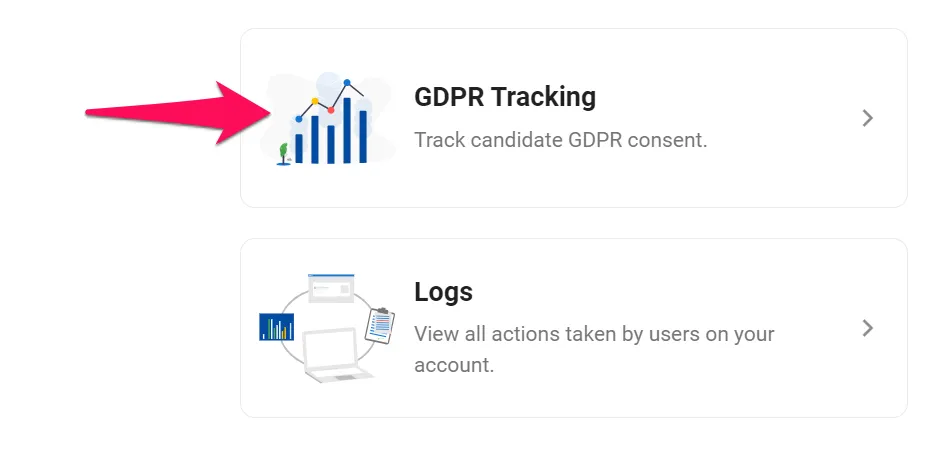
Understanding candidate data protection as a core responsibility, you don't need to build GDPR compliance from scratch. Platforms like Manatal include built-in compliance tools that automate many technical and procedural requirements.
Manatal’s GDPR Compliance Guarantee:
- Tools supporting GDPR compliance.
- Encrypts and secures all of your data.
- Allows you to easily access, modify, and delete your data.
{{cta}}
When does GDPR apply to US companies?
GDPR applies to any organization, regardless of location, that processes personal data of individuals located in the European Union. This means:
- A US-based company recruiting candidates from France, Germany, or any EU member state must comply with GDPR
- A Canadian firm with a single EU applicant must follow GDPR protocols for that candidate's data
- An Australian company hiring remote workers in the EU falls under GDPR jurisdiction
No EU office, employees, or customers are required; if you process data from EU-located individuals, GDPR applies. Enforcement is rigorous: Authorities have issued over €5.88 billion in fines since 2018. [2] The maximum penalty is €20 million or 4% of global annual turnover (whichever is higher). [3] Regulators routinely impose substantial fines for negligent practices.
Key GDPR Rights & Obligations for Recruiters Using an ATS
To maintain a GDPR-compliant recruitment process, you must respect four major pillars of candidate rights. Here is how a robust ATS helps you uphold them:
- Candidate Consent (Lawful Basis) You cannot store a resume just because you found it. You need a lawful basis, usually explicit consent. Manatal’s Consent Request Tool automates this, sending emails to candidates asking permission to retain their data and tracking who has said "yes."
.webp)
- Right to Access (Data Portability) Candidates have the right to request a copy of their data. Instead of manually compiling files, Manatal allows for instant data export, turning a complex request into a few clicks.
- Right to be Forgotten (Erasure) If a candidate asks to be deleted, you must scrub them from all systems. A GDPR-compliant system ensures that when you hit delete, the data is truly gone, not just hidden in an archive.
.webp)
- Transparency (Privacy Policies) You must clearly explain how you use data. Your GDPR-compliant privacy policy should be easily accessible. Manatal’s Career Page Editor allows you to link your privacy notice directly to the application form, ensuring total transparency before data is even submitted.
Why a Standard ATS May Not Be Enough
Many agencies rely on standard tools, legacy ATS platforms, generic CRMs, or Excel spreadsheets. These may organize data but often lack GDPR-required security. Choosing a generic tool over a specialized GDPR-compliant system is like leaving your door unlocked versus hiring a 24/7 guard.
Is your current system putting you at risk?
- Backups: Does your system permanently delete data from backups when you delete a candidate profile? (Most spreadsheets do not).
- Access Control: Can you limit which team members see sensitive data?
- Encryption: Is the data encrypted in transit and at rest?
Manatal exceeds basic functionality with SOC 2 Type II compliance, ensuring that data transfers and storage meet the highest security standards. Don't get caught off guard during an audit because your software wasn't built for the modern privacy era.
Practical Steps for Recruiters to Ensure GDPR Compliance Today
Achieving compliance sounds daunting, but it can be broken down into actionable steps. Here is a checklist to help you sleep more easily at night:
- Audit Your Data: Map out where you currently hold candidate data (email, desktop, ATS).
- Update Your Policy: Ensure you have a clear, GDPR-compliant privacy policy visible on your career site.
- Document Consent: Use your ATS to automate consent requests for old candidates in your database. Manatal’s automation tools can handle this in bulk.
- Establish Deletion Workflows: Set reminders to delete candidate data after a specific retention period (e.g., 6 or 12 months) if they haven't been hired.
- Secure Your Storage: Migrate data from local drives to a secure, GDPR-compliant cloud platform like Manatal.
What Happens If You Don’t Comply: Risks for Recruiters
The cost of noncompliance is twofold: financial and reputational. Financially, fines can reach up to €20 million or 4% of annual global turnover. But for recruiters, the reputational damage is often worse. Trust is your currency. If word gets out that you exposed candidate salaries, contact details, or resume data, your pipeline will dry up. Imagine the stress of a candidate asking for their data, and you are unable to find it, or even worse, prove you deleted it. A GDPR-compliant tracking system acts as your insurance policy. Manatal is designed to mitigate these risks, ensuring you can answer any data request with confidence and speed.
Why Recruiters Should Choose Manatal to Support Their GDPR Compliance
Manatal isn't just an ATS; it is a partner in your compliance strategy. We understand that you want to focus on hiring, not legal paperwork.
By choosing Manatal as your GDPR-compliant tracking system, you gain:
- Automated Compliance: Tools to manage consent, modification, and deletion requests effortlessly.
- World-Class Security: SOC 2 Type II certification and advanced encryption to keep data safe.
- Efficiency: The ability to combine powerful AI recruiting features with rigorous GDPR-compliant protocols.
You get the full power of a modern ATS without the lingering fear of data mismanagement.
Conclusion
Data privacy is here to stay. As a recruiter, your obligation to protect candidate data is as important as your ability to spot talent. Using a GDPR-compliant system isn't just about following the rules; it's about demonstrating professionalism and respect.
Don't wait for a complaint to audit your process. Switch to a GDPR-compliant tracking system that works as hard as you do. Ready to secure your recruitment process? Start your free trial with Manatal today and see how easy compliance can be.
Frequently Asked Questions (FAQs)
Q: What features make an applicant tracking system GDPR compliant?
A: A GDPR-compliant ATS should support consent management, data encryption, access controls, deletion requests, and clear candidate disclosures, because those are the core features needed to handle personal data lawfully and securely. Manatal says its platform includes tools for consent collection, deletion from profile, career-page disclosures, CSV data export for access requests, encrypted candidate databases, and role-based access control.
Q: How does a GDPR compliant applicant tracking system handle candidate data privacy?
A: It protects candidate data through encryption, restricted access, secure storage, and processes for consent, access, and deletion requests, so recruiters can respond to data-subject rights without relying on manual tracking. Manatal says it encrypts candidate databases, uses role-based access control, keeps daily backups, and provides tools to manage consent and delete candidate records when required.
Q: What steps should be taken to ensure an applicant tracking system complies with GDPR regulations?
A: Use an ATS that can collect and record consent where needed, show the required privacy notices, restrict access by role, support data export and deletion requests, and document how candidate data is stored and transferred. Manatal’s GDPR guidance and security documentation point to exactly those controls, including consent handling, career-page disclosures, CSV exports, encrypted storage, and access controls.
Q: How can a business verify if their applicant tracking system is GDPR compliant?
A: Review the vendor’s GDPR and security documentation, confirm how it handles consent, deletion, access requests, encryption, access control, and international data transfers, and ask for evidence of security practices such as SOC 2 Type II or equivalent controls. Manatal publishes those details in its GDPR and security pages, including encryption, role-based access, AWS hosting, daily backups, and SOC 2 Type II in its compliance messaging.
Q: What are the consequences of using a non-GDPR compliant applicant tracking system in the EU?
A: The risks include warnings, reprimands, temporary or permanent bans on processing personal data, and fines of up to €20 million or 4% of global annual turnover, whichever is higher. The European Commission says these sanctions can be imposed for non-compliance with EU data protection rules.
Citations:
.webp)







.webp)

.webp)


.webp)


