





A strong recruitment team helps organizations manage hiring more consistently, reduce delays, and improve candidate quality across the recruitment process. Whether you are building a small hiring team, scaling an in-house recruiting team, or managing a high-volume agency operation, the right structure determines how effectively your team’s recruitment process supports business growth. This guide explains the core roles inside a recruitment team, compares common recruitment team structures, and outlines practical ways to organize responsibilities, workflows, and accountability across your hiring operations.
What Is a Recruitment Team?
A recruitment team is a specialized function responsible for employer branding, candidate sourcing, hiring coordination, and recruitment operations. A well-structured team helps organizations attract, assess, and hire qualified talent more consistently. Team structure often varies depending on company size, hiring volume, and organizational complexity. The primary goal is to create a coordinated hiring process with clear ownership, consistent evaluation, and efficient workflow management.
Recruitment Team Roles: Core and Specialized Functions
Most recruitment teams are built around recruiters, hiring managers, and HR leadership, with additional support roles added as hiring needs grow. Recent SHRM research highlights that modern recruitment increasingly depends on sourcing, employer branding, hiring coordination, analytics, and workforce planning to address ongoing hiring challenges.[1]
Core Roles (Directly Involved in Hiring)
These roles directly manage sourcing, evaluation, coordination, and hiring decisions.
Recruiters
- Manage sourcing, screening, interviews, and candidate communication throughout the hiring process
- Keep hiring pipelines active and organized
- Support hiring managers during candidate evaluation and selection
- Common KPIs include time to fill, qualified candidate pipeline size, interview-to-offer ratio, offer acceptance rate, candidate experience metrics, and source effectiveness
- Often use recruitment analytics, source tracking, and candidate experience data to improve hiring outcomes
Hiring Managers
- Define job requirements and align hiring priorities with team goals
- Interview shortlisted candidates and make final hiring decisions
- Work closely with recruiters during evaluation and selection
- Common KPIs include interview feedback turnaround time, interview-to-hire conversion rate, quality of hire, offer acceptance rate, first-year retention, and hiring satisfaction scores
- Structured interview and selection processes help improve evaluation consistency and reduce delays
Head of HR
- Oversees recruitment policies, approvals, compliance, and workforce planning
- Ensures hiring processes align with company standards and labor regulations
- Coordinates recruitment strategy across departments
- Common KPIs include requisition approval turnaround, compliance adherence, first-year turnover rate, hiring process consistency, cost per hire, and workforce planning accuracy
- Often reviews recruitment processes to improve coordination between recruiters, hiring managers, and leadership
Recruitment Coordinators
- Manage interview scheduling, candidate communication, documentation, and ATS updates
- Support recruiters by handling administrative coordination
- Help maintain organized hiring workflows across teams
- Common KPIs include interview scheduling turnaround time, candidate response time, ATS data accuracy, interview reschedule rate, administrative error rate, and communication speed
- Help reduce operational bottlenecks during the hiring process
Talent Sourcers
- Identify and engage potential candidates for open and future roles
- Build pipelines for hard-to-fill and high-volume positions
- Support recruiters with qualified candidate leads
- Common KPIs include outreach response rate, qualified leads generated, pipeline growth, source quality, time to first qualified shortlist, and passive candidate engagement rate
- Often use talent mapping and sourcing analytics to strengthen recruiting pipelines
Interview Panelists
- Participate in interviews and candidate assessments
- Evaluate technical skills, communication ability, and team fit
- Provide structured hiring feedback to recruiters and hiring managers
- Common KPIs include feedback completion rate, interview scorecard consistency, time to submit feedback, interview participation rate, and hiring calibration accuracy
- Structured interview processes help improve consistency across candidate evaluations
Specialized Recruitment Roles
As recruitment teams grow, organizations often add specialized roles to support branding, compliance, onboarding, analytics, and workforce planning. SHRM’s 2025 Talent Trends research notes that employers are increasingly investing in employer branding, sourcing strategies, workforce development, and recruiting technology to improve hiring outcomes in competitive labor markets.[2]
These roles may include:
- Employer Branding Specialist
- Recruitment Marketing Specialist
- DE&I Specialist
- Compensation and Benefits Specialist
- Onboarding Specialist
- Assessment Specialist
- HR Technology or ATS Specialist
- Legal and Compliance Advisor
- Workforce Planning Analyst
Smaller organizations may combine these responsibilities into HR or recruiter roles, while larger companies and staffing agencies often separate them into dedicated functions.
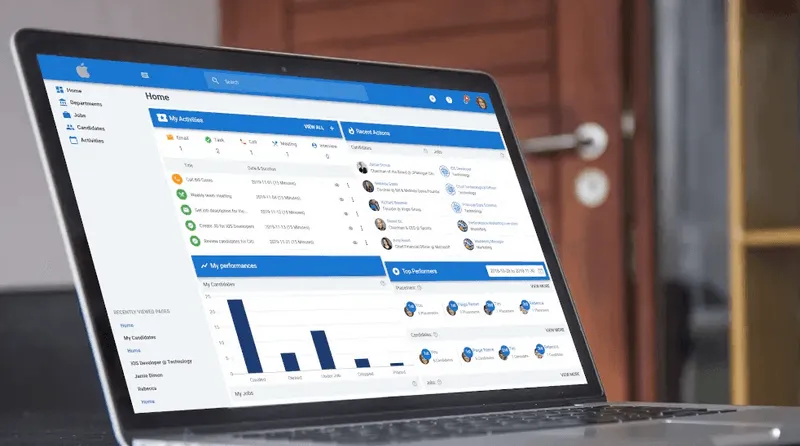
As teams scale, platforms like Manatal ATS help centralize hiring workflows through Collaboration and Activities features that support communication, task tracking, and hiring coordination across teams. Organizations can also use Custom Permissions to manage system access by role or responsibility while maintaining hiring visibility and data security.
{{cta}}
Popular Recruitment Team Structures
Clear roles perform best when arranged in an optimal organizational framework. Selecting the wrong structure can increase administrative friction and slow hiring operations. Your recruitment structure should align with hiring volume, organizational complexity, and recruitment goals.
In-House Centralized Structure
A centralized recruitment structure places hiring operations under one talent acquisition leader or HR function. Recruiters follow shared processes, reporting standards, and hiring workflows across the organization.
- Standardized Hiring: Teams use the same interview process, evaluation criteria, and approval workflows across departments and locations.
- Centralized Reporting: Recruitment data, hiring metrics, and candidate records stay within one reporting structure, making oversight easier.
- Resource Allocation: Recruitment leadership can prioritize hiring requests and distribute recruiter workloads based on company-wide needs.
- Process Control: Central oversight helps reduce duplicated sourcing efforts and keeps hiring practices aligned across teams.
- Shared KPIs: Recruiters are measured using consistent hiring metrics, workflows, and performance standards.
This structure is commonly used in larger in-house recruitment teams that require centralized coordination and standardized hiring operations
In-House Decentralized Structure
Unlike centralized recruitment, a decentralized structure gives individual departments or regions more control over hiring. Recruiters often work directly with specific business units to support faster and more specialized hiring decisions.
- Department Alignment: Recruiters work closely with specific teams, which helps them understand technical requirements, hiring priorities, and team structures more accurately.
- Faster Decisions: Hiring managers and recruiters can move candidates through the process more quickly because approvals and communication stay within the department.
- Regional Flexibility: Different offices or business units can adjust hiring processes based on local market conditions, hiring volume, or role requirements.
- Shared Hiring Ownership: Department leaders take a more active role in recruitment planning, candidate evaluation, and hiring decisions.
In-House Pod Structure
If your hiring process requires more specialization than a decentralized structure but faster coordination than a fully centralized model, a pod structure can provide a middle ground. In this setup, a small cross-functional team manages a single hiring pipeline, typically with dedicated sourcing, recruiting, and coordination responsibilities.
- Shared Ownership: Each pod is responsible for a specific hiring function, department, or role category, which keeps accountability clear across the team.
- Specialized Collaboration: Sourcers, recruiters, and coordinators work as one unit instead of operating in separate workflows, which reduces communication gaps and duplicated work.
- Faster Workflow Management: Smaller teams can make hiring decisions and move candidates through the pipeline more quickly because fewer handoffs are involved.
- High-Volume Support: Pod structures are commonly used for departments with continuous or high-volume hiring needs because the same team manages the pipeline consistently over time.
360-Degree Team Structure
While pod structures divide hiring responsibilities across a small team, some organizations prefer one recruiter to manage the entire recruitment process independently. In a 360-degree structure, a single consultant handles both stakeholder management and candidate delivery from sourcing through placement and onboarding.
- End-to-End Ownership: One recruiter manages sourcing, screening, client communication, interview coordination, offer management, and onboarding.
- Direct Communication: Candidates and hiring stakeholders work with the same recruiter throughout the process, which reduces handoff issues and keeps communication consistent.
- Stronger Accountability: Since one consultant owns the entire hiring cycle, performance and hiring outcomes are easier to track at the individual level.
- Best Use Cases: This structure is commonly used by boutique recruitment agencies, executive search firms, and smaller recruiting teams that focus on relationship-driven hiring.
180-Degree Team Structure
Another common agency recruitment model is the 180-degree structure, where client acquisition and candidate delivery are handled by separate teams. In this setup, account managers focus on business development and client relationships, while delivery recruiters manage sourcing, screening, and candidate submissions.
- Client Management: Account managers handle sales activities, maintain client relationships, and secure new job orders for the recruitment team.
- Candidate Delivery: Delivery recruiters focus on candidate sourcing, qualification, interview coordination, and shortlist management.
- Specialized Roles: This structure separates sales responsibilities from recruiting execution, which allows each team to focus on a narrower set of tasks.
- Coordination Requirements: Teams need clear communication and handoff processes because client management and candidate delivery are managed separately.
Recruitment Team RACI Matrix
Unclear handoffs can cause qualified candidates to fall through the cracks, making it important to formalize pipeline ownership using a RACI matrix. This framework removes operational ambiguity by clearly defining who is Responsible, Accountable, Consulted, and Informed at each key hiring milestone.

Download the RACI Matrix template >>
- Copy the Template: Download and copy the template above to your internal company knowledge base, shared drive, or applicant tracking system onboarding folder.
- Review with Leadership: Conduct a 15-minute alignment meeting with your Head of HR and hiring managers to review these core boundaries before launching a new recruitment drive.
- Enforce Accountability: Require all team members to review this matrix during onboarding to ensure every stakeholder knows exactly when they are expected to execute, consult, or step back.
Best Practices for Building a Recruitment Team
Build the team around the hiring process, not just the number of open roles. Start by mapping the current workflow, then assign ownership where delays, handoffs, and unclear accountability appear.
- Define the hiring need: Review current gaps, delays, and future hiring demand with hiring managers, HR, and leadership before you add roles or capacity.
- Set clear ownership: Decide who owns sourcing, screening, feedback, and handoffs at each stage so work does not stall or get duplicated.
- Match roles to the business: Use business-facing recruiters or TA partners where hiring teams need closer support, and keep shared functions in place for process control and reporting.
- Build around the candidate journey: Map intake, sourcing, screening, interviews, feedback, offer, and close so you can remove bottlenecks and reduce drop-offs.
- Use consistent evaluation: Standardize interview formats and feedback timing so candidates are assessed on the same criteria and decisions move faster.
- Track hiring flow, not just output: Watch stage-to-stage timing, feedback lag, and drop-off rates instead of relying only on total hires.
Conclusion
A centralized recruitment team may work best for organizations that need standardized processes and reporting, while decentralized, pod-based, or agency-style models may better support specialized hiring, regional flexibility, or faster delivery. The key is to align your recruitment team structure with your hiring volume, business priorities, and operational complexity so recruiters, hiring managers, and leadership teams can work through the recruitment process with clear ownership and consistent coordination.
Frequently Asked Questions
Q: What are the key roles in a recruitment team?
A: A recruitment team usually includes recruiters, hiring managers, HR leadership, recruitment coordinators, talent sourcers, and interview panelists. In larger teams, you may also add employer branding, recruitment marketing, compliance, onboarding, ATS administration, and workforce planning support.
Q: How do you determine the size of your recruitment team?
A: Team size should reflect hiring volume, role complexity, number of locations, and how much coordination the business needs. A smaller team can handle low-to-moderate hiring volume with shared responsibilities, while high-volume or multi-location hiring usually requires more specialized coverage for sourcing, coordination, and reporting. Many teams use platforms like Manatal to manage workload visibility and streamline collaboration as hiring demand grows
Q: What skills should you look for when hiring recruitment team members?
A: Look for sourcing ability, structured interviewing, stakeholder communication, organization, data literacy, and follow-through. Recruiters and coordinators also need strong candidate management skills, while hiring managers need clear decision-making and timely feedback.
Q: How can technology be leveraged to enhance the efficiency of a recruitment team?
A: Use an ATS to centralize candidate records, job postings, communication, and interview scheduling. Manatal also supports collaboration through notes, tags, task assignment, and team notifications, plus Custom Permissions for controlled access and Reports & Analytics for tracking KPIs. The platform can also distribute job postings across multiple channels and sync email and calendar activity.
Q: What strategies help build a cohesive and effective recruitment team?
A: Define ownership early, standardize the hiring process, keep feedback timing consistent, and use one system for communication and task tracking. A clear role structure works best when recruiters, hiring managers, and coordinators know where decisions happen and who owns each stage. Manatal’s Collaboration and Activities features and Custom Permissions support that structure by keeping communication, responsibilities, and access rules organized.
Citations
.webp)







.webp)

.webp)


.webp)


