





A bad hire is expensive, impacting everything from recruitment costs and productivity to team morale and culture. This guide explains how a structured selection process prevents these issues, clarifies the hiring workflow by distinguishing recruitment from selection, and demonstrates how automation streamlines routine tasks for better decision-making.
By the end of this article, you will learn the core differences between recruitment and selection, the seven essential stages of a structured candidate selection process, and how to use data, scorecards, and assessments to improve hiring accuracy and key metrics.
Where the Selection Process Fits in Hiring
Before moving into the stages of the candidate selection process, make the distinction between recruitment and selection explicit.
- Purpose: Recruitment attracts and builds a pool of potential candidates, while selection evaluates and narrows candidates to the best fit.
- Focus: Recruitment centers on marketing activities such as employer branding, sourcing channels, and outreach, whereas selection focuses on systematic filtering and assessment of candidates.
- Position in the hiring workflow: Recruitment comes first at the front of the process, while selection happens after a candidate pool has been established.
- Core activities: Recruitment involves promoting roles, sourcing talent, and encouraging applications, while selection includes screening, interviews, assessments, and final decision making.
- Outcome: Recruitment results in a pool of relevant candidates ready for evaluation, while selection results in one candidate being chosen for the role.
- Dependency: Recruitment must generate a relevant and qualified candidate pool, while selection depends on recruitment to supply candidates.
- Ownership and metrics: Recruitment focuses on reach, sourcing effectiveness, and pipeline strength, while selection focuses on evaluation quality and hiring accuracy.
Clarifying this boundary helps assign ownership and metrics. Recruitment creates options; selection chooses the most likely to perform.
The 7 Stages of the Selection Process
A structured selection process helps you evaluate candidates consistently and reduce hiring mistakes. Each stage gathers specific information about the candidate. The stages below outline a clear path from reviewing applications to making the final hiring decision.
1. Application and Resume Screening
Start by reviewing applications to identify candidates who meet the minimum requirements. Focus on skills, relevant experience, and qualifications listed in the job description.
Manual resume review slows down screening when application volume is high. An Applicant Tracking System, such as Manatal, helps you review candidates faster.
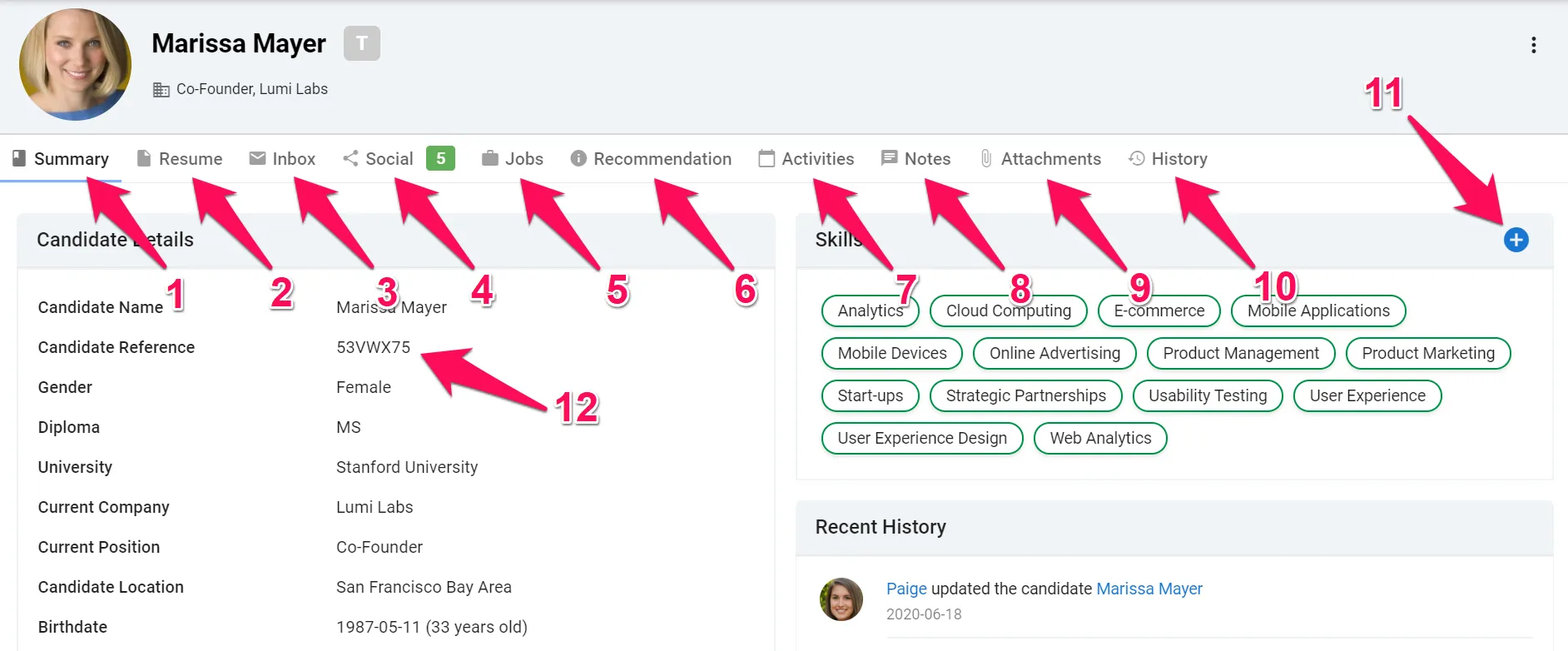
- Centralized candidate profile: The candidate view shows the resume, work history, skills, tags, notes, and hiring stage in one profile. You do not need to switch between resumes, spreadsheets, and email.
- Search and filtering: Filter candidates by skills, experience, education, tags, or other criteria. This helps you narrow a large applicant pool quickly.
- Pipeline visibility: See where each candidate sits in the hiring pipeline and move them to the next stage.
At this stage:
- Remove candidates who do not meet the basic role requirements.
- Move qualified candidates to the next step of the selection process.
2. Initial Screening Call
Following the resume screening, use a short screening call to confirm whether the candidate should move forward. Keep the call focused and limit it to 10 to 15 minutes.
Confirm the following points:
- Salary expectations. Check whether the candidate’s range fits the role’s budget.
- Availability and notice period. Confirm when the candidate could start.
- Core skills. Ask one question that verifies the most important skill for the role.
- Location or work eligibility. Confirm the candidate meets location or work authorization requirements.
- Motivation for the role. Ask why the candidate applied and what they expect from the position.

Integrations such as KrispCall let you place calls without leaving the ATS, while Manatal’s AI Interviewer takes it further by automating early-stage candidate screening. Calls, SMS messages, voicemails, and AI-led interview interactions are all stored in the candidate profile, giving your team full visibility into every touchpoint. This reduces manual tracking and keeps communication consistent, so you can move faster. In practice, that speed matters. Candidates often accept interviews or offers from the first company that engages them.
{{cta}}
3. Competency Assessments
Resumes and screening calls offer limited insight into candidates’ real capabilities. So, competency assessments provide objective data on a candidate's actual skill sets. For example, a technical role might require a coding challenge to evaluate syntax proficiency, while a sales role might use a situational judgment test to measure lead qualification skills and adopt sales enablement techniques to close sales more quickly.
Manatal’s integrations with assessment providers allow you to:
- Send assessments from the candidate profile.
- Track which candidates completed the test.
- Store assessment scores in the candidate record.
- Review results alongside resumes, interview notes, and scorecards.
4. Structured Interviews

Structured interviews improve hiring accuracy because they minimize subjective "gut feelings" and ensure every candidate is evaluated against the exact same performance indicators. If you need a head start, use our interview question libraries to prepare these sessions.
Standardize candidate reviews between your team members to identify the right candidates. Record interview feedback immediately after the session. Use a candidate scorecard to rate each candidate on criteria such as technical skills, problem-solving, communication, and collaboration.
5. Background and Reference Checks
After thoroughly assessing a candidate's suitability through interviews and assessments, perform comprehensive background and reference checks as the final verification step before extending an offer.
Start with basic background verification. Check whether the candidate’s work history and education match the details listed on the resume.
Common background checks include:
- Employment history verification. Confirm job titles, dates of employment, and responsibilities.
- Education verification. Confirm degrees or certifications listed on the resume.
- Criminal record checks. Required for some regulated roles or industries.
- Credit checks. Used in roles that involve financial responsibility.
Next, run reference checks. Speak with former managers or colleagues who worked closely with the candidate.
Ask specific questions. Focus on performance and behavior.
Examples:
- How did the candidate handle deadlines or pressure?
- What were the candidate’s strongest skills?
- What areas needed improvement?
- Would you hire this person again?
Record the feedback and compare it with your interview evaluation. Look for consistent patterns. A strong candidate should show similar strengths across references, interviews, and assessments.
For a deeper guide on conducting this step, see our background check for employers guide.
6. Making the Hiring Decision
The final step in the selection process is the hiring decision. Do not rely on gut feeling. Use scorecards to evaluate candidates based on their performance at each stage.
Scorecards combine input from multiple evaluators and compare candidates against the job requirements. For instance, if two candidates both have strong communication skills but one scores significantly higher on technical problem-solving via the scorecard, the choice becomes data-driven rather than an emotional preference. This structure reduces bias and supports a clear decision.
7. Extending the Job Offer and Negotiation
After you choose a candidate, extend the job offer and manage the negotiation. This step confirms the hire.
Prepare a clear offer. State the salary, benefits, start date, job title, and reporting line. Confirm the details in writing. Remind the candidate why the role matters, what they will work on, and who they will work with.
Expect negotiation. Ask the candidate what matters most to them. Review your compensation range and benefits policy. Adjust terms within the approved limits.
Handle this stage carefully. The hiring experience directly affects whether candidates accept an offer. Research shows that 76% of candidates say a positive hiring experience influences their decision to accept a job offer. Clear communication, fast responses, and written confirmation of the agreement help prevent drop-offs. [1]
Reducing Bias in the Selection Process
Bias affects hiring decisions and can remove qualified candidates from the pool. You need clear controls in your selection process. Here are some tips to reduce bias:
- Blind resume screening: Remove names, photos, gender indicators, and school names during early screening. Focus on skills and experience.
- Collaborative hiring: Include several interviewers in the evaluation. Use interview panels where each interviewer submits an independent score to reduce individual bias.
- Standardized scoring rubrics: Use structured interviews and ask the same questions for every candidate. Score each answer with a defined rubric and record those scores immediately.
- Culture add evaluation: Avoid hiring based on similarity with current staff. Evaluate how a candidate expands team capability through different experiences or viewpoints.
Key Metrics to Measure Process Efficiency
To have an effective selection process, you must track key performance indicators (KPIs). These metrics provide insights into bottlenecks and strategy improvements.
Time to Hire
Measure the number of days from job approval to accepted offer.
Formula: (Date of Offer Acceptance - Date of Job Approval)
Offer Acceptance Rate
Calculate the percentage of candidates who accept your offer.
Formula: (Number of Accepted Offers / Total Number of Offers Extended) * 100
Quality of Hire
Evaluate new hire performance and retention six to twelve months after the start date.
Formula: (Job Performance Score + Culture Fit Score + Retention Score) / Number of Indicators
Review these metrics together. High speed with poor quality signals weak screening, while high quality with slow hiring signals process delays.
Conclusion
Consistent hiring requires a structured selection process. Follow the defined stages from screening to final offer. Use structured interviews, scoring rubrics, and recorded evaluations. Focus on objective assessment instead of intuition. Track Time to Hire, Offer Acceptance Rate, and Quality of Hire. These metrics reveal delays, weak screening, or offer problems. Review results and adjust sourcing, interviews, and offers. Platforms such as Manatal support screening, scoring, and hiring team collaboration. Control bias during screening, interviews, and final decisions.
Frequently Asked Questions
Q: What is the difference between recruitment and selection?
A: Recruitment is the process of sourcing and attracting a broad pool of candidates. Selection is the subsequent process of screening and evaluating those candidates to choose the best fit for the role.
Q: How long should a selection process take?
A: While it varies by industry, a standard selection process typically takes between 20 to 45 days. High-level or technical roles may take longer due to extensive assessments.
Q: What are the main stages of the selection process?
A: The main stages include resume screening, initial calls, competency assessments, structured interviews, background checks, the final hiring decision, and the job offer.
Q: How can companies reduce bias in hiring?
A: Companies can reduce bias by using blind resume screening, implementing structured interviews with fixed questions, and using collaborative hiring panels with standardized scoring rubrics.
Citation:
.webp)







.webp)

.webp)


.webp)


