





According to the World Economic Forum’s Future of Jobs Report 2025, 63% of surveyed employers identify skill gaps in the labor market as the primary barrier to business transformation for 2025–2030. [1] A skills gap analysis replaces guesswork with a clear, data-driven picture of your workforce: what it can do today versus what it needs to do to achieve strategic targets. This guide walks you through a streamlined, repeatable process for identifying critical skill shortages, deciding whether to upskill or hire, and executing a concrete action plan with modern recruiting tools.
What Is a Skills Gap Analysis?
A skills gap analysis is the structured process of comparing the capabilities your organization requires against the skills your workforce currently possesses, then creating a targeted strategy to bridge the difference. You can run the analysis at several levels:
- Individual: one person measured against the requirements of their role.
- Team or department: individual gaps rolled up to show where a function is thin.
- Organization: missing capabilities mapped to strategic goals like a product launch or a new market.
The same comparison works for a candidate you are evaluating. You measure the applicant against the role's required skills, which is exactly how skills-based hiring screens talent before an offer.
How to Conduct a Skills Gap Analysis
A skills gap analysis connects business strategy to daily capability. Skipping key steps can weaken the analysis. Without a clear business goal, for example, teams may collect skills data that is difficult to connect to business priorities.
Follow this 6-step execution model using dedicated tools at each phase:
Step 1: Anchor to a Specific Business Goal
Define the exact commercial outcome you need to achieve before measuring any skills. Avoid abstract objectives like "improve digital skills."
- Example: "Increase quarterly pipeline conversion by 15%" or "Launch the generative AI feature by Q3."
- Recommended Tools: OKR frameworks (Asana and Jira) and strategy maps.
Step 2: Map Target Skills and Required Proficiency Levels
Identify the specific skills each role needs to hit the business goal, and establish a clear proficiency target for each.
- Example: A data analyst role requires SQL querying at Level 4 (Advanced) and Tableau dashboard creation at Level 3 (Intermediate).
- Recommended Tools: competency frameworks, with Manatal AI Job Description Generator, users can turn role requirements into structured job descriptions.
Step 3: Inventory Current Skills Across Three Angles
Collect multi-source ratings to prevent single-evaluator bias. Triangulate data using self-assessments, manager reviews, and objective testing.
- Example: Cross-reference an engineer's self-rating with code reviews and technical test scores to find their actual baseline.
- Recommended Tools: candidate assessments, 360-degree survey platforms (e.g., Culture Amp).
Step 4: Score Baseline Capabilities on a Standardized Scale
Rate skills consistently using an observable 1-to-5 behavioral scale:
1: No Exposure
2: Basic (Needs Supervision)
3: Intermediate (Works Independently)
4: Advanced (Coaches Others)
5: Expert (Sets Standards)
- Recommended Tools: Manatal offers a customizable recruiting scorecard that can standardize how hiring teams evaluate candidates. This can help hiring teams apply a more consistent evaluation framework.
.png)
{{cta}}
Step 5: Calculate and Prioritize Skill Gaps
Subtract the current baseline score from the required target score to quantify the gap, then prioritize each gap based on its direct impact on business goals. Focus resources on critical, high-impact gaps while deprioritizing minor gaps in non-essential areas.
- Example: Subtracting a current SQL score of 2 from the target score of 4 reveals a gap of 2. A gap of 2 in revenue-generating forecasting takes priority over a gap of 3 in internal administrative tools.
- Recommended Tools: Automated Skills Matrices (Excel/Google Sheets formulas, ATS dashboards), Impact vs. Effort Prioritization Matrices, Weighted Scoring Spreadsheets, and Manatal's AI recommendation engine (to compare skill requirements against candidate databases and generate ranked match scores).
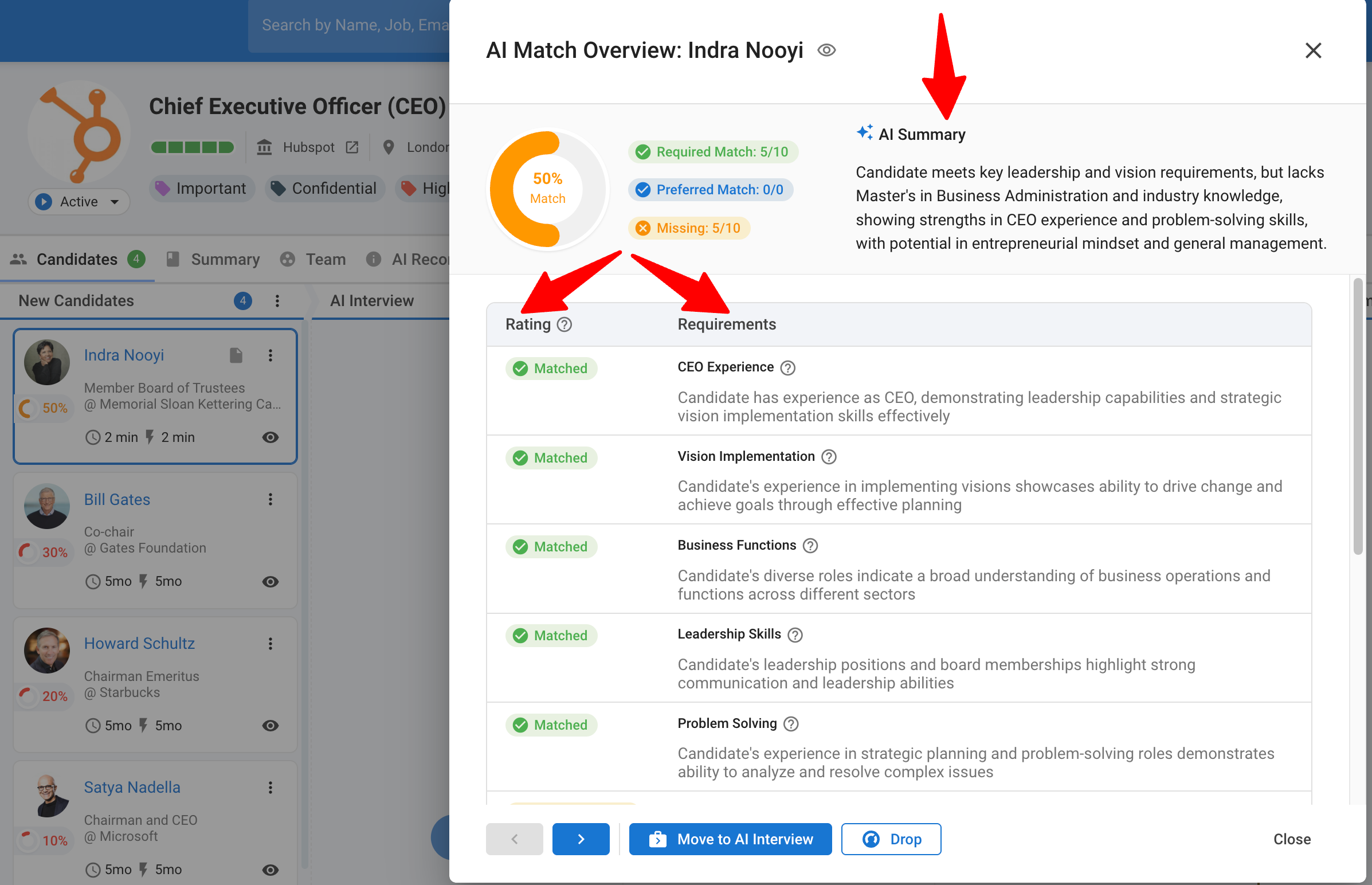
Step 6: Assign Action Paths (Train, Redeploy, or Hire)
Match each prioritized gap to its optimal resolution model based on urgency, cost, and talent availability:
Train: Minor gaps (1–2 levels), long timelines, teachable skills.
Redeploy: Internal candidates with adjacent capabilities who can shift roles immediately.
Hire: Severe gaps (3+ levels), high urgency, scarce market skills.
- Recommended Tools: Manatal ATS, including its candidate database and AI-powered search tools, and L&D management platforms (Coursera, LinkedIn Learning).
How to Score Skills Consistently
Scores are only comparable if everyone reads the scale the same way. Anchor each number to an observable behavior before you collect a single rating. For example, 1 means no exposure, 2 means needs supervision, 3 means works independently, 4 means coaches others, and 5 means sets the standard.
Collect ratings from three angles: self-assessment, manager review, and a short objective test. Self-ratings tend to run high, so reconcile large disagreements before they enter the matrix. A skill everyone scores differently is usually a sign the target level was never defined clearly.
The Copy-Ready Skills Matrix
The skills matrix is the artifact that holds all of this. Rows are skills; columns record the required level, the current level, and the gap. Here is a small filled example for a data analyst role:
The largest gap is not always the first one to close. A gap of 3 on forecasting can matter more than a gap of 2 elsewhere if forecasting drives the quarter's revenue plan. Weight each gap by how much the business goal depends on it, then work down that list.
Skills Gap Examples in the Workplace
Concrete examples make abstract gaps easier to identify and fix:
- AI Literacy (Marketing): Writers who produce strong copy but lack prompting and quality-checking skills for generative AI, slowing down AI-assisted workflows.
- Data Analysis (Operations): Managers who read dashboards but cannot run SQL queries or build models, creating bottlenecks for the analytics team.
- Leadership (New Managers): High performers promoted without people-management skills, leading to struggles with delegation, feedback, and team turnover.
- Compliance (Finance): Accountants missing updated regulatory knowledge, creating immediate legal and financial risks.
Should You Train or Hire to Close the Gap?
Once you identify a gap, you can upskill, reskill, redeploy internal talent, or recruit externally. A compliance gap may be fastest to close with a targeted hire, while a leadership gap usually responds better to coaching. The right move depends on the gap, which is the decision the next section covers. The right choice depends on speed, cost, urgency, and market availability:
- Train when the skill is teachable, the gap is one or two levels, and the goal is far enough out.
- Redeploy when someone internal already has the skill and can be freed up faster than a new hire.
- Recruit when the skill is scarce, business-critical, and no internal path reaches the required level in time.
Factor in hidden costs like lost productivity during training or onboarding time for new hires.
According to TestGorilla’s 2025 research, 85% of employers use skills-based hiring, and 91% of employers using skills-based hiring report improved retention. [2]
How to Measure Progress After Your Analysis
A skills gap analysis is only useful if you check whether the gaps actually closed. Re-run the matrix on a set cadence, quarterly for fast-moving roles and annually for stable ones, and compare current scores against your original targets.
- Track two numbers: gaps closed and gaps still open, each tied back to the business goal that started the exercise. Keeping this record in your recruitment CRM or ATS ties every closed gap to the hire or training plan that closed it. If a plan did not move the score, change the plan, not the target.
- Set a clear threshold for what counts as closed. A gap is closed when the current score meets the required level and holds for one review cycle, not the day a hire starts. This stops you from marking gaps closed on paper while the capability is still ramping up.
Closing skills gaps requires measurable results. Manatal's report and analytics track how long it takes to fill roles opened for skill gap mitigation (time-to-fill) and identify which candidate sources yield the most qualified talent (source of hire).
Conclusion
A skills gap analysis only delivers value when it becomes a repeatable operating process, not a one-off exercise. Treat the skills matrix as a living dataset. Standardize proficiency definitions, refresh inputs regularly, and link every gap to a clear build-or-buy decision with ownership and timelines. When HRIS, LMS, and ATS data are aligned, organizations move from reacting to talent shortages to proactively planning workforce capability with the same rigor applied to revenue and growth targets.
Frequently Asked Questions
Q: How often should you conduct a skills gap analysis?
A: At minimum, annually. Run it more frequently (every six months) for functions where technology, regulations, or strategy change fast. Also run it after major organizational changes, such as restructures, M&A, or new product launches.
Q: What are common examples of skill gaps in the workplace?
A: Technical gaps often include data analytics, cloud platforms, cybersecurity, and AI/ML. Soft skill gaps frequently appear in communication, leadership, critical thinking, and adaptability. The specific mix depends on your industry and growth priorities.
Q: Should you train employees or hire to close a skills gap?
A: Train when the gap is narrow, the employee is motivated, and you have time. Hire when the skill is critical, urgent, and absent internally. Most organizations do both, using internal development as the default and external hiring when speed or depth of expertise demands it.
Q: What tools do you need to run a skills gap analysis?
A: At minimum, a spreadsheet to build your skills matrix and score gaps. Add an assessment tool (like TestGorilla) to validate self-reported skills. Add an ATS (like Manatal) to act on gaps you decide to fill by hiring, with features like resume parsing, AI search, and candidate scoring.
Q: How do you do a skills gap analysis for an individual (or for yourself)?
A: Follow the same process at a smaller scale. Define the skills required for your current or target role, rate your current proficiency on each, identify the gaps, and prioritize. Use manager feedback, peer input, or third-party assessments to validate your self-assessment.
Citations:
.webp)







.webp)

.webp)


.webp)


