


IN THIS GUIDE
- Augment your sourcing and save time with Manatal AI
- Work faster by automating candidate shortlisting and scoring
- Scale initial screens with an AI recruiting agent
- Writing great job requirements for better AI results
Recruitment in 2026 has gone through dramatic shifts on both employers as well as jobseekers’ ends. Recruiters have to face daily realities of increased demand for skilled talent in a market that doesn’t yield enough of it, a larger volume of applications thanks to AI-assisted resumes, applications and assessment submission, and the challenges of doing their sourcing and hiring better and faster without using more resources.
AI tools have stepped up to the task in a big way for recruiters. For every use-case under the sun, you can probably find an AI tool that promises to do it ‘magically’. But the practice is still relatively new, and a successful workflow is still not set in stone. In this guide, we will walk you through an ‘essential A-to-Z’ of hiring with the best in class AI tools on the Manatal platform: From sourcing, shortlisting and scoring to even running automated screening calls. With just one tool under your belt, you can be both a one-man agency or an enterprise hiring team that runs lean while increasing output dramatically.
Augment Your Sourcing and Save Time With Manatal AI
The first stage where you can benefit the most from switching to AI-assisted processes is the sourcing step. Finding candidates manually or by spending a budget on job ads has always been a fixed function, but now there are new avenues to approach your goals using Manatal.
You can diversify and accelerate your sourcing using several native channels:
- Free and Premium Job Board posting: Distribute your job ads across major global networks to attract active job seekers.
- My Own Contracts: If you have pre-existing job ad campaigns running, you can integrate them directly into the platform to centralize your ads in one place.
- Sourcing Hub: No existing talent pool? No problem. Search from over 600 million profiles around the globe to find the exact talent you need.
Manatal’s AI works by analyzing the core requirements of your open roles and cross-referencing them against the data points in a candidate’s profile. Over time, as it processes more resumes and job descriptions, it extracts skills, titles, and experiences to create a highly searchable, enriched database.
Here is a brief overview of the workflow some expert recruiters use to get the most out of their sourcing efforts.
- Gather profile data from professional networks: Capture candidate information from platforms like LinkedIn or GitHub with one click using the People-Match Chrome Extension.
- Find contact details: Use this feature to find the most up-to-date contact information to ensure the candidates don’t miss the job offers.
- Parse flat resumes into structured profiles: For any resumes received via your job posts on Manatal, the system fills out a structured profile full of work history, skills and more in multiple languages.
- Enrich candidate data: Automatically scan social platforms to find matching socials for any candidate's profile, giving you a complete view without manual research.
Now let’s zoom in and discover how your recruitment team can use these tools for the next stages.
Automating Candidate Shortlisting and Scoring
When you manage a large volume of inbound applications or search through a database of thousands of past candidates, manually reading every resume is impossible. Manatal’s AI Recommendation Engine acts as an automated filter to prioritize your list.
Here are ways you can use Manatal’s recommendation engine to build a shortlist:
- Instantly score your database: When you create a job description, the AI reads the required skills and experience. It then scans your entire candidate database and assigns a percentage match score to every profile.
- Discover semantic matches: The system understands context, not just exact keywords. If you are looking for a "Frontend Developer," the AI knows to highlight candidates with "React" and "JavaScript" experience, even if the exact title is not listed.
- Adjust criteria weighting: You can filter your candidate pool further using the skill weighting system. Add a specific requirement to your job description and define its individual importance level to refine your list of matches.
You can make AI scoring a standard part of your process by letting the system surface your "silver medalists", i.e. past candidates who are a high match for your new role before you even post the job externally.
Scale initial screens with an AI recruiting agent
The most significant bottleneck in a high-volume or fast-moving pipeline is the preliminary phone screen. Coordinating time zones and blocking out hours of calendar space limits how many people you can actually evaluate.
You can automate this phase using Manatal’s AI interviewer. Instead of scheduling back-to-back calls, you deploy an AI recruiting agent to conduct asynchronous video interviews.
How to set up an automated screening interview:
1. Generate or add your own interview questions: You can input your preferred screening questions or ask the AI to generate a relevant list based on the job description you created.
2. Send the interview link: Send an invitation to the candidates from your shortlist.

Reviewing the results: Once a candidate finishes, you do not have to watch the entire recording. The system automatically generates a full text transcript of the conversation. It also provides an assessment summary, grading the candidate's spoken answers against your required criteria and highlighting where they excelled or fell short.
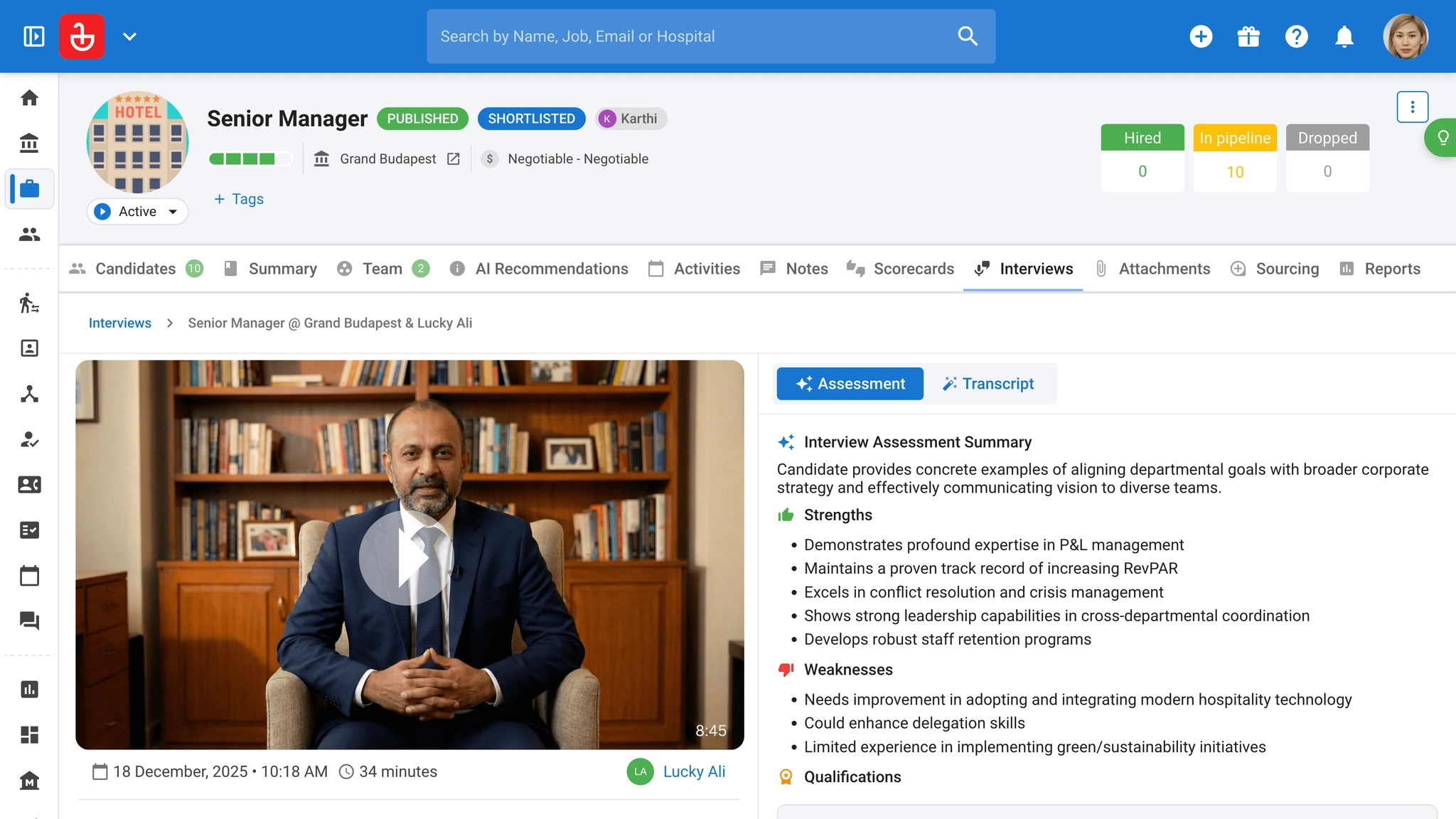
The human element in an automated pipeline
Automation handles the administrative volume of recruitment, not the final decision.
The final stages of hiring will always require a heuristic eye. Reviewing an AI-generated interview summary gives you a data-driven baseline, but you remain the final frontier for assessing cultural fit, communication nuances, and team dynamics. Using these tools simply ensures that when you finally sit down with a candidate, you already know they possess the technical foundation required for the role.
Start building your automated pipeline
Ready to see how these tools work with your own candidate data?
- Browse over 10,000 resumes and see how fast the system scores them.
- Set up your first AI Interviewer sequence.
- Visit the help center for step-by-step technical guides.
{{cta}}
.webp)







.webp)

.webp)


.webp)


