





A bad hire can cost your company an average of $17,000 per mis-hire. [1] That's before you factor in the damage to team morale, lost productivity, and the time your HR team spends on replacement cycles. This guide strips away the platitudes. You won't find advice about "being nice" or "asking questions." You'll learn how to be a good interviewer with structured interviews that predict job performance, spot your own biases before they wreck your hiring decisions, and turn every interview into a data point that makes your next hire better than the last.
How to Be a Good Interviewer: Skills Matter
Glassdoor data shows 72% of candidates who have a negative interview experience share it publicly. [2] That's not just a PR problem. That's a talent acquisition problem. The best candidates research your company before applying. If they find reviews describing unprepared interviewers who showed up late or asked questions already answered on the resume, they won't apply.
Unstructured interviews have a correlation of 0.38 with job performance, which is better than a coin flip but still limited, whereas structured interviews increase that correlation to 0.51. [3] You need a process that predicts success.
Preparation: The Phase Most People Skip
Most interviewers open the resume thirty seconds before the candidate walks in. This is an insult to the candidate. It also guarantees a shallow conversation.
- Audit the resume early. Look for gaps in employment. Identify specific technical achievements that require deeper explanation. Mark the areas where the candidate used vague language.
- Define Success Metrics. You must know what a "win" looks like for this role in six months. If you cannot define the output, you cannot interview for the input.
- Standardize the environment. Turn off Slack notifications. Close your email. A distracted interviewer misses the subtle cues that signal a candidate is inflating their experience.
- Standardize your interview script. To ensure a fair and compliant process, list your interview questions in advance. Focusing strictly on job-related competencies helps prevent illegal interview questions or biased inquiries.
How to Interview Someone: The 5-Step Framework
1. The Opening
Spend two minutes setting the stage. Explain the format of the interview. Tell them you will be taking notes. This transparency lowers candidate anxiety. Anxious candidates hide their true potential. You want them relaxed so you can see their actual ceiling.
2. The Pitch
Do not spend twenty minutes talking about the company history. The candidate already researched you. Spend three minutes explaining why this specific role matters to the company’s current quarterly goals. Then stop talking.
3. Structured Questioning
Use behavioral questions. Stop asking "What would you do if...?" and start asking "What did you do when...?"
- Bad: Are you a good leader?
- Good: Tell me about a time you had to fire a friend.
Force the candidate to use the STAR method [4]. If they skip the "Result," dig back in. Ask for the specific revenue number or the exact percentage of time saved.
4. The Candidate’s Turn
The quality of a candidate’s questions reveals their seniority. A junior asks about the vacation policy. A senior asks about the friction between the engineering and product teams. If they have no questions, they haven't thought deeply about the role's challenges.
5. The Close
Be definitive about the timeline. Tell them they will hear from you by Thursday. Then, actually call them on Thursday. Ghosting candidates is the fastest way to ruin your reputation in a tight talent market.
Essential Resource: The Evaluation Scorecard
Memory can be unreliable, frequently filtering out the middle portion of an interaction. You must use a scorecard. An interview scorecard forces you to grade candidates on specific competencies immediately. Use a 1-5 scale. Write down the evidence for the grade. Standardizing this process across a whole team is impossible with paper or fragmented spreadsheets.
Candidate Scorecard Template (1-5 Rating)
1 = Unsatisfactory: Lacks required skills
2 = Marginal: Below expectations; requires substantial training and development.
3 = Satisfactory: Meets basic requirements and can perform assigned tasks effectively
4 = Above Average: Exceeds expectations with clear evidence of strong performance.
5 = Exceptional: Outstanding; demonstrates leadership qualities or specialized expertise.
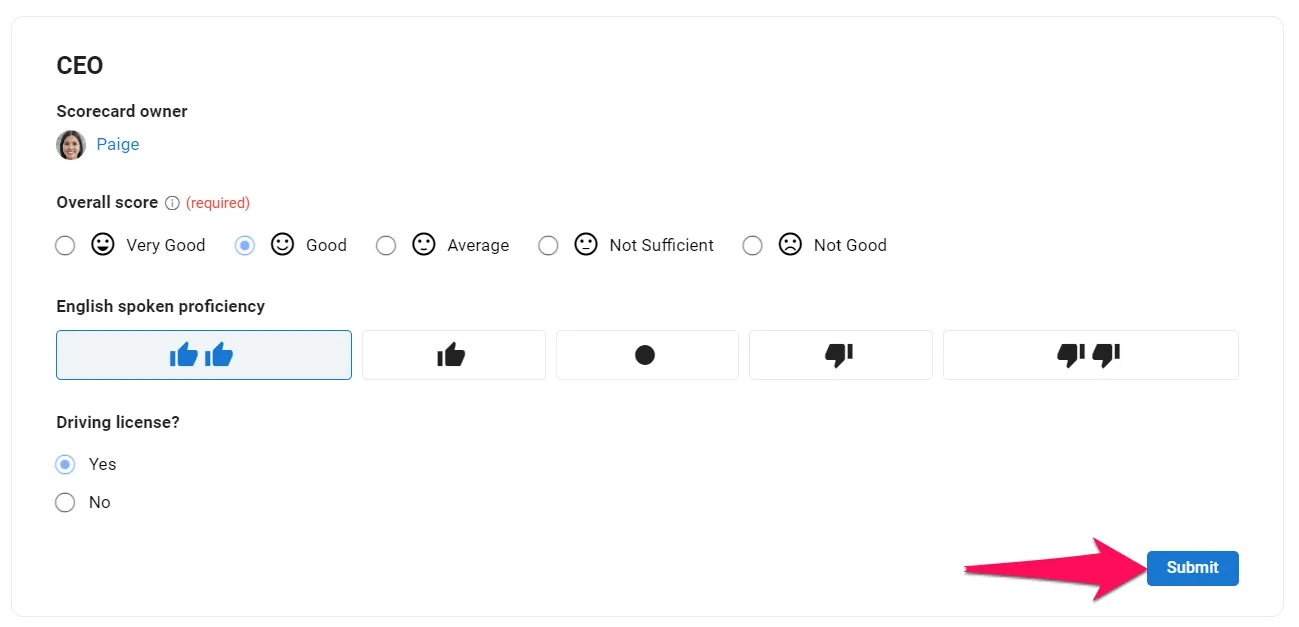
Manatal’s candidate scorecard lets you conduct interviews using digital scorecards built directly into the platform. You can rate candidates on pre-set criteria in real-time and share feedback with the hiring team instantly

Using a scorecard removes the "gut feeling" and replaces it with a data-backed comparison. Your hiring team sees the feedback instantly. No more chasing managers for their "thoughts" three days after the interview.
{{cta}}
Signs of a Bad Interviewer
You are failing as an interviewer if you recognize these patterns in your own sessions.
- The 70/30 Violation. If you are talking more than 30% of the time, you are pitching, not evaluating. You are there to gather data, not to hear yourself speak.
- The Halo Effect. Do not let a candidate's previous employer (like Google or McKinsey) blind you to their actual skills. Top companies make hiring mistakes too.
- Inconsistency. If you ask Candidate A about their leadership and Candidate B about their technical stack, you cannot compare them. You are comparing apples to engines.
Conclusion: Master How to Be a Good Interviewer
Learning how to be a good interviewer isn't about memorizing interview questions. It's about building a repeatable system that separates signal from noise. The framework matters more than your natural charisma. Start small; pick three competencies for your next role. Write two behavioral questions for each. Use the same scorecard for every candidate. Compare the quality of your hiring decisions six months later against your previous approach. Your next interview is an opportunity to collect better data. Stop treating it like a casual conversation and start treating it like the high-stakes decision it actually is.
Frequently Asked Questions
Q: How long should an interview last?
A: 45-60 minutes for most roles. Longer interviews don't improve prediction accuracy. They just create fatigue that clouds judgment. Phone screens should run for 20-30 minutes at most. Final rounds with multiple interviewers can stretch to 90 minutes, but build in breaks.
Q: What interviewing techniques work best for remote candidates?
A: Use the same structured approach you'd use in person. Test your video setup beforehand. Send the interview agenda 24 hours in advance so candidates can prepare their environment. Ask the same behavioral questions but add one specific to remote work: "Tell me about a time you had to collaborate on a complex project without meeting face-to-face."
Q: How many interviewers should participate in the hiring process?
A: Three to four at most. Each interviewer should assess different competencies to avoid redundancy. One person evaluates technical skills, another assesses cultural values alignment, and a third examines management style. More interviewers don't increase accuracy. They increase coordination overhead and slow down decisions.
Q: How do I improve my interviewing techniques if I'm new to hiring?
A: Shadow experienced interviewers first. Watch how they probe for details, handle silence, and redirect rambling answers. Record your practice interviews (with permission) and review your talk time ratio. Ask candidates for feedback on their experience. Most won't be honest in the moment, but end-of-process surveys reveal what you're doing wrong.
Q: Should I tell candidates why they weren't selected?
A: Yes, but keep it factual and competency-based. "We moved forward with someone who had more direct experience managing distributed teams" is useful. "You weren't a culture fit" is legally risky and unhelpful. Candidates who receive specific feedback are 30-50% more likely to apply for future roles. [5] The ones you ghost will tell other people to avoid your company.
Citation:
.webp)







.webp)

.webp)


.webp)


