





LinkedIn job ads are paid acquisition campaigns. When structured correctly, they give recruiters control over targeting, budget, and applicant flow; when handled casually, they produce volume without quality and inflate screening time. This guide shows hiring teams and agencies exactly how to run LinkedIn job ads for performance, including how to post them properly, what they realistically cost, and what high-converting ads look like, so your spend turns into qualified interviews instead of unfiltered applications.
Why LinkedIn Job Ads Require Operational Discipline
LinkedIn continues to expand globally, now exceeding 1.3 billion members across more than 200 countries, which increases reach but also ad competition.[1]
At the same time, LinkedIn’s advertising ecosystem enforces minimum campaign budgets and rewards properly funded, structured campaigns.[2]
Here is what that means in practice:
- Broad targeting drives volume but lowers applicant quality.
- Poor screening inflates manual review time.
- Weak formatting reduces mobile engagement.
- Untracked campaigns make ROI impossible to calculate.
Running job ads on LinkedIn is not just about posting. It is about targeting, screening, and pipeline control.
Connect LinkedIn Job Ads to Your ATS
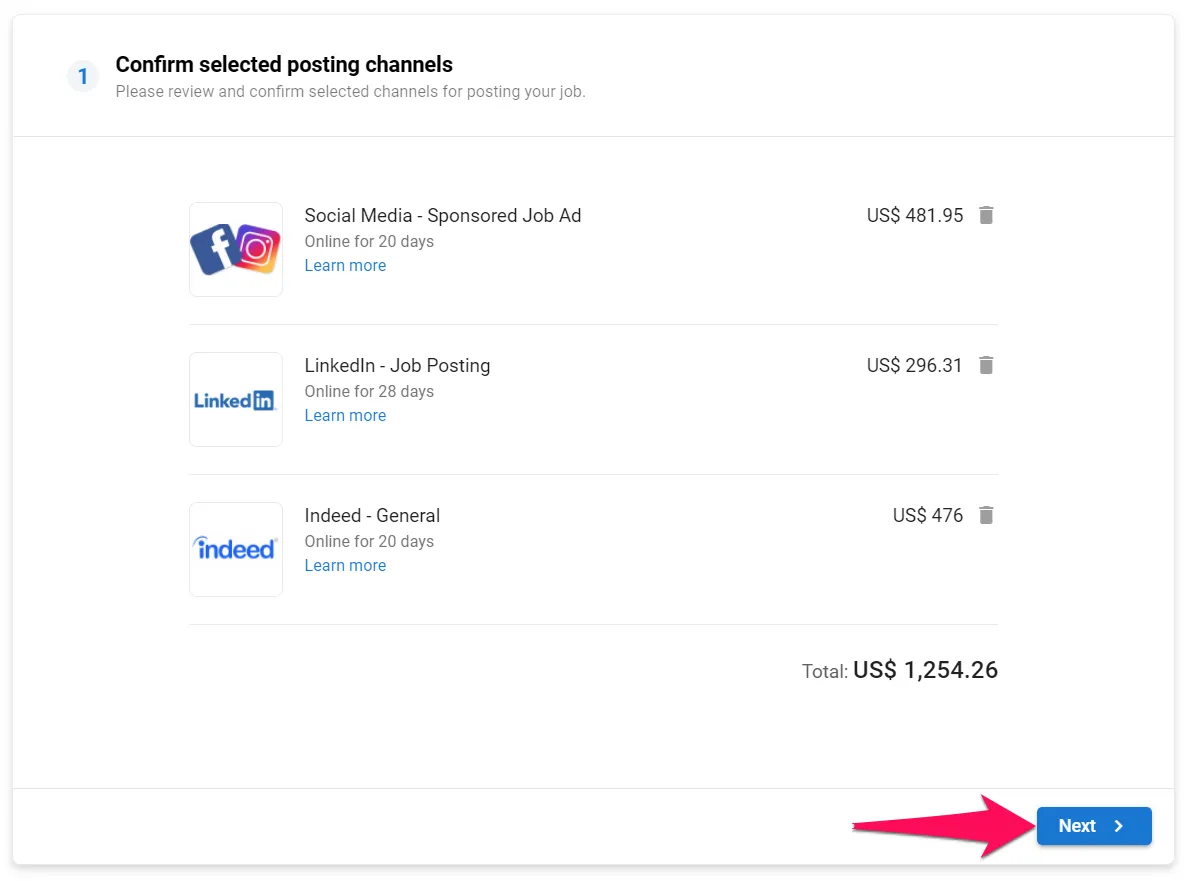
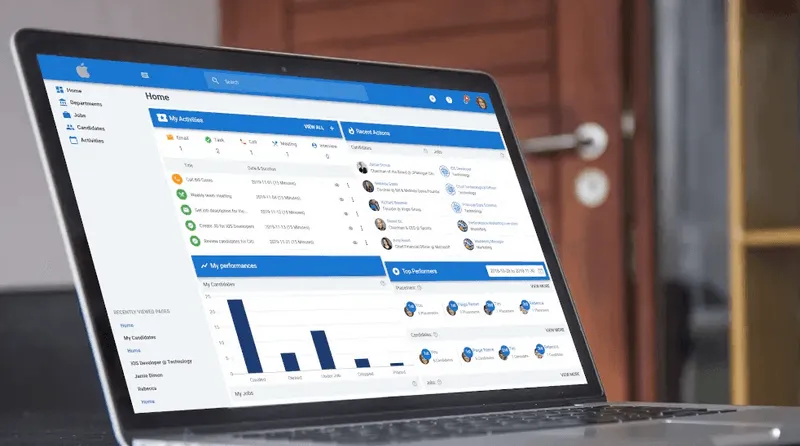
When LinkedIn job ads are paired with a centralized system and supported by a premium job board posting, you control reach and routing at the same time. Premium distribution expands your ad across multiple job boards from one place, increasing qualified exposure without fragmenting sources. Instead of managing postings separately, you launch broadly while keeping applicant data unified inside one hiring workflow.
What this really means is simple. Paid acquisition only works if the operational layer can absorb demand. Broader distribution drives visibility and applicant flow. But if screening is delayed or candidates sit untouched, cost per hire rises regardless of click price. Distribution scales results. Process determines whether that scale helps or hurts.
{{cta}}
Organic Job Boards/Standard Job Boards vs. Promoted LinkedIn Job Ads
LinkedIn Basic Jobs rely on organic visibility and LinkedIn's internal recommendation algorithms.
Promoted LinkedIn job ads operate within LinkedIn’s advertising auction system, with budget control, bidding, and targeting capabilities. Industry benchmarks show that LinkedIn advertising costs vary significantly by competition and targeting depth.[3]
For recruiters who need predictable volume, promoted job ads on LinkedIn provide:
- Targeting by job title, seniority, skills, company size, and location
- Daily or lifetime budget controls
- Campaign performance metrics
High-volume hiring teams may also use LinkedIn Job Slots, which allow prepaid role rotation rather than per-click management.[4] Choose based on hiring frequency and required control.
While job ads focus on inbound applicant flow, many teams pair them with active sourcing via LinkedIn Recruiter. To see how these costs compare and which license fits your team's size, see our detailed breakdown on how much LinkedIn Recruiter costs.
How to Post LinkedIn Job Ads (Operational Walkthrough)
LinkedIn provides a structured workflow for posting and promoting roles. Detailed steps are documented in LinkedIn’s help center.[5]
Operational checklist:
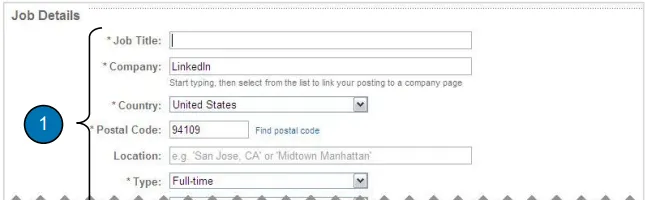
- Prepare the job content first: title, salary band, 1–2 line impact statement, 3–5 outcome-based responsibilities, and 3 must-haves.
- Navigate to the Jobs section (or Campaign Manager for advanced campaigns) and create a new job campaign.
- Select promotion type: sponsored job post or job slot placement.[4]
- Define targeting filters. Start narrower for senior or niche roles.
.webp)
- Set budget. LinkedIn enforces a minimum daily threshold; practical tests typically start at $25–$50 per day to gather meaningful data.[5]
- Add 2–3 screening questions to reduce unqualified volume.
.webp)
7. Confirm applicant routing into your ATS.
LinkedIn Job Ads Cost: What Recruiters Should Expect
There is no universal cost benchmark for LinkedIn job ads. Pricing depends on role competitiveness, geography, and audience specificity.
However, several consistent patterns emerge:
- LinkedIn campaigns have minimum budget requirements; meaningful learning usually requires more than the bare minimum.[5]
- Industry reports indicate cost-per-click ranges from lower single digits to double digits for highly competitive technical roles.[3]
- Job slots offer an alternative model for high-frequency hiring.[4]
Rather than optimizing only for CPC, you should measure:
- Cost-per-applicant
- Applicant-to-interview ratio
- Interview-to-hire ratio
- Cost-per-hire
These sourcing metrics require structured source tracking inside an ATS.
Writing LinkedIn Job Ads That Convert Qualified Candidates
Strong LinkedIn job ads convert because they prioritize clarity, outcomes, and transparency.
1. Title: Search Visibility First
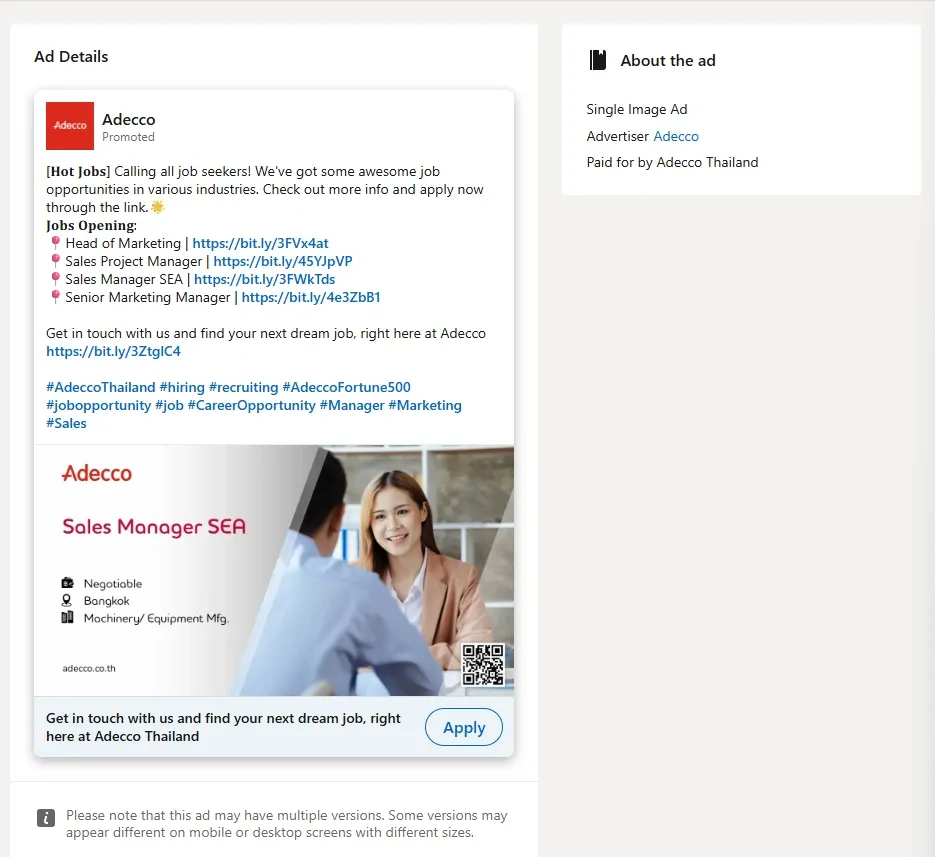
Use standardized titles with seniority and key qualifiers.
Example:
Senior Product Engineer, Frontend, Remote, $110k–$140k
Clear titles improve discoverability and reduce mismatched applications.
2. Opening Hook: Signal Impact Immediately
Answer three questions in one or two lines:
- What will this person own?
- Why does it matter?
- What level of autonomy?
Example:
Own frontend architecture for a platform serving 10M monthly users and lead a 4-person team delivering measurable performance improvements.
3. Put Compensation and Logistics Near the Top
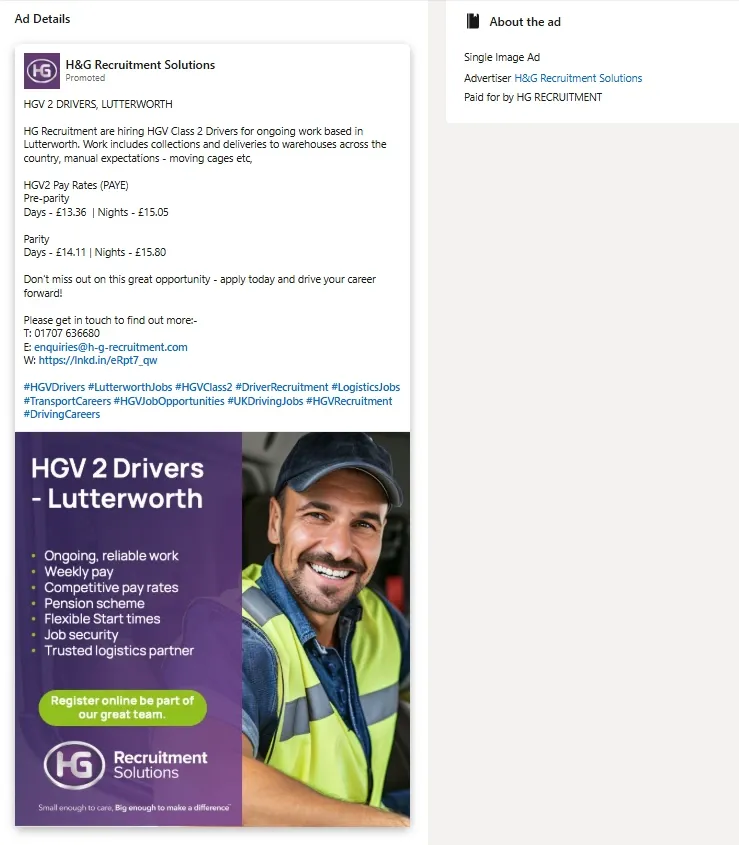
Include:
- Salary or OTE range
- Bonus or equity details
- Work model and timezone expectations
- Reporting line
- Number of interview stages
Transparency filters out misaligned applicants early.
4. Frame Responsibilities as Outcomes
Limit to 4–6 measurable outcomes.
Task:
Manage enterprise accounts.
Outcome:
Close 6–8 enterprise deals per quarter averaging $50k ARR.
Outcome-based phrasing attracts performance-oriented candidates.
5. Separate Must-Haves from Nice-to-Haves
Use 3–5 essential requirements. Keep optional skills clearly labeled. Long requirement lists reduce completion rates and deter qualified applicants.
6. Replace Culture Claims with Proof
Avoid vague language like dynamic culture.
Instead include:
- Revenue or user growth metrics
- Funding stage
- Team size and expansion rate
- Average tenure
Proof signals stability and opportunity.
Examples of High-Converting LinkedIn Job Ads
These LinkedIn job ads examples illustrate why structure influences performance.
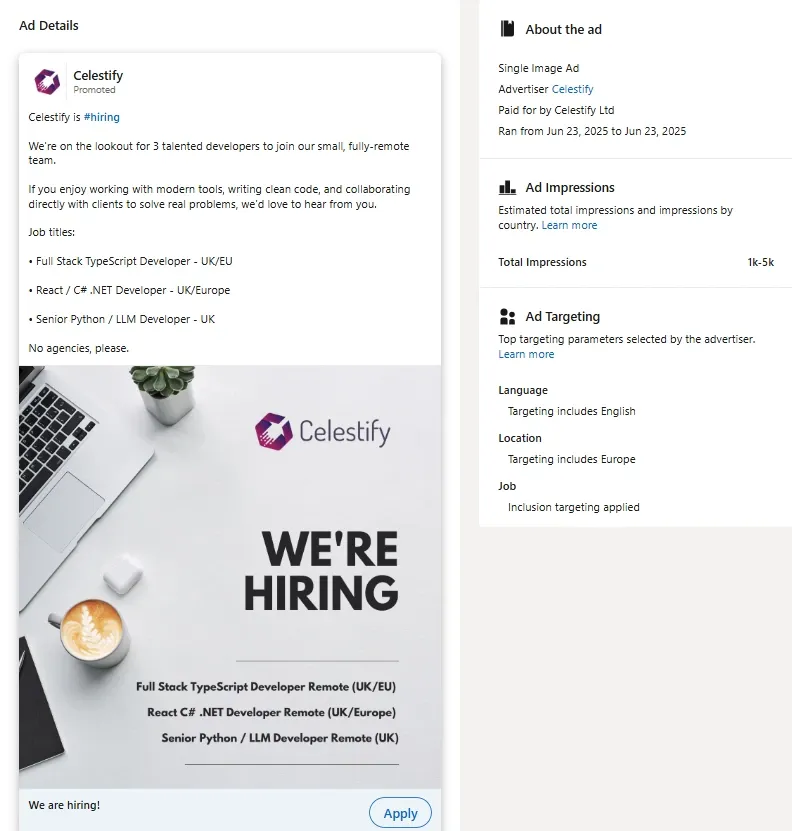
The Celestify ad is structured for speed. It leads with a clear hiring signal, short supporting copy, and bullet-listed job titles with location qualifiers. The visual reinforces urgency and remote flexibility. This format reduces friction and increases scroll-stopping power, which typically improves click-through and application starts. The tradeoff is broader appeal, which can increase total applicants while lowering average fit.
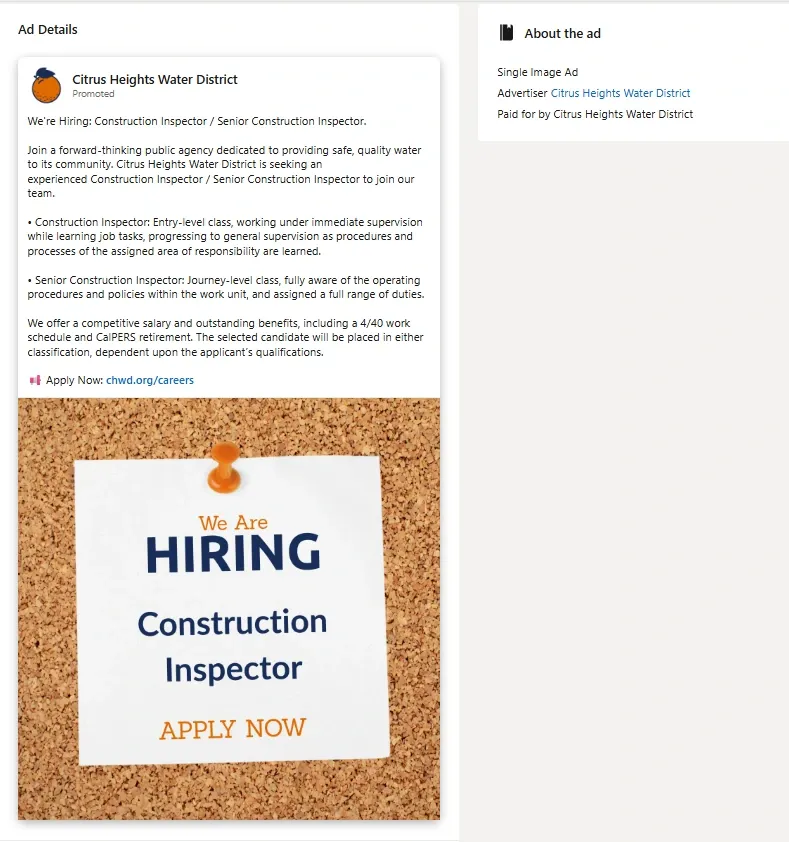
The Citrus Heights Water District ad uses a dense, formal structure with a long introductory paragraph, classification breakdown, and benefits detail. That level of specificity builds credibility and filters for serious, actively searching candidates. The tradeoff is cognitive load. The copy requires reading, so casual scrollers are less likely to click. Expect lower applicant volume but stronger alignment and higher qualification rates.
For more inspiration on structuring effective job ads, check out these hiring ad examples to see what works across industries.
Optimizing Budget and Campaign Performance
Set predefined performance thresholds before launching.
Monitor:
- Click-through rate
- Cost per applicant
- Applicant-to-interview ratio
Pause underperforming targeting combinations and reallocate spend to higher-converting segments.
Remember, minimum budget rules exist, but meaningful optimization requires disciplined testing.[5]
Final Checklist Before Launching LinkedIn Job Ads
Conclusion
LinkedIn job ads work when targeting, transparency, and intake are aligned. Posting job ads on LinkedIn without structured screening or pipeline management increases noise and inflates cost per hire. Pair disciplined campaign execution with a centralized ATS that tracks source performance and ranks candidates efficiently. When LinkedIn acquisition feeds directly into a structured pipeline, ad spend turns into measurable hiring outcomes rather than administrative overhead.
Frequently Asked Questions
Q: How do LinkedIn job ads work?
A: LinkedIn job ads function as a targeted matching engine, leveraging a 1.3-billion-member professional database to push openings directly into the feeds and inboxes of ideal candidates. Recruiters must choose between Sponsored Jobs for individual, high-priority roles or Job Slots for high-volume rotation, while the platform's algorithm uses real-time data to prioritize "passive" talent who aren't actively searching but match your specific skill and seniority requirements.
Q: How much does a job ad cost on LinkedIn?
A: LinkedIn utilizes a dynamic bidding model where costs are dictated by competition and audience desirability rather than a flat fee. Most ads operate on a Pay-Per-Click (PPC) basis with average bids ranging from $52 to $8 per click, though premium roles in tech or finance often demand higher bids to remain visible. You can control spending by setting daily minimums (typically $10) or total budget caps, allowing you to scale up for urgent hires or throttle back for evergreen talent pipelines.
Q: Is it worth it to post jobs on LinkedIn?
A: For professional and specialized roles, LinkedIn is indispensable because it offers unparalleled access to verified career data and a "credibility engine" that high-turnover job boards lack. While the cost-per-click is higher than competitors like Facebook or Indeed, the investment is justified by higher candidate quality and the ability to reach the 70% of the workforce that is passive. It is the premier choice for white-collar and leadership roles, particularly when integrated with an ATS to automate the journey from click to hire.
Citations
.webp)







.webp)

.webp)


.webp)


