





Candidate ghosting, where a new hire backs out or stops responding before Day 1, affects 28% of accepted offers [1]. The root cause is almost always the same: a communication void between the signed offer letter and the start date. Pre-boarding is the structured engagement period between offer acceptance and the first day of work, and it is how you close that gap. This guide defines what pre-boarding is, explains why it directly affects retention and productivity, shows you how to automate the entire process with an Applicant Tracking System (ATS), and provides a timeline-based pre-boarding checklist.
What Is Pre-Boarding?
Pre-boarding is the set of activities that take place between the moment a candidate accepts your offer and their first day on the job. It is distinct from onboarding, which begins on Day 1.
- The focus of pre-boarding is logistics, compliance, engagement, and anxiety reduction. You handle administrative setup, send welcome communications, provide IT access, and maintain regular contact so the new hire feels connected before they officially start.
- Onboarding begins on Day 1 and focuses on role-specific training, deep culture immersion, performance goal setting, and manager check-ins.
Why Pre-Boarding Is Critical for New Employees
A communication void between offer acceptance and start date puts every hire at risk. Here is the business case for a structured pre-boarding process.
- Reduce candidate ghosting and offer drop-offs: When weeks pass without contact, candidates second-guess their decision and remain open to counter-offers. Consistent pre-boarding communication signals that your organization values them and is prepared for their arrival.
- Accelerate time-to-productivity: Completing tax forms, I-9 verification, document signing, and IT provisioning before Day 1 means the first day is about training and team introductions, not paperwork. Your new hire is more productive faster.
- Lower first-day anxiety: 80% of professionals report nervousness before starting a new job [2]. A welcome email, a clear first-day schedule, and a team introduction before the start date reduce uncertainty. New hires who know what to expect perform better in their first week.
- Improve early retention: New hires who receive consistent pre-boarding communication can improve early retention. Pre-boarding is your first opportunity to demonstrate that the candidate experience matches the promises made during the interview process.
How to Automate Pre-Boarding with an ATS
An ATS with workflow automation turns pre-boarding into a repeatable, five-step process. Follow these steps to eliminate manual tracking and ensure every new hire receives a consistent experience.
Step 1: Set Up Automated Email Triggers
- Open your ATS and navigate to the workflow automation settings. In Manatal, go to the Settings menu, select Automation, and create a new trigger.
- Set the trigger condition to "Candidate status changes to Hired."
- Define the action: send a pre-written welcome email to the new hire. Include the start date, a welcome message from the hiring manager, and a link to any pre-boarding documents.
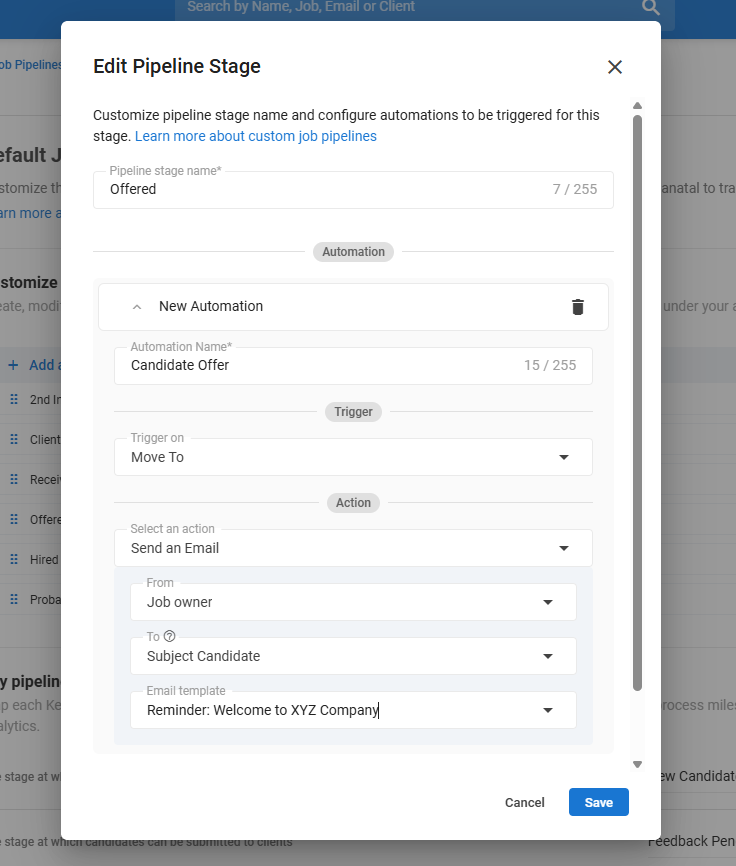
- Add a second trigger for a follow-up reminder email three days after the first, confirming that the new hire has received everything they need.
- Once saved, every candidate who moves to "Hired" status receives this sequence automatically, with no manual follow-up required.
Step 2: Build Your Post-Offer Pipeline Stages
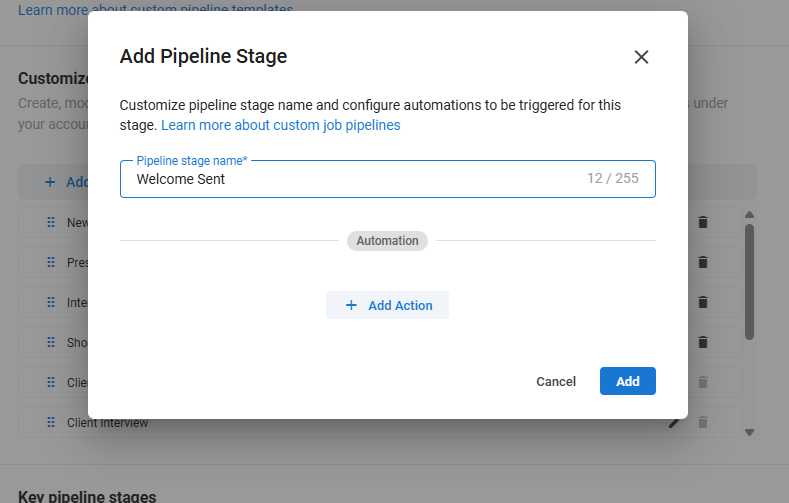
- With your email triggers in place, create dedicated pre-boarding stages in your recruitment pipeline. In Manatal, open your pipeline view and add new stages after "Hired," such as "Welcome Sent," "IT Provisioned," and "Paperwork Complete."
- Assign a default owner to each stage. For example, assign "IT Provisioned" to your IT lead so they receive a notification the moment a candidate enters that stage.
- Drag each new hire's card through the stages as tasks are completed. This gives your entire team a visual overview of where every incoming hire stands.
Step 3: Route Documents for E-Signature
- Connect your e-signature tool to your ATS. Manatal integrates with Adobe Sign, allowing you to send offer letters, NDAs, tax forms, and benefits enrollment documents directly from the candidate profile.
- Select the documents, choose the signer, and send. The candidate receives a signing request via email, completes it on any device, and Manatal stores the signed copy in the candidate's profile automatically.
Step 4: Sync Data to Your HRIS and Payroll System
- Finally, connect your ATS to your HRMS or payroll platform. Manatal's Open API integrations allow you to sync new hire data, including personal details, emergency contacts, and tax information, directly to your HR system.
- This eliminates duplicate data entry. When the new hire's record is complete in your ATS, the same data flows to payroll and benefits without a second round of manual input.
Once all four steps are configured, your pre-boarding program can run with minimal manual follow-up. Each new hire receives the same consistent experience, and your HR team's workload stays flat regardless of hiring volume.
{{cta}}
The Four Dimensions of a Successful Pre-Boarding Strategy
Every effective pre-boarding program covers four operational categories. Build your program across all four to ensure nothing is missed.
Logistics and IT
Ship hardware to remote hires or confirm workstation setup for in-office employees. Set up email accounts, software access, and VPN credentials. When configuring network security, evaluate whether a free VPN vs a paid VPN better suits your company's privacy and data protection requirements. Share the first-day schedule with arrival time, dress code, parking details, or remote login instructions.
Compliance and Administration
Send I-9 verification forms, tax documents, and payroll enrollment paperwork for completion before Day 1. Clear any outstanding background checks. Route Non-Disclosure Agreements (NDAs) and other confidentiality documents for e-signature. Track completion status for every item.
Culture and Connection
Send a personalized welcome email from the hiring manager or direct team. Ship a welcome package with company swag and the employee handbook. Invite the new hire to a team Slack channel, group chat, or internal social platform. This type of candidate engagement can help reduce ghosting risk.
Strategy and Communication
Establish a check-in cadence with the new hire: a brief call or email once a week between offer acceptance and start date. Assign an onboarding buddy or mentor. Set clear expectations for the first week, including scheduled meetings, training sessions, and performance milestones. Apply the same engagement principles used to keep candidates engaged during the hiring process to maintain momentum before Day 1.
The Ultimate Pre-Boarding Checklist for HR
Use this timeline-based checklist to manage the human and cultural elements of pre-boarding, perfectly complementing your automated ATS workflows.
Immediately After Offer Acceptance
- Extend a personal congratulations: Give the candidate a quick phone call or send a personalized video message to celebrate their acceptance before the automated emails kick in.
- Finalize the onboarding buddy assignment: Match the new hire with a mentor or buddy so they have a designated peer contact from day one.
- Brief the hiring manager: Ensure the manager knows the offer is accepted and remind them to start blocking out time for first-week 1-on-1s and team introductions.
One to Two Weeks Before Start Date
- Ship the welcome package: Send out company swag, a physical copy of the employee handbook, and a warm welcome note to build Day 1 anticipation.
- Coordinate the first-week agenda: Work with the hiring manager to build a structured, balanced schedule for the new hire’s first week (including training sessions, meets-and-greets, and downtime).
- Facilitate the buddy introduction: Have the assigned onboarding buddy reach out informally to introduce themselves and offer to answer any casual questions.
- Monitor ATS paperwork progress: Check your pipeline dashboard to ensure compliance forms are being signed, following up manually only if a bottleneck occurs.
One Day Before Start Date
- Send Day 1 logistics: Email the essential details, such as arrival time, dress code, parking instructions, remote login protocols, and who to ask for at the front desk.
- Verify physical tech readiness: Confirm with IT that the physical laptop and hardware peripherals are configured, tested, and physically ready at the desk (or delivered to the remote hire's home).
- Prep the internal team: Send a quick reminder to the immediate team celebrating the new hire's arrival tomorrow and reminding them of any scheduled welcome lunches or meetings.
- Confirm the Day 1 schedule: Double-check that everyone involved in the new hire's first day (managers, presenters, HR reps) is ready and has the calendar invites secured.
Conclusion
Pre-boarding is the operational bridge between offer acceptance and Day 1. A structured program across logistics, compliance, culture, and communication reduces candidate ghosting and accelerates time-to-productivity. Teams that maintain consistent pre-boarding communication also see stronger retention at the 90-day mark.
Frequently Asked Questions
Q: How can organizations mitigate remote pre-boarding disruptions caused by hardware delivery delays?
A: To prevent logistics delays from impacting the first day, organizations should configure an applicant tracking system like Manatal milestones to trigger hardware shipments 10 to 14 days before the start date. If equipment is delayed, the Day 1 schedule should be pivoted to mobile-friendly or browser-accessible tasks. New hires can utilize personal devices to complete compliance documentation, review corporate literature, or participate in introductory video conferences, ensuring the start date remains unchanged.
Q: How can employers establish authentic engagement during remote pre-boarding?
A: While corporate merchandise provides a physical touchpoint, digital engagement is essential to mitigate drop-off risks for remote employees. Organizations should supplement automated workflows with personalized touches, such as a brief video message from the hiring manager. Furthermore, granting early, restricted access to communication platforms like Slack or Microsoft Teams allows the department to welcome the incoming employee, establishing a strong professional connection prior to Day 1.
Q: How should an organization handle an offer revocation during the pre-boarding phase?
A: If an organization must rescind an offer due to a failed background check or shifting business priorities during pre-boarding, HR must coordinate with legal counsel to issue a formal, written revocation notice. Simultaneously, the candidate's status must be updated immediately within the ATS to deactivate all automated email workflows and task notifications. This prevents unauthorized automated communications and terminates any pending access to internal systems.
Q: How does cross-border hiring alter compliance requirements within a pre-boarding strategy?
A: International pre-boarding requires strict adherence to localized labor laws, tax regulations, and data privacy frameworks (such as GDPR). Organizations must ensure that employment contracts, non-disclosure agreements, and compliance documentation are legally binding within the candidate’s specific jurisdiction. Integrating an Employer of Record (EOR) platform with your ATS can automate the verification and localization of these documents prior to Day 1.
Q: Should the pre onboarding process be differentiated for executive-level hires?
A: While the foundational administrative and compliance elements remain consistent, executive pre onboarding requires a more bespoke, high-touch communication cadence. The focus shifts from basic tactical preparation to strategic alignment. The sequence should include private briefings with key board members, early access to high-level corporate performance data, and scheduled introductory sessions with stakeholder groups to facilitate immediate leadership impact.
Citations
.webp)






.webp)

.webp)


.webp)


