





Recruiting compliance failures are expensive. In FY 2025, EEOC recoveries reached $660 million for 17,680 victims, which translates to roughly $35,000–$40,000 per victim before legal fees, reputational damage, or internal time are factored in.[1] Other than being a legal concern, recruiting compliance is also an operational risk embedded across the hiring cycle.
At the same time, the regulatory scope continues to expand. Pay transparency laws now apply across approximately 15 U.S. states and D.C. Additionally, New York City requires bias audits for automated employment decision tools under Local Law 144,[2] while Illinois mandates candidate notification and consent for AI-analyzed video interviews.[3] GDPR enforcement on HR data handling is also increasing across Europe, raising the baseline for how candidate data must be managed.
This article is intended for general learning purposes only and does not constitute legal advice. Readers remain responsible for ensuring their own recruiting practices comply with applicable laws and regulations, and should consult qualified employment counsel for jurisdiction-specific guidance. We offer a practical overview of recruiting compliance, explain how obligations can differ between in-house teams and recruitment agencies, and provide a phase-by-phase checklist to help audit your hiring process.
Maintaining Recruiting Compliance Across the Hiring Cycle
Anti-Discrimination Compliance
The Equal Employment Opportunity Commission enforces federal protections against discrimination in hiring. These laws prohibit discrimination based on race, color, religion, sex, national origin, age, or disability, and they apply directly to job ads, screening, and interviews, as outlined in the EEOC’s overview of federal anti-discrimination laws.
To operationalize this, focus on where most violations occur:
- Job descriptions: Remove non-essential physical requirements, age-coded phrases, and gendered titles using patterns flagged in EEOC guidance on discriminatory practices.
- Interviews: Standardize scorecards tied to role criteria and avoid illegal interview questions related to protected characteristics.
- Documentation: Keep consistent evaluation records to reduce exposure to subjective decision-making claims.
This is also where structured hiring workflows matter. If evaluation criteria are not defined up front, compliance breaks down quickly.
Data Privacy Compliance: GDPR, CCPA, and Candidate Data Storage
Every resume, assessment, and interview note is regulated personal data. Under GDPR and CCPA, teams are expected to collect only what is necessary, retain it for a defined purpose, and support candidate rights around access and deletion.
Focus on three controls:
- Data retention: GDPR limits storage to the hiring purpose, as explained in the GDPR fundamentals breakdown.
- Candidate rights: Under CCPA, candidates can request access to or deletion of their data, which is detailed in the California Attorney General’s CCPA resource.
- Execution: Your ATS must support export and deletion on demand. If it cannot, that is a direct compliance gap.
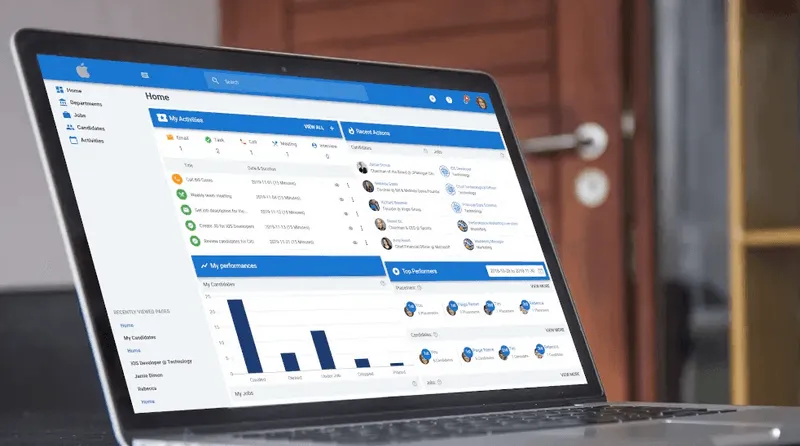
If your current process relies on manual tracking or disconnected systems, that gap becomes operational risk. This is where using an applicant tracking system like Manatal to centralize candidate data becomes a compliance control, not just a productivity upgrade.
Pay Transparency Laws and Salary History Bans
Pay transparency is now a legal requirement across multiple jurisdictions, not a best practice. Employers are expected to disclose salary ranges and avoid using salary history in hiring decisions, with evolving requirements tracked through pay transparency law resource.
To stay compliant:
- Include salary ranges and, where required, benefits in job postings.
- Remove salary history questions from all forms and interview scripts.
- Anchor compensation to internal bands, not candidate history.
In Europe, requirements go further under the EU Pay Transparency Directive framework, which mandates early salary disclosure and restricts prior pay inquiries.
AI in Hiring and Automated Employment Decision Tools
AI in hiring is now regulated, and enforcement is expanding. As enforcement evolves, talent acquisition compliance increasingly depends on how automated tools are audited and disclosed.
To stay compliant:
- Map your tools: Identify any system that scores, filters, or ranks candidates.
- Audit vendors: Request documentation aligned with emerging enforcement expectations, as highlighted in this Analysis of AI Liability Under Employment Law.
- Ensure transparency: Notify candidates when AI is used and obtain consent where required.
This is where many teams underestimate risk. The issue is not just using AI but also failing to document how decisions were made.
In-House vs. Agency Recruiting Compliance
The compliance burden shifts depending on whether you are hiring internally or placing candidates for clients. The core principles stay the same, but how liability is distributed changes how you manage risk, documentation, and oversight.
In-House Hiring
When hiring for your own organization, accountability is end-to-end. Every step must align with employee recruitment laws and internal hiring compliance standards, not just the final decision.
In practice, that means:
- Job descriptions are reviewed against current recruitment requirements before going live.
- Interviewers follow structured scorecards to reduce subjectivity and support compliance recruiting practices.
- Offers and onboarding documents are consistent with legal and internal policy expectations.
- Ownership sits clearly with HR leadership or legal, not distributed across hiring managers.
This is where most teams fail. They treat recruiting compliance as a policy exercise instead of a system built into daily hiring decisions.
Agency Recruiting Compliance
Agencies operate under a different model. You control sourcing, screening, and candidate handling, but client-side decisions still affect your exposure. That is where recruitment agency compliance becomes more complex.
The key risk is co-employment. If a client applies discriminatory hiring practices and you continue supplying candidates without escalation, you are not insulated from liability.
To manage that:
- Validate client job descriptions before submission to ensure alignment with recruitment compliance standards.
- Confirm interview processes follow fair hiring principles tied to talent acquisition compliance.
- Require documented, role-based rejection criteria.
- Establish data-sharing agreements that define purpose, legal basis, and retention terms.
This is a defensible recruiting compliance checklist that protects your agency when decisions are challenged.
How Manatal Supports Recruiting Compliance for In-House Teams and Agencies
Manatal is built to support both internal teams and agencies without forcing the same workflow.

For agencies: The custom resume builder reduces unnecessary data exposure by letting users hide or unhide specific information sections and fields when generating candidate resumes, supporting compliance with data minimization requirements.

For client collaboration: Guest Accounts (via the Guest Portal) allow controlled access to candidate profiles without exposing the full pipeline. Agencies and in-house teams can share only selected candidate details and progress with external stakeholders while using customizable settings (including the Candidate Profile Teaser for anonymized early-stage summaries).
For compliance structure: Its SOC 2 Type II certification and GDPR-aligned architecture (with built-in tools for consent management, data deletion requests, and compliance reporting) give teams a baseline for handling candidate data in line with modern recruitment requirements.
More importantly, these features are not isolated tools. They sit inside a structured hiring workflow. That means compliance is enforced at the process level, not dependent on individual recruiter behavior.
If your current hiring process relies on manual steps or inconsistent documentation, the risk is not theoretical. It shows up when decisions need to be justified.
{{cta}}
Recruiting Compliance Checklist
Use this recruiting compliance checklist at the start of every role and as part of your ongoing hiring compliance audits. It is designed to align with current employee recruitment laws, core recruitment requirements, and the practical realities of both in-house and recruitment agency compliance workflows.
Phase 1: Preparation and Job Posting
Phase 2: Sourcing and Data Collection
Phase 3: Interviewing and Screening
Phase 4: Offer and Onboarding
Conclusion
Hiring compliance does not have a finish line. New York City's AEDT law was passed in 2021, partially implemented in 2023, and is still generating enforcement guidance in 2026. State-level pay transparency requirements are expanding. Federal agencies are publishing AI hiring guidance on overlapping timelines with state legislation. Treat this checklist as a living document. Assign a named owner inside your HR function whose job includes monitoring regulatory updates from the EEOC and your state labor authority. Then review this checklist every quarter. If you are using an ATS that cannot support data deletion requests, consent tracking, or candidate-level access controls, replace it before it becomes the evidence in a recruiting compliance failure.
Frequently Asked Questions
Q: Who is responsible for recruiting compliance: HR, legal, or hiring managers?
A: Recruiting compliance is a shared responsibility, but accountability should be assigned clearly. HR typically owns hiring compliance processes, policy design, and interviewer training, while legal advises on jurisdiction-specific recruitment compliance requirements. Hiring managers must follow the approved workflow consistently. In agency environments, recruitment compliance also extends to client coordination, documentation, and candidate handling. Tools like Manatal can help reinforce that structure through centralized workflows, role-based access, and standardized candidate records.
Q: What qualifies as an automated employment decision tool?
A: An automated employment decision tool is any system that scores, filters, ranks, recommends, or otherwise influences candidate decisions in a way that may trigger AEDT-related recruiting compliance obligations. Because these systems can affect hiring compliance outcomes, teams should document how the tool works, keep a human review step in the process, and retain vendor audit materials. In a platform like Manatal, structured workflows and candidate scoring controls can help support recruitment compliance by keeping evaluation criteria visible and consistent.
Q: How long can candidate data be stored under GDPR or CCPA?
A: Under GDPR and CCPA, candidate data should be stored only as long as it is needed for a legitimate hiring purpose or another lawful retention basis. Strong recruiting compliance means defining retention periods in advance, applying them from the point of collection, and making deletion workflows part of the hiring compliance process. An ATS like Manatal can support this by helping teams manage consent, candidate records, and deletion requests in one place.
Q: What documents are most important when defending a hiring decision?
A: The most useful documents for recruitment compliance are role criteria, scorecards, interview notes, rejection rationale, and records showing that every candidate was evaluated against the same standard. These materials strengthen hiring compliance by showing that decisions were based on objective, job-related factors rather than subjective judgment. Manatal’s structured candidate profiles and scorecards can help teams keep that documentation organized and easier to audit.
Citations
.webp)







.webp)

.webp)


.webp)


