


The talent market of 2026 does not look like the one most HR strategies were built for. Hiring volumes have cooled. Workers have settled in. Automation has moved from aspiration to expectation. The rules governing who gets hired, how, and under what arrangement are being rewritten from multiple directions at once.
This report brings together eight of the most consequential shifts underway in recruitment and workforce management today. Each trend is data-informed, carries direct strategic implications, and requires immediate attention rather than waiting for the next planning cycle. We have designed this report to be read as a complete picture of where the labor market is heading and as a practical reference for the decisions HR leaders are making right now
TREND 01 | HIRING INTEGRITY
Verification Overcomes Resume Trust Crisis
Applications are up 45% year-over-year. With 39% of candidates using AI to apply, the resume is no longer a reliable signal. In 2026, hiring requires proof.
Recruitment has a noise problem. Post a role today, and within hours you will receive hundreds of polished, keyword-optimized applications that are difficult to differentiate. As AI-generated resumes become indistinguishable from human-authored ones, the function of the resume as a reliable hiring signal is fundamentally compromised. Verification is moving upstream; assessments are entering the earliest stages of hiring, sometimes before human review begins.
THE EVIDENCE
The volume of applications is no longer a metric of success but a barrier to quality. LinkedIn reports job applications have increased 45% year-over-year, with roughly 11,000 submissions every minute. This surge is fueled by automation; Gartner reports 39% of candidates use AI during applications, which blurs the line between demonstrated skill and presentation quality.
This lack of clarity creates a significant security and quality risk. Gartner predicts that by 2028, one in four candidate profiles could be fake. Because traditional screening cannot catch these sophisticated fabrications, 94% of hiring managers say hiring now takes longer than two years ago.
As a direct defensive measure against this "AI-generated noise," organizations are fundamentally changing how they filter talent. Gartner expects 50% of global organizations to require AI-free assessments by 2026 to ensure the person behind the screen possesses the skills they claim.
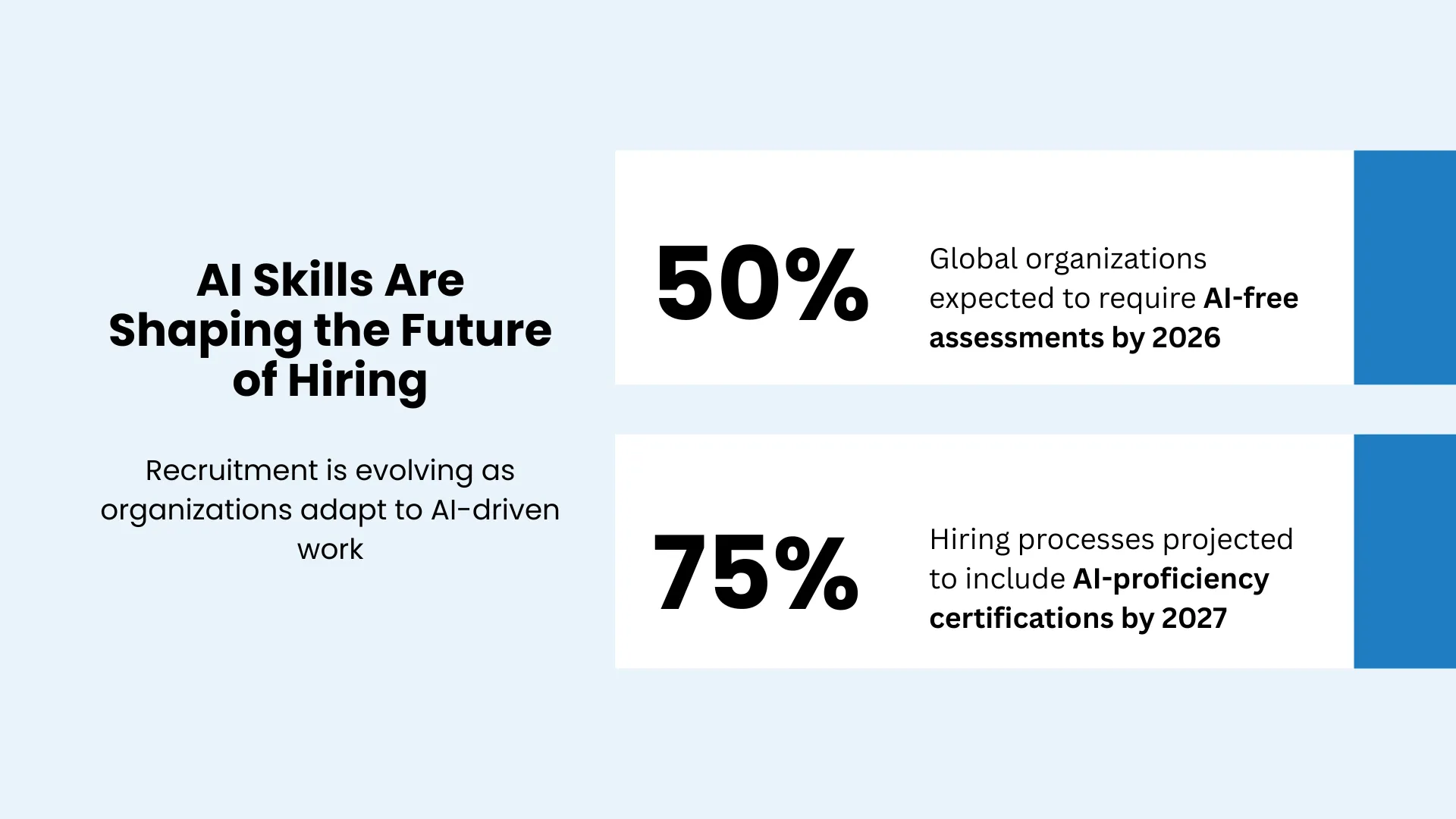
"The central hiring question is shifting. Not 'How well does this candidate present?' But 'What can this candidate prove?'"
WHAT HR LEADERS SHOULD DO
- Move skills validation upstream. Waiting until late-stage interviews to verify capability is too slow and too costly. Assessments embedded before human review improve signal quality and reduce wasted time on both sides.
- Build a verified candidate database. As credential inflation continues, organizations with structured records of assessed, verified talent will have a compounding advantage in speed and quality of hire.
- Design screening for scale. Manual review of AI-polished applications is not a scalable model. Automation with human checkpoints produces better outcomes at lower cost per hire.
HOW MANATAL HELPS
Manatal's AI scoring engine evaluates candidates against role-specific criteria at scale, reducing dependence on resume quality as a proxy for fit and helping teams surface the strongest candidates faster, even in high-volume pipelines.Try it in your own hiring pipeline. Start your Free Trail.
Sources: LinkedIn Talent Insights; Gartner Talent Research 2025; Robert Half Hiring Survey.
TREND 02 | COMPLIANCE & TECHNOLOGY
AI in Hiring: Disclosure Requirements
The era of invisible automation in hiring is legally over. Regulators are now formalizing transparency standards, and HR teams must be ready.
For years, talent acquisition teams relied on automation to manage the volume and complexity of modern hiring. Algorithms ranked resumes. Chatbots screened candidates. In most cases, candidates were never informed. That silence has now become a liability. Regulators have noticed, and a growing number of jurisdictions now require employers to be explicit about when and how AI touches the hiring process.
THE EVIDENCE
Under requirements taking effect January 1, 2026, employers in Ontario, Canada, with 25 or more employees must include a written AI disclosure statement in any publicly advertised job posting if artificial intelligence is used at any stage of hiring.
.webp)
Sources: HRPA, Ontario Pay Transparency & AI Disclosure in Hiring, 2026; Ontario Bill 149, Working for Workers Four Act, 2024.
TREND 03 | HIRING CRITERIA
Skills Replace Degree Requirements
Degree requirements are being removed at scale. The hiring question has shifted from 'What did you study?' to 'What can you do today?'
For decades, degrees and job titles acted as shorthand for capability. That signal is weakening. As AI adoption accelerates and hybrid roles evolve, employers are discovering that formal education does not always reflect current, deployable skills. The pace of change has simply outrun the pace of credentialing. According to PwC, AI-related roles are evolving 66% faster than non-AI roles. In environments where job requirements change annually, four-year credentials struggle to keep pace
THE EVIDENCE
The transition toward a skills-first model is driven by the need to find qualified talent in a high-speed market. Research indicates that 53% of employers have already removed degree requirements for specific roles. This is a strategic response to the fact that by 2030, 60% of new jobs will not typically require a formal degree.
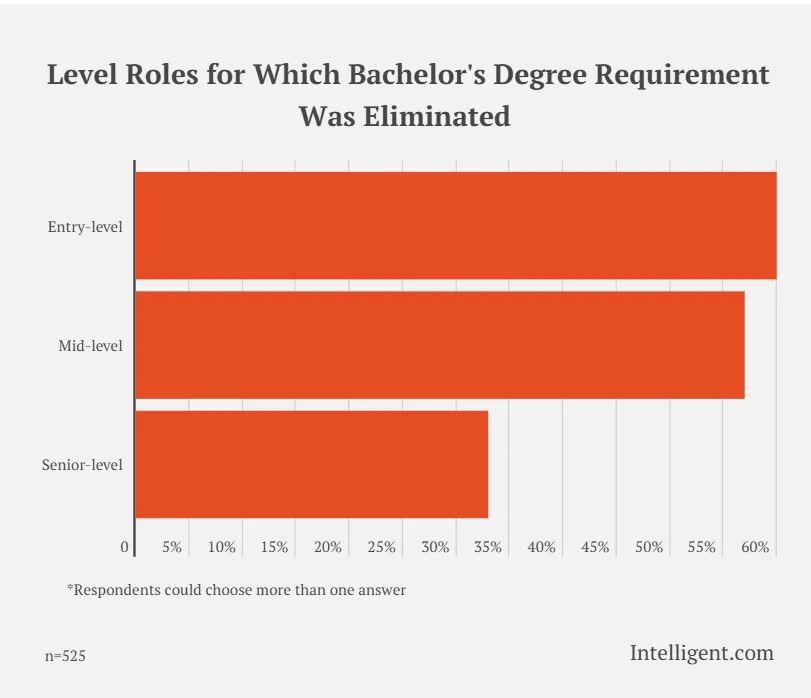
LinkedIn research shows that job postings requiring AI literacy in the United States grew by 70% year-over-year by 2025. This indicates that AI proficiency has become a foundational expectation for modern roles.
When organizations prioritize specific AI competencies over traditional job titles, they experience an 8.2x global expansion in their available talent pool. This demonstrates that a skills-based approach is the most effective way to solve the AI talent shortage.
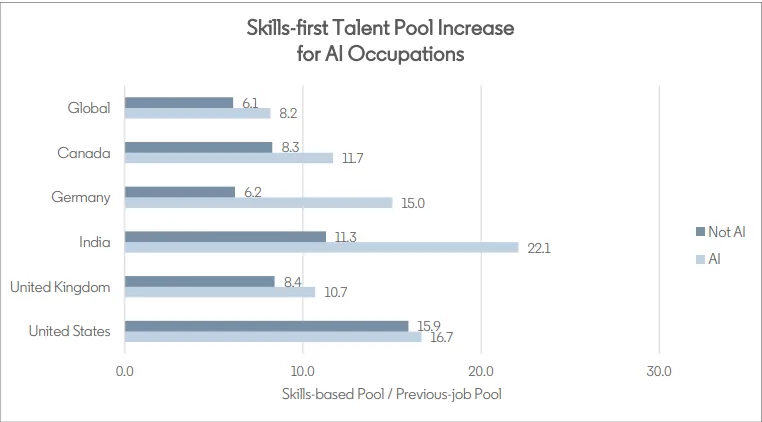
WHAT HR LEADERS SHOULD DO
- Remove non-predictive degree filters. For most roles, a degree signals completion, not competence. Removing the filter on even a subset of roles immediately expands the accessible talent pool.
- Use structured competency assessments. Competency-based evaluations give hiring managers a more reliable signal of job readiness than academic background.
- Invest in targeted upskilling. The organizations building the most capable workforces map skill gaps to individual roles and close them with measurable interventions
HOW MANATAL HELPS
Manatal's platform gives HR teams full visibility into how AI-assisted scoring and ranking works: teams can disclose its use accurately and configure it in ways that align with both regulatory requirements and internal hiring standards.Try it in your own hiring pipeline. Start your Free Trail.
Sources: PwC Workforce Pulse Survey, June 2025; Intelligent.com, College Degree Requirements Survey, 2025; TalentoHC, Skills-Based Hiring Guide, 2025; LinkedIn Economic Graph, Skills-Based Hiring Report, March 2025; LinkedIn Economic Graph, Building a Future of Work That Works, January 2026.
TREND 04 | TALENT MOBILITY
Internal Mobility Drives Retention Strategy
Workers are not leaving. Employers are not cutting. And the roles that do get filled are increasingly going to people already on the payroll.
After years of mass exits and an overheated hiring market, the labor market has entered a new phase: quieter, slower, and more internal. Three reinforcing forces are reshaping how organizations build their teams, and together they are pushing talent strategy away from external sourcing and toward internal deployment.
- The Big Stay: Employees are choosing stability over mobility as the risk of leaving a secure role no longer feels worth the reward. This results in fewer applications and intensifying competition for a shrinking pool of active candidates.
- Labor Hoarding: After the post-pandemic scramble to rehire, organizations now retain staff even during slowdowns. This reflects a deliberate shift toward treating headcount as a strategic asset rather than a variable cost.
- Quiet Hiring: This is the natural response to both trends. Rather than posting externally, organizations fill skill gaps by redeploying existing employees through stretch assignments and cross-training. This is no longer a workaround; it is now a standard practice.
THE EVIDENCE
This environment is defined by a mutual desire for stability between the employer and the employee. LinkedIn reports that the U.S. quits rate has settled near 2%, while layoffs hover at a historic low of roughly 1%.

61% of new roles at Fortune 500 companies were filled internally in 2025. 83% of those same organizations now have formal internal mobility programs in place. The trend is clear and accelerating: the talent market has moved behind the firewall.
.webp)
That internal shift is happening against a broader backdrop of slowing job growth overall. The chart below shows U.S. monthly job growth against the estimated breakeven rate, the minimum growth needed just to keep the labor market steady. The gap between the two explains why external hiring has become harder to justify and why internal deployment has moved from a workaround to a core strategy.
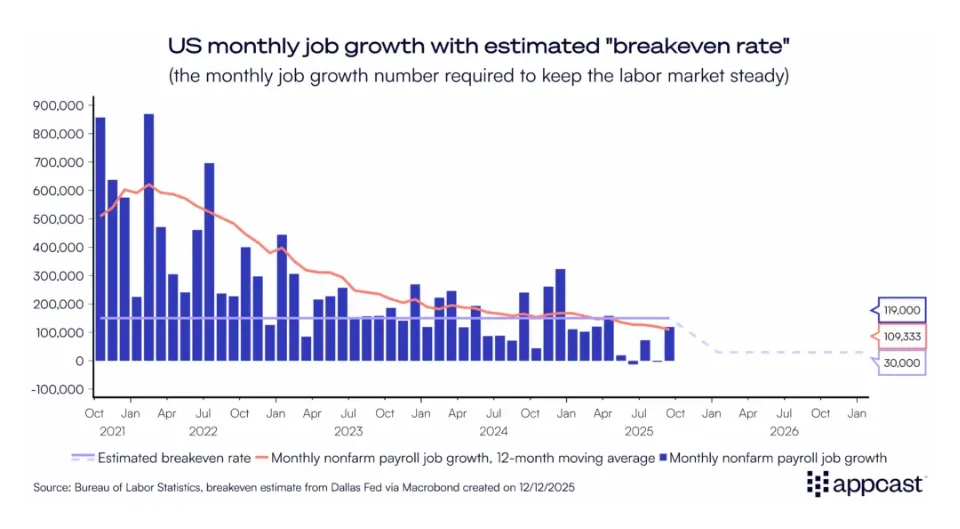
“The strategic question has changed. It is no longer 'How do we hire more?' It is ‘How do we deploy better?’”
WHAT HR LEADERS SHOULD DO
- Build an internal skills inventory. Organizations without a live map of internal capabilities are making redeployment decisions blind. You cannot move talent you cannot see.
- Formalize internal mobility processes. The organizations filling the most roles internally have clear nomination, matching, and transition workflows.
- Treat disengagement as a retention risk. In a low-churn market, employees who stay but disengage are the real danger. Stretch assignments and regular talent reviews are essential retention tools.
HOW MANATAL HELPS
Manatal's pipeline and candidate management tools give teams a unified view of internal and external talent: this makes it faster to match skills to open roles.Try it in your own hiring pipeline. Start your Free Trail.
Sources: Indeed Hiring Lab, JOLTS Report, January 2026; Recruitonomics, "How Much Longer Can the Great Stay Last?", 2025; The Daily Hire, Internal Mobility Programs Report, 2025.
TREND 05 | AI & WORKFORCE CAPABILITY
AI Fluency: New Hiring Baseline
Demand for workers with AI fluency has grown from 1 million to 7 million in two years. Most workforces are not close to ready.
The bottleneck to business value is no longer technology; it is the workforce's ability to direct it. We have entered the era of agentic AI: systems capable of planning and executing multi-step goals without constant human oversight. Yet only 39% of organizations report enterprise-level impact from their AI investments because of a lack of scaled AI literacy. And the gap is widening faster than most workforce plans account for.
THE EVIDENCE
According to McKinsey Global Institute, the number of workers in roles explicitly requiring AI fluency rose from approximately 1 million in 2023 to 7 million in 2025, a sevenfold increase in just two years. This growth spans both STEM and non-STEM roles, covering everything from using AI tools in daily workflows to managing human-agent teams. The chart below shows where that demand is concentrating and how fast each category is growing.
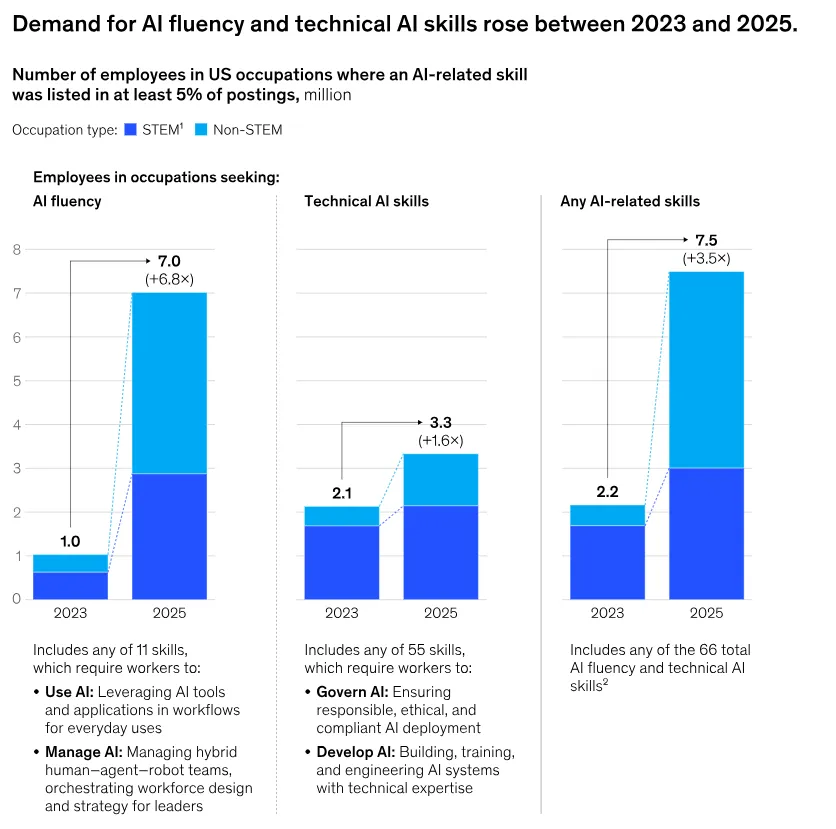
LinkedIn's Economic Graph shows that U.S. job postings requiring AI literacy grew 70% year over year, while time spent on AI learning courses surged 92%. The economic cost of falling behind is significant: McKinsey estimates that organizations closing the AI fluency gap stand to unlock $2.9 trillion in annual economic value by 2030.
Critically, 60% of that $2.9 trillion sits not in back-office functions but in core, sector-specific work. The charts below show exactly where the dividing line between human and machine is being drawn, and which side of it your workforce currently sits on.
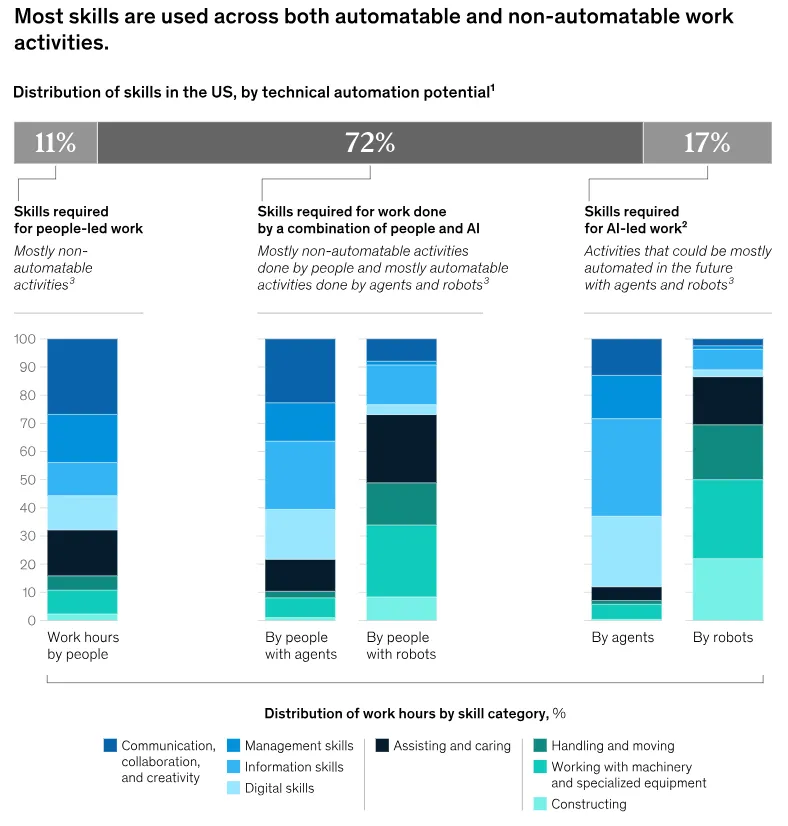
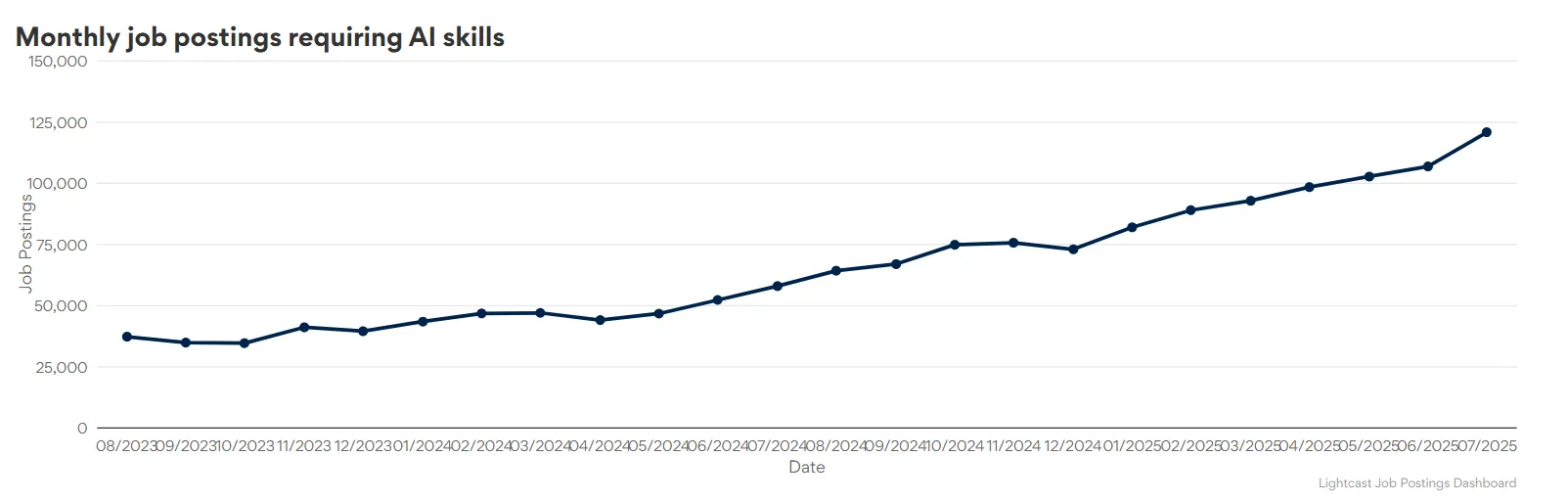
That redistribution is showing up directly in hiring. The line graph below tracks monthly job postings requiring AI skills from 2023 to 2025, and the trajectory is consistent: demand has climbed steadily with no sign of leveling off.
WHAT HR LEADERS SHOULD DO
- Audit AI fluency gaps by function. The deficit is rarely uniform, hence, knowing where your organization's gaps are widest allows targeted investment rather than blanket training that moves no one fast enough.
- Redesign job profiles around human-AI collaboration. Role descriptions built for pre-AI workflows are misaligned with how work actually gets done. Updating them improves candidate quality and gives hiring managers a clearer brief.
- Make AI fluency a continuous L&D investment, not a module. The capability is evolving too fast for point-in-time training. Organizations need ongoing development tied to real business workflows and measurable performance outcomes.
HOW MANATAL HELPS
Manatal's AI-powered candidate scoring and matching helps teams prioritize candidates with emerging technical skills and reduces manual screening.Try it in your own hiring pipeline. Start your Free Trail.
Sources: McKinsey Global Institute, "Agents, Robots, and Us: Skill Partnerships in the Age of AI," 2025; McKinsey, "The State of AI," 2025; LinkedIn Economic Graph, Building a Future of Work That Works, January 2026; Lightcast, Job Postings Data (Lightcast Job Postings Dashboard), 2023–2025.
TREND 06 | RETENTION & WORK MODEL
Hybrid Work Defines Modern Employment
The most expensive workforce decision a company can make right now is not a bad hire. It is a rigid return-to-office mandate.
Hybrid work has completed its transition from pandemic-era accommodation to permanent, non-negotiable baseline. What began as a crisis-driven experiment has normalized into an expectation that cuts across seniority levels, functions, and industries. The shift is no longer about where people work. It is about who holds the power in the employment relationship.
Flexibility and autonomy have begun to outrank marginal salary increases as drivers of job satisfaction and retention decisions. In a labor market where churn has slowed but disengagement has not, employees are staying put, but not unconditionally. The condition, increasingly, is hybrid.
THE EVIDENCE
Gallup's 2025 hybrid work data shows that among remote-capable employees, 51% currently work hybrid, and six in ten say hybrid is what they want. But preference is only part of the story. The more telling signal is what happens when flexibility is taken away.
.webp)
Gallup also finds that employee engagement has fallen to a 10-year low, with the sharpest declines among workers subject to rigid on-site mandates. Hybrid work has emerged as one of the few scalable retention levers that does not increase fixed costs. The cost of offering flexibility is low; the cost of withdrawing it is not.
"Organizations that treated return-to-office as a cultural reset are discovering it functions more like a talent drain."
WHAT HR LEADERS SHOULD DO
- Formalize hybrid policy before the next RTO conversation forces it. Informal arrangements managed at manager discretion create inconsistency and equity risk. A documented, role-based policy is a far stronger foundation than verbal agreements and precedent.
- Map attrition risk against work model data. Most organizations do not yet know whether their highest-risk departures correlate with RTO pressure. Connecting turnover data to work arrangement data reveals where the real exposure sits.
- Reframe flexibility as a cost efficiency, not a concession. The salary premium required to replace an employee who leaves over a rigid RTO mandate is quantifiable. Making that case in financial terms and not cultural ones, lands more effectively with CFOs and boards.
HOW MANATAL HELPS
Manatal's reporting and analytics help leaders track hiring activity by role type and location: this provides the data to make the business case for flexible work.Try it in your own hiring pipeline. Start your Free Trail.
Sources: Gallup Hybrid Work Indicator, Q2 2025; Owl Labs State of Hybrid Work, 2025.
TREND 07 | SKILLS & COMPENSATION
Green Skills Command Hiring Premium
Candidates with green skills are being hired at nearly 50% above the workforce average. This is not a sustainability story; it is a talent market story.
Green skills are no longer confined to sustainability roles. Across industries, candidates with capabilities in areas like carbon accounting, ESG reporting, and sustainable supply chain management are consistently outperforming peers in hiring outcomes. Employers are using these skills as a proxy for systems thinking, regulatory literacy, and long-term adaptability; qualities in short supply in a market defined by selectivity.
THE EVIDENCE
Green hiring has grown across every industry between 2021 and 2025, including sectors where sustainability was historically an afterthought. The chart below shows the compound annual growth rate in green hires by industry, and the spread makes clear this is no longer a niche movement.
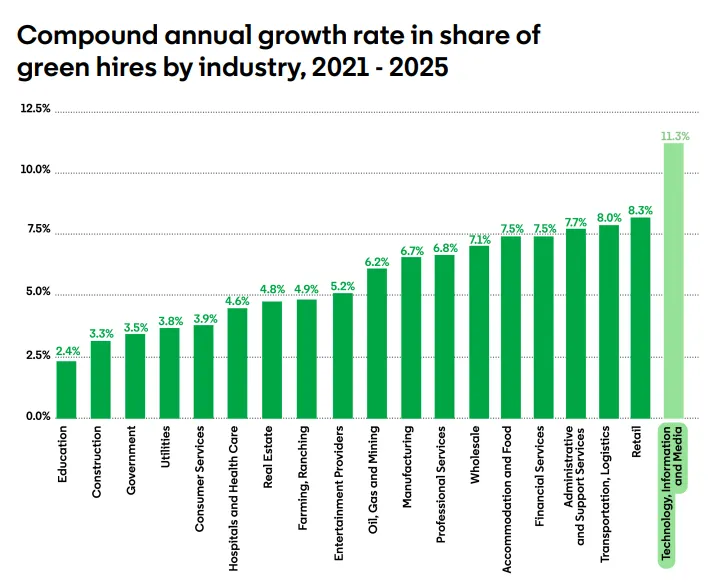
The hiring premium for green-skilled workers reflects just how scarce this talent has become. Globally, they are being hired at a rate 46.6% higher than the broader workforce average, and in high-growth markets like India that figure approaches 60%.
%20(1).webp)
WHAT HR LEADERS SHOULD DO
- Update compensation for green skills. Legacy salary bands will systematically underprice green-capable employees where retention risk quietly accumulates.
- Prioritize internal green skill development. Building these capabilities from within reduces wage pressure and improves pipeline depth.
- Make EVP substantive on sustainability. Green-skilled candidates evaluate employers on whether sustainability is genuinely embedded in operations
HOW MANATAL HELPS
Manatal's skills-based filtering and candidate tagging allows recruiting teams to actively source and track candidates with green capabilities: this builds pipelines ahead of demand.Try it in your own hiring pipeline. Start your Free Trail.
Source: LinkedIn Workforce Insights. Global hiring rate analysis for green-skilled professionals versus overall workforce averages.
TREND 08 | WORKFORCE ARCHITECTURE
Contracting Moves From Stopgap Strategy
Contract roles are outperforming full-time postings in a declining market. For a growing number of employers, contingent labor is no longer a fallback; it is the model.
Contract work has moved from a short-term gap filler to a deliberate part of workforce architecture. Driven by persistent cost pressures and economic uncertainty, organizations are increasingly utilizing contingent labor as a primary strategy for agility.
This shift is mirrored by the talent pool; professionals are now moving from one contract role to another within the same industry rather than seeking permanent placement. As contract terms grow longer, the traditional distinction between temporary and permanent staff is blurring. This represents a workforce that has reorganized around a new employment norm where specialized skills are deployed on a project-to-project basis.
THE EVIDENCE
Contract work is growing even as overall hiring slows. LinkedIn data shows contract job postings continued a steady climb through 2025, increasing 7% even as permanent hiring volumes declined. The chart below puts that in context, showing how contract postings have moved in the opposite direction to full-time and part-time roles year over year.
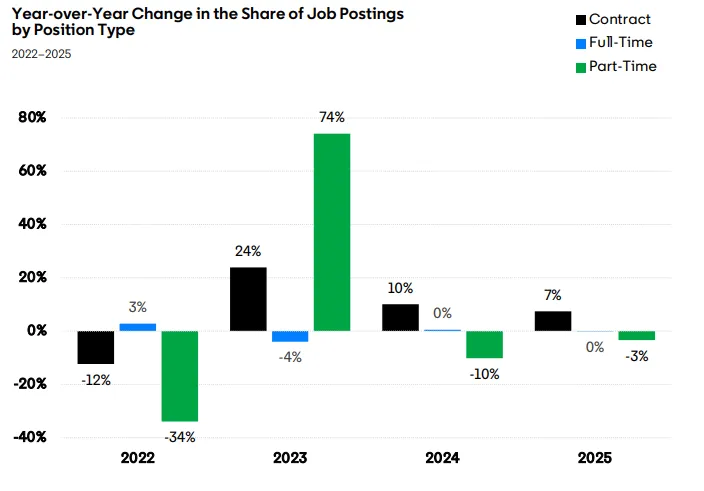
The permanence of this shift becomes even clearer when you look at what happens after a contract ends. The contract-to-permanent conversion rate has fallen to approximately 14% by late 2025, down from 56% in 2016. Workers are not using contract roles as a stepping stone to permanent employment anymore. They are moving from one contract to the next, within the same industry. The chart below shows how sharply that pattern has accelerated post-pandemic across every major sector.
WHAT HR LEADERS SHOULD DO
- Integrate contractors into headcount planning. Treating contingent labor as a separate, reactive workforce produces gaps in visibility and capability planning. Strategic workforce architecture requires a unified view of all labor types.
- Apply sourcing rigor to contractors. Specialized contract workers are highly selective. They require structured pipelines, clear expectations, and a streamlined onboarding process to ensure immediate productivity.
- Redesign engagement for longer relationships. As contract tenures grow, standard communication, integration, and recognition become critical retention variables. Treating long-term contractors as outsiders creates cultural friction and talent risk.
HOW MANATAL HELPS
Manatal supports both permanent and contract hiring workflows in a single platform: this gives teams a unified pipeline view across employment types and ensures that the same data-driven rigor is applied to every hire.Try it in your own hiring pipeline. Start your Free Trail.
Source: LinkedIn Economic Graph & American Staffing Association, State of Staffing & Search, February 2026.
- https://www.gartner.com/en/newsroom/press-releases/2025-07-31-gartner-survey-shows-just-26-percent-of-job-applicants-trust-ai-will-fairly-evaluate-them
- https://press.roberthalf.ca/2025-06-18-Hiring-Headaches-94-per-Cent-of-Managers-Say-Hiring-Time-Has-Increased,-and-Nearly-a-Quarter-Have-Made-Costly-Hiring-Mistakes-in-the-past-Two-Years
- https://www.gartner.com/en/newsroom/press-releases/2025-10-21-gartner-unveils-top-predictions-for-it-organizations-and-users-in-2026-and-beyond
- https://www.hrpa.ca/hr-insights/ontario-pay-transparency-2026/
- https://www.pwchk.com/en/press-room/press-releases/pr-130625.html#:~:text=While the picture on productivity,up from 25%25 last year
- https://www.intelligent.com/34-of-companies-eliminated-college-degree-requirements/
- https://talentohc.com/skills-based-hiring-a-2025-guide-to-hiring-for-potential/#:~:text=Degrees don't always reflect,leading this trend across industries.
- https://economicgraph.linkedin.com/content/dam/me/economicgraph/en-us/PDF/skills-based-hiring-march-2025.pdf
- https://sustainabilitymag.com/news/demand-for-green-skills-is-outstripping-supply-twice-over
- https://www.hiringlab.org/2026/01/07/november-2025-jolts-report-musical-chairs-but-the-music-has-stopped/
- https://recruitonomics.substack.com/p/how-much-longer-can-the-great-stay?utm_source=publication-search
- https://www.trainingjournal.com/2026/content-type/opinion/the-hr-ld-trends-that-will-define-2026/
- https://www.hr.com/en/resources/free_research_white_papers/talent-mobility-programs-2025_mbkjnda4.html
- https://www.mckinsey.com/mgi/our-research/agents-robots-and-us-skill-partnerships-in-the-age-of-ai
- https://www.mckinsey.com/capabilities/quantumblack/our-insights/the-state-of-ai
- https://sustainabilitymag.com/news/demand-for-green-skills-is-outstripping-supply-twice-over
- https://www.edx.org/resources/demand-for-ai-skills
- https://owllabs.com/state-of-hybrid-work/2025
- https://economicgraph.linkedin.com/content/dam/me/economicgraph/en-us/PDF/linkedin-global-green-skills-report-v07.pdf
- https://economicgraph.linkedin.com/content/dam/me/economicgraph/en-us/PDF/asa-linkedIn-state-of-staffing-report-jan-2026.pdf
.webp)






.webp)

.webp)


.webp)


