


Traditional human resource strategies often overlook how artificial intelligence fundamentally changes team structures. This lack of preparation creates a major risk because a new tier of "AI-native" companies is pulling ahead, generating six times the revenue growth of competitors by aligning AI with actual business strategy. Our latest Manatal HR Trends report shows you how these leading firms use AI to expand workforce capacity by 30%, increase junior-level productivity, and successfully shift talent into strategic roles.
Key Highlight From The Report
The AI Headcount Expansion
Gartner forecasts show AI investment drives workforce growth of up to 30% in specific business units. This growth occurs because organizations build new capabilities. This shift represents a redistribution of talent toward complex, high-value activities. Organizations restructure to accommodate this expansion.

Market Adoption and Redefined Roles
Gallup surveyed 23,717 U.S. employees, comparing AI-adopting firms with non-adopting firms. The former expands faster; specifically, 34% of AI adopters report employee growth, while only 28% of companies without AI report similar growth. This shows that job creation outpaces displacement across the market.
In addition to headcount growth, companies change internal role definitions. According to the SHRM State of AI in HR 2026 report, businesses shift focus to maximize human potential. Data shows clear reinvestment trends:
- 57% of organizations increase upskilling opportunities
- 24% of organizations create entirely new roles.
This trend indicates a disciplined migration of talent as professionals focus on strategic execution.

AI Raises the Capability Floor
AI provides a high-performance baseline that eliminates proficiency gaps between novice and elite workers. A study by Harvard Business School and Boston Consulting Group monitored 758 consultants. Top-tier consultants achieved a 17% productivity gain with generative AI. The bottom half of performers improved their productivity by 43%. This intervention narrowed the performance gap to its thinnest margin in history.
Automated access to institutional knowledge eliminates baseline proficiency gaps by 12%. Gallup adoption data shows that half of all U.S. employees now use AI tools in their daily work routines.

The Shifting Hiring Landscape
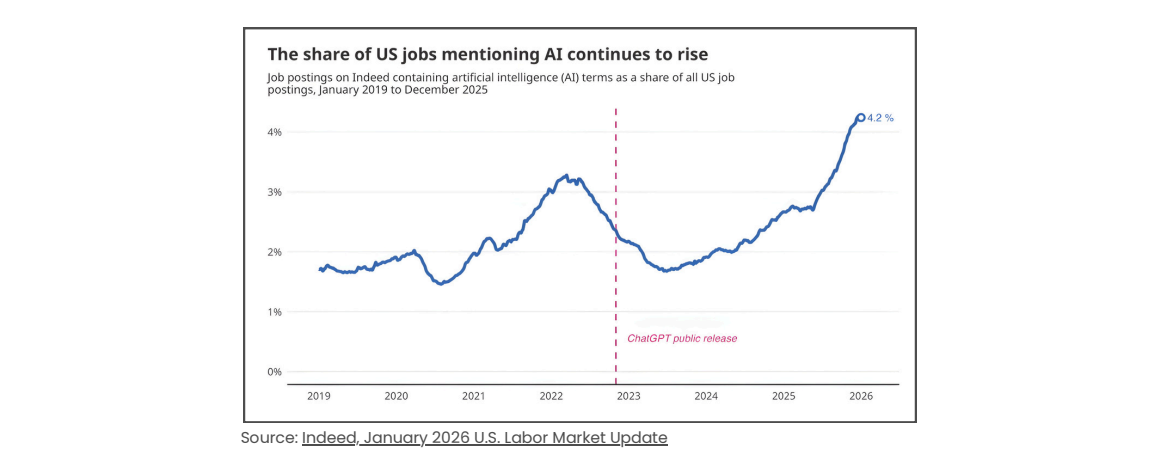
While AI-driven sectors experience rapid growth, the broader job market shows signs of tightening. Industry data reveals that net hiring intent has dropped by 4%, reflecting increasingly selective hiring practices across many organizations. Consequently, overall hiring rates have fallen to a five-year low of 3.1% as labor growth splits sharply between different economic sectors.
Insights For Workforce Leaders
- Model Headcount on Ambition: Base future hiring needs on specific strategic goals rather than technology hype. Determine if the organization needs to defend existing productivity or upend the market.
- Transition to Strategic Governance: Establish cross-functional oversight to guide AI adoption. Target upskilling initiatives toward business units positioned for headcount expansion.
- Designate High-Value Work Zones: Identify areas where automation handles routine execution. Redefine those specific roles to prioritize strategic and relational responsibilities.
- Navigate the Tightening Labor Market: Prepare for selective hiring environments as overall hiring rates dip to a five-year low of 3.1%. Focus your hiring budget tightly on specialized, high-growth AI roles rather than general headcount expansion.
Wrap-Up
These four shifts reveal a clear division in the modern workplace. While overall hiring rates hit a five-year low of 3.1% and net hiring intent dropped by 4%, companies adopting AI are unlocking a 43% boost in junior productivity and up to 30% workforce growth. To stay competitive during this transition, you must align your talent strategy with these changing baselines. Download the complete Manatal Monthly HR Trends Report to access the full datasets and adapt your hiring process today.
.webp)






.webp)

.webp)


.webp)


