





Turnover metrics are vanity projects unless you use them to fix your bottom line. Most HR departments treat the turnover calculation as a year-end chore for the board deck. They get the math wrong. They ignore seasonal volatility. They fail to realize that a 20% turnover rate is actually a 20% tax on their operating budget. This guide covers the specific formulas you need, including the rolling 12-month calculation that most HR teams still get wrong, as well as industry benchmarks and the one retention lever most companies ignore: hiring better people in the first place.
What is Employee Turnover?
Employee turnover measures the rate at which employees leave your workforce and are replaced. You need to track two categories separately:
- Voluntary turnover: Resignations. The employee chose to leave. This is the number that should terrify you because it usually signals compensation gaps, poor management, or cultural rot.
- Involuntary turnover: Layoffs, terminations, performance-based exits. You initiated the separation. Some involuntary turnover is healthy; you want to shed poor performers. Some HR analysts suggest sustained involuntary turnover above 5% may indicate hiring or management issues, depending on industry context. [1]
The Core Turnover Calculation Formula
The Standard Monthly Turnover Calculation
You cannot calculate turnover based on a single point in time. You must define a specific window. Most companies use a monthly or annual cadence. The formula is simple. Divide your total number of departures by your average headcount. Multiply by 100 to get the percentage.
To find your average headcount, add your employee count from day one of the month to the count on the final day. Divide that by two. Do not use your peak headcount or your starting headcount alone. This skews the data.
Step-by-step example:
Company A starts January with 95 employees. By month's end, they have 105 employees. During January, 7 people left (5 resigned, 2 were terminated).
- Calculate average number of employee: (95 + 105) / 2 = 100
- Count total separations: 7
- Apply formula: (7 / 100) × 100 = 7% monthly turnover
Annual Turnover Calculation
Sum all separations across 12 months, then divide by the average headcount across those 12 months.
If Company A had 84 total separations across the year and maintained an average headcount of 100 employees:
(84 / 100) × 100 = 84% annual turnover
That's a death spiral. You replaced nearly your entire workforce in one year.
Rolling 12-Month Turnover Calculation
Monthly snapshots are deceptive. One bad manager or a single round of layoffs can make a healthy company look like a sinking ship. Smart operators use the Rolling 12-Month (R12) calculation to smooth out these spikes.
This metric tracks data from the last 12 months and is updated monthly. It provides a moving average that reflects long-term trends rather than seasonal noise.
- Sum the total separations from the last 12 months.
- Calculate the average headcount for each of those 12 months.
- Divide the total separations by the average of those 12 averages.
The True Cost of Turnover
Your turnover rate is a financial metric. It represents the "Cost of Vacancy." When an employee leaves, you lose more than a body. You lose tribal knowledge. You pay for job board postings. You waste senior leadership time on interviews.
Industry data suggests replacing a mid-level manager costs 150% of their annual salary. [2] If you have 100 employees and a 15% turnover rate, you are losing 15 people a year. At an average salary of $80,000, churn costs your business $1.8 million annually. View your turnover rate as an indirect impact on your EBITDA.
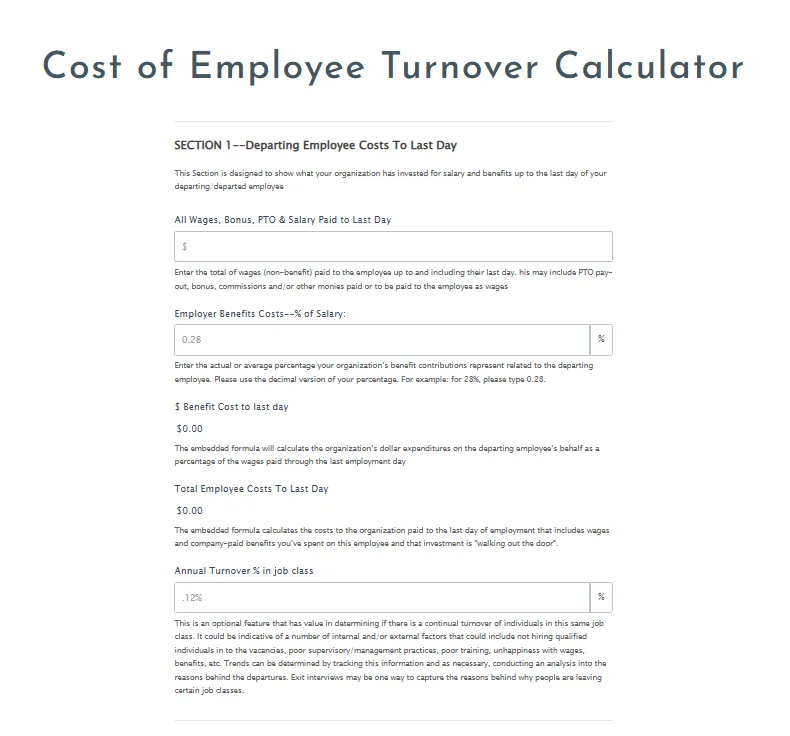
You can use a turnover cost calculator to get a complete picture of the costs that are incurred when an employee departs.
Why Traditional Screening Cannot Keep Pace
Most hiring managers fall back on resumes because they have no better way to quickly compare candidates. Manatal's AI Recommendation Engine reads your job description, automatically extracts the required skills, and ranks every candidate in your database against those criteria in seconds. Every recommendation includes a requirement-level breakdown showing exactly where a candidate fits or misses the mark. You control the weighting, so five years of management experience matters more than a degree.

{{cta}}
Interpreting Your Results: What is a Good Turnover Rate?
According to Gallup, a turnover rate of less than 10% is considered healthy [3], regardless of industry. The U.S. Bureau of Labor Statistics reports a 3.3% national average across all sectors. This figure shifts when you filter by specific industries or analyze targeted monthly separation metrics. Benchmarking your performance against these granular subcategories is the only way to determine whether your retention strategy is failing.
2026 Average Turnover Rate by Industry (US Bureau of Labor Statistics):
Your goal isn't zero turnover. You want to shed the bottom performers (in many forced-ranking systems, the bottom 5–10% may be managed out). What kills companies is regrettable turnover: high performers leaving because you underpaid or overworked them or because you put an incompetent manager above them.
How to Reduce Turnover
Most retention advice focuses on compensation and benefits. Yes, paying people fairly matters. But throwing money at a broken culture just means you're overpaying people to hate their jobs longer. Here are some actions your organization can take to tackle turnover:
- Compensation/Benefits: Benchmark against your local market at the 60th percentile minimum for critical roles. Stock options and equity matter for startups. Health insurance quality matters for families. Match your competitors or expect attrition.
- Career Development: Studies suggest companies with strong internal mobility retain employees nearly 2x longer because ambitious employees see a clear path forward. If your only advancement route requires leaving the company, they will leave.
- Improving Quality of Hire: This is the retention lever most companies ignore. Retention starts before you sign the offer letter.
Better approach:
- Test for job-specific competencies during interviews: Give candidates a real work sample. A "full-stack engineer" who can't debug a simple API integration in 30 minutes will struggle on your team, no matter how impressive their resume looks.
- Screen for long-term potential, not just current qualifications: Someone who's held 5 jobs in 3 years will probably add to your turnover rate within 24 months. Look at career trajectory and stability patterns.
- Match candidates on work-style compatibility: A data analyst who thrives in structured, predictable environments will quit within 6 months at your chaotic startup, where priorities shift weekly. Misalignment of work pace and decision-making structure predicts early exits more reliably than skills gaps.
Conclusion
While turnover reports show you the past, quality of hire predicts your future. If people leave within the first 90 days, the issue is usually the hiring decision, not the workplace. Improving who you hire today directly slashes turnover rates for the next quarter.
Start your 14-day free trial with Manatal to stop calculating losses and start hiring for retention.
Frequently Asked Questions
Q: Does turnover calculation include internal transfers?
A: No. Internal transfers from Department A to Department B don't count as separations. The employee is still on your payroll. Turnover only measures people leaving the company entirely.
Q: How do I calculate turnover for a specific department?
A: Use the same formula, but limit your data set:
Q: What is the difference between attrition and turnover?
A: Attrition typically refers to a natural reduction in headcount without replacement (retirements, resignations, or when you choose not to backfill the role). Turnover assumes you're replacing the departing employee.
Q: Should I include contractors in my math?
A: Exclude 1099 contractors. Their contracts are designed to end. Mixing them with full-time equivalents (FTEs) will artificially inflate your churn rate and mask real cultural issues.
Citation
.webp)








.webp)

.webp)


.webp)


