


Choosing the right Recruitment Management System (RMS) can be a game-changer for your organization, but with so many options available, how do you ensure you make the right choice? From user-friendly interfaces to robust analytics, there are several key features you should look for to maximize your recruitment efficiency. This guide explores what makes a top-notch RMS and how to select one that aligns perfectly with your company's needs and goals.
What is a Recruitment Management System?
A Recruitment Management System (RMS) is software that automates and manages the full hiring process. It streamlines tasks like job postings, applicant tracking, interview scheduling, and onboarding. Leveraging automation, analytics, and AI, an RMS reduces hiring time, improves candidate experience, and enables strategic, data-driven recruitment.
How Does a Recruitment Management System Work?
Modern RMS platforms are cloud-based, centralizing the hiring process. They aggregate job postings across channels and collect applications in a unified database. Upon application, the system parses resumes, extracts key data, and builds searchable profiles. Recruiters track candidates through customizable stages, from screening to offer. Built-in tools support team collaboration, interview scheduling, and consistent communication with applicants. The integrated CRM nurtures talent pools and sustains relationships with promising candidates for future roles.
Key Features of an Effective Recruitment Management System
Applicant Tracking System (ATS) Capabilities
The ATS recruitment system forms the operational backbone of recruitment management. Essential ATS features include:
- Pipeline management with customizable hiring stages that reflect your unique process
- Resume parsing and candidate profiling to automatically extract and organize applicant information
- Collaborative evaluation tools that enable hiring teams to review and rate candidates together
- Automated workflows for routine tasks like acknowledgment emails and status updates
- Advanced search and filtering to identify qualified candidates from large applicant pools quickly
{{cta}}
Recruitment CRM
A recruitment CRM system extends beyond transactional hiring to build long-term relationships with talent. Key CRM capabilities include:
- Talent pool management to organize and segment candidates by skills, experience, and interest
- Engagement tracking that records all interactions with potential candidates
- Automated nurture campaigns to keep passive candidates warm for future opportunities
- Relationship analytics that help identify your most valuable talent sources
.webp)
AI-Powered Automation
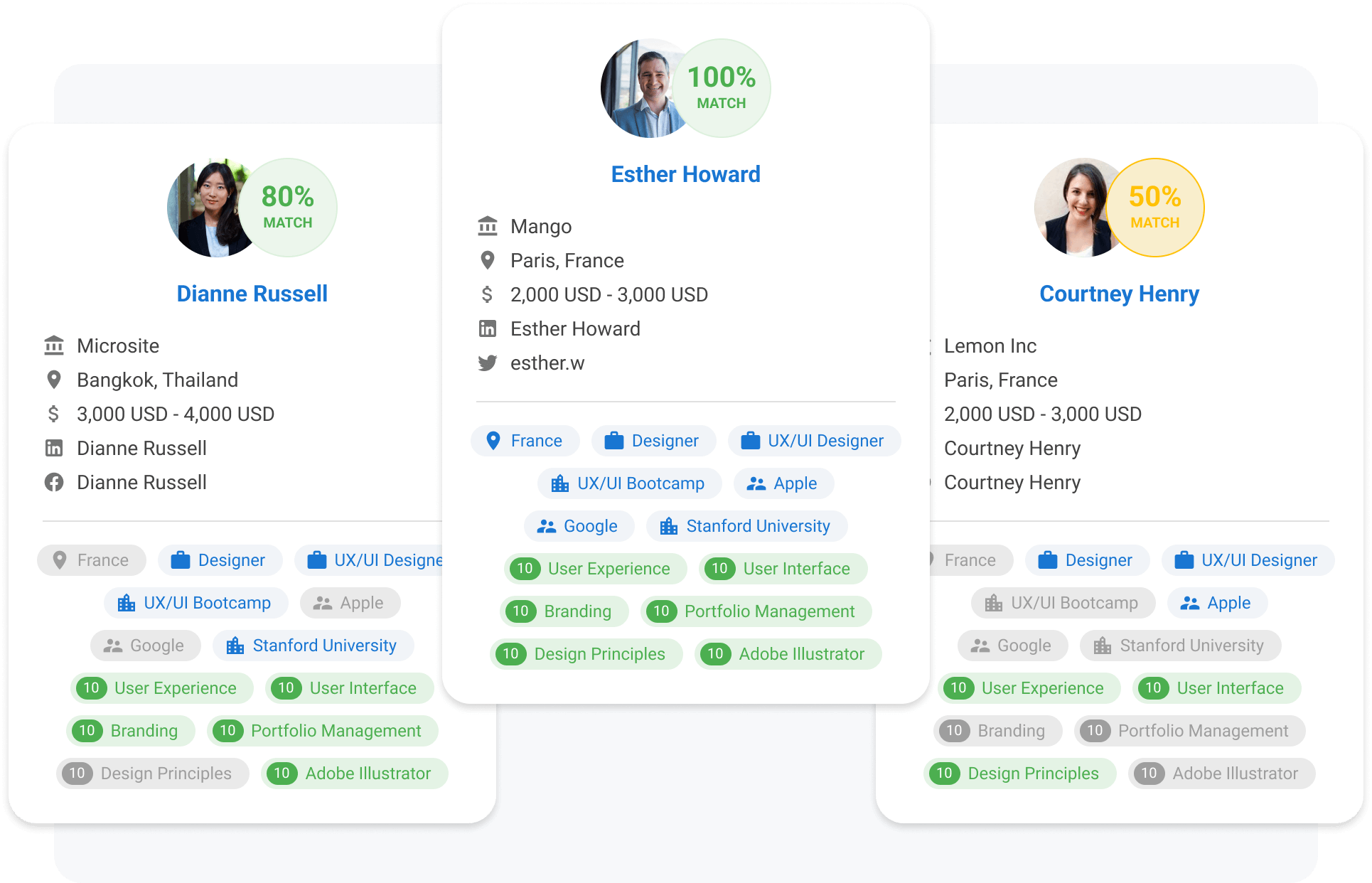
AI has transformed recruitment efficiency. Studies show 86.1% of recruiters report faster hiring processes with AI tools [1], and some organizations reduce timelines by up to 70% via automation [2]. Prioritize systems with:
- Smart matching that ranks candidates by job fit
- Chatbots and screening for initial queries and qualifications
- Predictive analytics for forecasting needs and success likelihood
Compliance and Data Security
As global privacy regulations evolve (e.g., GDPR, CCPA, PDPA), compliance is essential. Seek RMS with:
• Tools for consent management and data rights
• SOC 2 Type II certification for security controls
• Audit trails for data access and processing
• Encrypted storage for candidate information
Manatal's compliance features address these requirements, reducing legal risk while maintaining candidate trust.
Analytics and Reporting
Data-driven recruitment demands robust metrics. Key capabilities include:
• Time-to-hire tracking to spot bottlenecks
• Cost-per-hire calculations for true acquisition expenses ($4,683 global average [3])
• Source metrics to evaluate job boards and channels
• Pipeline analytics for drop-off points
• Diversity reports for equitable practices
.webp)
Benefits of Implementing a Recruitment Management System
Dramatic Time Savings
The most immediate benefit is speed. With automation handling routine tasks like resume screening, interview scheduling, and candidate communications, recruiters can focus on high-value activities like candidate engagement and strategic planning. Organizations leveraging AI-driven recruitment tools have reduced hiring timelines by up to 70%. [2]
Reduced Cost per Hire
While the global average cost-per-hire is approximately $4,683 [3], automated recruitment systems help mitigate these costs by reducing manual labor, improving candidate matching, and reducing reliance on expensive external recruiters.
Improved Candidate Experience
Today's candidates expect responsive, transparent hiring processes. A recruitment system ensures timely communications, provides clear status updates, and creates a professional impression that strengthens your employer brand.
Enhanced Collaboration
When hiring teams work from a shared platform, decision-making becomes faster and more consistent. Stakeholders can review candidates, share feedback, and track progress in real time, regardless of location.
Scalability for Growth
As hiring volume increases, manual processes quickly become unmanageable. Cloud-based recruitment systems scale effortlessly, whether you're hiring 10 or 1,000 people, without proportional increases in recruitment headcount.
Better Hiring Decisions
With comprehensive candidate profiles, structured evaluation frameworks, and historical hiring data at your fingertips, you can make more informed, objective hiring decisions that improve the quality of hire.
Choosing a Recruitment Management System: Key Criteria
Define Your Hiring Priorities
Start by understanding your organization's specific needs:
- High-volume hiring? Prioritize automation and bulk processing capabilities
- Strategic talent acquisition? Focus on analytics and talent intelligence features
- Agency or RPO? Look for robust CRM functionality to manage client and candidate relationships
Evaluate Ease of Use
The most feature-rich system fails if your team won't use it. Prioritize:
- Intuitive interfaces that require minimal training
- Mobile accessibility for recruiters working remotely or at events
- Customizable workflows that match your existing processes
- Quality customer support and implementation assistance
Assess Integration Capabilities
Your recruitment system should connect seamlessly with existing HR technology:
- HRIS/HCM systems for employee data transfer
- Job boards and social media platforms for job distribution
- Assessment tools for skills testing and evaluation
- Background check services for pre-employment screening
- Calendar applications for interview scheduling
Audit Candidate Experience and Compliance Risk
Map your current data collection and communication flows to identify potential regulatory exposure. Ensure your chosen system provides:
- Candidate-friendly application processes across devices
- Transparent data usage and privacy policies
- Automated consent management
- Data retention and deletion capabilities
Consider Total Cost of Ownership
Look beyond the subscription price to understand:
- Implementation and onboarding costs
- Training requirements and associated time investment
- Integration expenses with existing systems
- Potential costs for additional users or features as you scale
Review Market Position and Stability
The ATS market is growing at an estimated 8.3% CAGR [4], reflecting strong ROI for adopters. Choose a vendor with:
- Proven track record and customer base
- Regular product updates and innovation
- Financial stability ensures long-term support
- Industry recognition and positive user reviews
Best Recruitment Management System List
Based on aggregated reviews, the top RMS are as follows:
Actionable Steps for Implementation
1. Define Your Hiring Priorities
Evaluate whether your organization needs automation for volume roles, analytics for talent intelligence, or CRM capabilities if you're agency-oriented. Use industry benchmarks to assess where you stand relative to peers in your sector.
2. Audit Candidate Experience and Compliance Risk
Map your data collection and communication flows to identify potential GDPR, CCPA, or PDPA exposure. This audit will reveal gaps your new system must address.
3. Pilot with a Scalable, Cloud-Based System
Run a trial period with an RMS that supports bulk upload, mass emailing, and pipeline customization. Test the system on a real hiring campaign to measure tangible time savings and process improvements.
4. Measure ROI with Metrics
Track before versus after implementation: time-to-hire, cost per hire, candidate drop-off rates, and interaction volumes. Use benchmark statistics, such as the average cost-per-hire of $4,683 and time-to-hire of 36 days, as your baselines for improvement.
Conclusion
A recruitment management system is essential for streamlining hiring and improving outcomes. Unlike an ATS, which primarily manages applications, an RMS handles the entire recruitment lifecycle, from job posting to onboarding. Organizations can transform their hiring process into a more strategic, efficient, and candidate-friendly operation by prioritizing usability, scalability, and data security. Platforms like Manatal demonstrate how a well-designed RMS can enhance recruitment without overwhelming teams with unnecessary complexity.
Frequently Asked Questions
Q: Is an RMS suitable for small businesses?
A: Yes. Even small businesses can benefit from an RMS by automating repetitive tasks, improving candidate communication, and strengthening their employer brand. Scalable solutions allow companies to start small and expand as needed.
Q: How can I ensure a smooth transition to an RMS?
A: Assess needs, engage stakeholders, and follow a structured onboarding with training and open dialogue for adoption.
Q: What are the main benefits of using an RMS?
A: An RMS increases efficiency through automation, enhances decision-making with analytics, improves candidate experience, and centralizes data, allowing recruiters to focus on strategic tasks.
Q: What is the cost of implementing an RMS?
A: Costs vary by size and features; subscriptions provide flexibility, while enterprise options require upfront investment. Assess the budget and needs first.
Q: How does an RMS help source passive candidates?
A: RMS integrates with LinkedIn/job boards for sourcing; AI analytics target skills to convert passives to actives.
Citations:
.png)


.webp)

.webp)

.webp)


.png)


