


Hiring a marketer is particularly challenging when you lack a marketing background, don't know which type of marketer you need, and lack the expertise to evaluate their work. When you hire a marketer for the first time, you face two decisions that determine whether this hire moves the business or just burns payroll: first, what type of marketer matches the stage and goals of your company, and second, which engagement model (full-time, freelance, fractional, or agency) fits your budget and workload. This guide walks through both decisions, gives you verified cost benchmarks, and leaves you with a repeatable hiring workflow.
What Kind of Marketer Do You Need?
Before you look to hire marketer talent, most early-stage companies should start with a generalist. A strong generalist, often a product marketer or growth marketer who is excellent in one discipline and capable across others, can own positioning, run a few acquisition channels, and ship campaigns without backup. Narrow specialists make sense later, when a single channel is big enough to justify a dedicated hire.
If you do need a specialist, here are the main tracks:
- Growth/performance marketer: Owns paid acquisition (Meta, Google, LinkedIn ads), SEO, and SEM. Delivers qualified traffic and measurable CAC.[1]
- Product marketer: Owns positioning, messaging, launches, and competitive intelligence. Delivers go-to-market playbooks and sales collateral.[2]
- Content/brand marketer: Owns editorial calendar, thought leadership, and brand voice. Delivers blog posts, whitepapers, and brand guidelines.[3]
- Demand generation marketer: Owns pipeline creation through webinars, events, and gated content. Delivers MQLs and SQLs to sales.[4]
- Lifecycle/email marketer: Owns onboarding sequences, retention campaigns, and churn prevention. Delivers engagement and retention metrics.[5]
Seniority matters as much as specialty when you hire marketer candidates. A first marketer or junior marketer executes a known playbook and needs direction. A marketing manager can build and run small programs with limited oversight. A head of marketing or CMO sets strategy, builds the team, and reports to the CEO. If you need someone to build the function, hire for strategy. If you already know the plays, hire for execution.
In-House vs. Freelance vs. Fractional vs. Agency
This is a decision, not a menu. Choose based on how ongoing the work is, how embedded the person needs to be, and what you can spend.
- Full-time in-house: Best for ongoing, company-critical work that requires deep context. Expect a salaried commitment and full employer costs. The trade-off is high fixed overhead.[6]
- Freelancer: Best for a single channel or project (e.g., launch a paid ads program, write a content pillar). Hourly or project-based. The trade-off is limited bandwidth and no strategic ownership.[7]
- Fractional CMO/head of marketing: Best for senior strategy when you need leadership a few days per month but cannot justify a full-time executive salary. Retainer-based. The trade-off is that execution still falls to someone else.[8]
- Agency: Best for multi-channel execution at scale or when you need to move fast without hiring. Monthly retainer, often with a percentage-of-spend model for paid media. The trade-off is cost; agency fees can climb quickly.[6] For a breakdown of agency fee structures, see our guide to recruitment fees, which covers similar retainer and success-fee logic.
Flexible and independent professional work is now mainstream. According to MBO Partners' 2025 State of Independence report, about 11.5 million US independent professional service providers now work with businesses, up 55% since 2020.[9] Fractional marketing leadership fits squarely in this trend.
What It Costs to Hire Marketer Talent
- Freelance Marketer: According to market pricing studies from Bootstrap Creative and benchmark reports on Clutch, pricing could be $50–$150/hour for project work or a single-channel focus.[10][11]
- Agency Retainer: As per Clutch's SEO Pricing Guide, Column Five Media, and industry cost breakdowns from HawkSEM, the range is about $1,500–$10,000/month for SMBs, or $100–$149/hour for specialty services to enable multi-channel execution and speed.[11][12][13]
- Fractional CMO: Based on market compensation analyses from Fractionus and O-CMO, the cost is about $8,000–$22,000/month for 2–3 days/week for senior strategy without a full-time executive budget.[14][15]
- Full-Time Junior Marketer (US): According to May 2024 data for Market Research Analysts from the U.S. Bureau of Labor Statistics, the median base salary is $76,950/year, making it a strong option when looking to hire marketer candidates for entry-level execution.[16]
- Full-Time Marketing Manager (US): Based on official May 2024 occupational wage estimates from the U.S. Bureau of Labor Statistics, the median base salary is $161,030/year (with a 10th–90th percentile range of $81,900–$239,200), best for full program ownership.[17]
Note: BLS figures are base salary only. Total compensation with bonuses or equity runs higher. CMO salary is not published by BLS; third-party salary guides peg it higher than marketing manager ranges.
Getting this hire right matters. According to SHRM, replacing an employee can cost 50% to 200% of their annual salary, depending on seniority.[18] A wrong marketing hire at a six-figure salary is a six-figure mistake.
Where to Find and Hire Marketer Candidates
Start with your own network. Ask founders, advisors, or investors for referrals. A warm introduction to a marketer who has already worked at a similar stage or industry shortens the evaluation cycle.
If referrals do not surface enough candidates, expand to:
- LinkedIn and marketing job boards: Broad reach, but expect high volume and variable quality.
- Vetted marketplaces: Platforms like MarketerHire or Toptal pre-screen candidates. Useful if you lack time to filter a large applicant pool yourself.
Good marketers evaluate companies as much as companies evaluate them. A founder with no public careers presence is at a disadvantage. Manatal's Branded Career Pages let you stand up a professional, on-brand careers site without code. You can use a custom domain, tailor application forms, and tell your company story, so marketing candidates see a polished employer before they even apply. Every application flows directly into your Manatal pipeline.
{{cta}}
Implementation: A Step-by-Step Hiring Workflow
This step-by-step framework guides your process whenever you hire marketer talent, taking you from a vague idea to a signed offer with clear 90-day expectations. Each step includes a checkpoint so you stay in control of the decision.
- Write the outcome first: Define the one or two results this marketer owns in 90 days. Examples: "Launch paid acquisition on Meta and hit $X CAC" or "Publish 12 SEO articles and reach Y organic sessions." Turn these into a one-page scorecard before you write the job description. This is a human decision; do not delegate it to a template.
- Draft the job description: List the channels they will own, the tools they will use, and the seniority level. If you are unsure how to phrase a marketing JD, generate a first draft using AI or a template, then have one outside marketer sanity-check it before posting.
- Choose your engagement model: Revisit the decision framework above. If the work is ongoing and strategic, lean full-time or fractional. If it is project-scoped, lean toward freelance or agency.
- Source candidates: Post to one broad job board (LinkedIn or Indeed) plus one specialized route, such as a marketing job board or a vetted marketplace like MarketerHire or Toptal. Capture every applicant in a single pipeline using Manatal so nothing slips through.
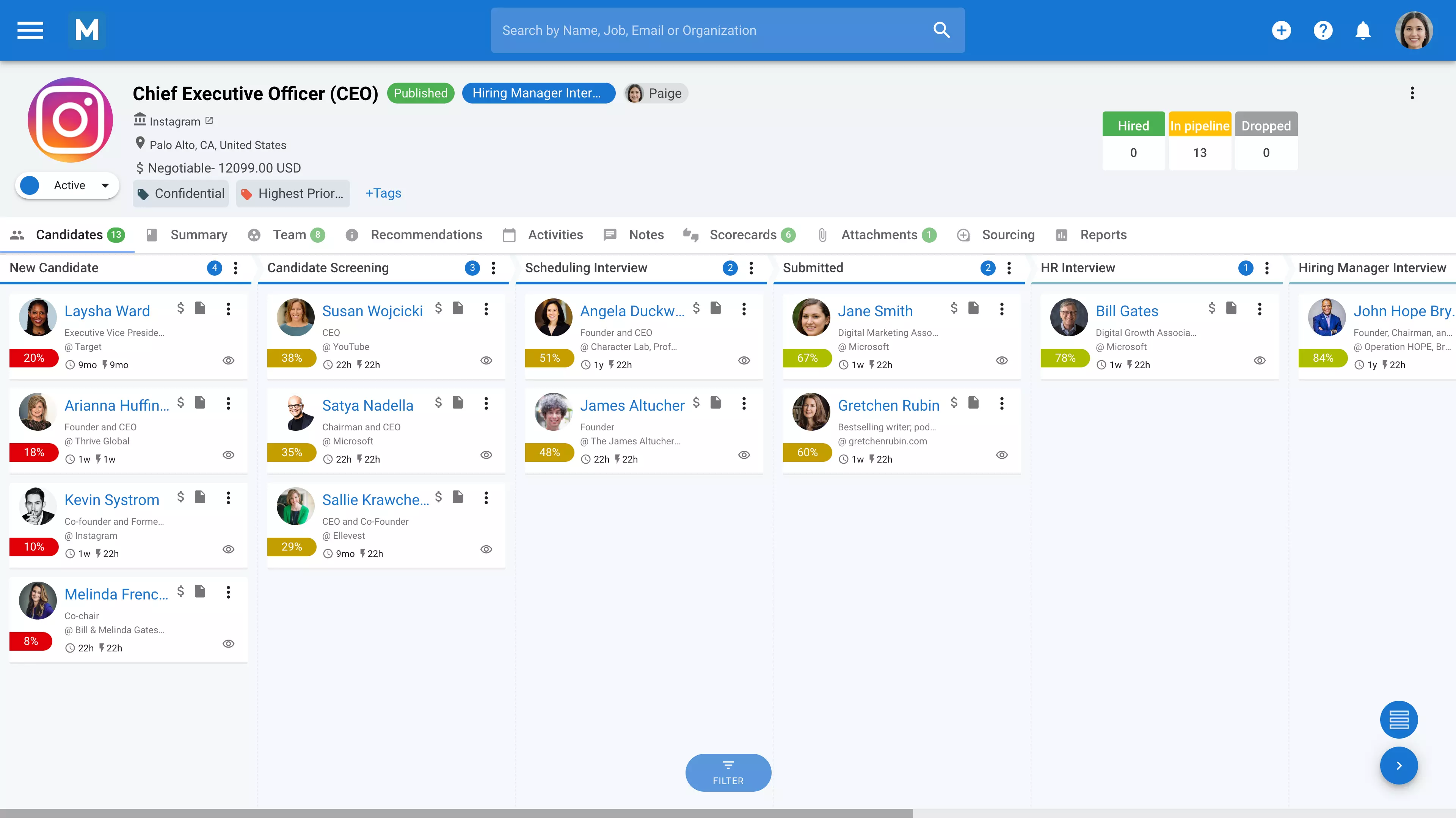
5. Screen against the scorecard. Reject based on the two defined outcomes, not gut feel. Rank candidates on how closely their past work maps to your specific goals.
6. Run one work sample. Ask finalists to complete a paid mini-project or join a 60-minute working session on your real problem (e.g., "audit our current funnel and outline your first 30 days"). This is a human evaluation checkpoint; you or a trusted advisor must review the output.
7. Reference-check the specific outcome. Call references and ask about the exact result the candidate claims to have driven. "They were great to work with" is not useful. "They grew paid acquisition from $X to $Y CAC" is.
8. Make the offer. Set 30/60/90 expectations tied directly to the scorecard you built in step one. Both sides should know exactly what success looks like.
How to Evaluate a Marketer When You Are Not a Marketer
Without marketing experience, you cannot judge portfolios on craft. Instead, judge candidates on process and outcomes.
- Define success up front: Before any interview, write down the one or two outcomes the hire owns in 90 days. Use this as your scorecard. Every question you ask should map back to whether the candidate can deliver those outcomes.
- Review their portfolio for reasoning: Ask the candidate to walk you through one project. A strong marketer explains why a campaign worked and cites specific metrics. A weak one shows polished assets but cannot explain the strategy or results.
- Run a paid work sample: A 60-minute working session or a short paid project tied to your real problem reveals how candidates think. Ask them to critique your current funnel and outline their first 30 days. Pay for their time; serious candidates expect it.
- Ask metrics-literacy questions: Example: "Walk me through a campaign you ran, the metric you were trying to move, and how you measured success." Vague, unmeasurable answers (e.g., "we increased brand awareness") are a red flag. Specific answers (e.g., "we drove 1,200 signups at $18 CAC by testing three ad variants") indicate someone who owns outcomes.
- Bring in one outside marketer: If you have zero internal marketing context, pay a marketing advisor or fractional CMO for a single screening conversation with your top candidate. One hour of outside expertise is cheaper than a bad hire.
Conclusion
Hiring the right marketer comes down to matching their specialization and engagement model directly to your immediate stage, budget, and 90-day growth targets. Defining measurable outcomes before interviewing, testing the process through structured work samples, and grounding compensation in market benchmarks removes guesswork from the process. This approach protects your budget from costly mis-hires and ensures your first marketing role drives accountable growth.
Frequently Asked Questions
Q: What kind of marketer should I hire first?
A: Most early-stage companies should hire a generalist, often a product or growth marketer, who can own positioning and run one or two acquisition channels. Narrow specialists make sense only after you have enough volume in a single channel to justify dedicated headcount.
Q: Is hiring a marketing agency worth it?
A: Agencies are worth it when you need multi-channel execution at speed or when you lack in-house capacity. They are not worth it if you need deep strategic ownership or if the monthly retainer exceeds what you would pay a strong full-time hire. Evaluate agencies on whether they can show measurable outcomes, not just activity reports.
Q: How do I evaluate a marketer if I do not know marketing?
A: Define the 90-day outcome before you interview anyone. Score candidates against that outcome, not against portfolio aesthetics. Run a paid work sample on your real problem, and ask candidates to walk through a past campaign with specific metrics. If you still feel unqualified to judge, bring in one outside marketer for a single screening call.
Q: What is a fractional CMO, and when should I hire one?
A: A fractional CMO is a senior marketing executive who works with your company part-time, usually a few days per month. Hire one when you need strategic direction and cannot afford a full-time executive. Fractional CMOs typically cost $8,000 to $22,000 per month on retainer for roughly two to three days per week of involvement.
Q: Where can I find marketers to hire?
A: Start with referrals from your network. Expand to LinkedIn, marketing job boards, and vetted marketplaces like MarketerHire or Toptal if referrals do not produce enough candidates. Capture every applicant in a single pipeline using an ATS like Manatal so you can screen efficiently.
Citations