





Going independent offers recruiters full control over client relationships and an uncapped direct line between effort and income. However, autonomy requires owning business development, delivery, and back-office admin without a safety net. With the global recruiting services market projected to reach roughly $690 billion in 2026, there is substantial opportunity for an independent recruiter who can carve out a niche and execute.[1] This guide covers how to launch and run a solo practice, from business setup and client acquisition to pipeline management and the essential tech stack.
Independent vs Agency vs In-House Recruitment
Understanding the tradeoffs helps clarify whether going independent is right for you.
- Agency recruiter: You work as an employee for a staffing firm. The agency supplies clients, brand recognition, tools, and training. In return, you split your commissions and follow the agency's processes and targets.
- In-house recruiter: You are an employee of a single company, filling roles for that employer only. Salary is stable but earnings are fixed, and you have limited exposure to different industries or client types.
- Independent recruiter: You run your own business. You keep your full fee (minus operating costs) and choose which clients and roles to take. The tradeoff is that you start with no guaranteed income, no shared candidate pipeline, and no brand equity. Client acquisition, delivery, and admin all fall on you.
Go independent if you have existing industry relationships, a clear niche you can speak to credibly, and comfort with variable income.
How to Become an Independent Recruiter
Follow these steps to set up a legitimate recruiting business and land your first clients.
1. Choose your niche
Specialize in a function or industry you already know. If you spent years recruiting software engineers, stay in tech. If you came from healthcare staffing, lean into that vertical.
Niche expertise lets you judge candidate fit faster, speak credibly to hiring managers, and tap existing networks. A simple gut-check: can you name 20 companies hiring in your niche right now? If not, sharpen the focus.
Recommended Resources for Market Research:
- Crunchbase / PitchBook: Track recent funding rounds. A company that just raised a Series A or B will almost always use that capital to hire quickly.
- Wellfound (formerly AngelList): Great for spotting emerging startups and niche hiring trends in the tech space.
- Industry Newsletters: Subscribe to niche-specific publications (e.g., Healthcare Dive for medical, TLDR for tech) to understand market shifts and spot who is expanding.
2. Register your business
Most independent recruiters operate as a sole proprietorship or single-member LLC. An LLC provides liability protection and can offer tax advantages, but always consult a local accountant or attorney for your jurisdiction.
In the US, you will need an Employer Identification Number (EIN) from the IRS. Open a dedicated business bank account immediately to keep personal and business finances separate.
Recommended Tools for Setup:
- Incorporation Services: Stripe Atlas, Clerky, or LegalZoom can help you form an LLC and get your EIN in days without navigating complex state websites.
- Modern Business Banking: Novo, Relay, or Mercury offer fee-free business checking accounts designed for digital entrepreneurs, with easy integrations into accounting software.
3. Set your fee model
Decide between contingency and retained models:
- Contingency: You are paid only when a candidate is hired. Standard rates sit between 15% and 25% of the candidate's first-year salary, with 20% being a common midpoint; industry fee benchmarks place most permanent contingency placements in this band.[2] For more on fee structures, see our guide to recruitment fees.
- Retained: The client pays a portion upfront (often one-third), with the balance due at defined milestones or on placement. Retained searches typically involve exclusive engagements and senior-level roles.
Draft a fee agreement that states your percentage, payment terms (e.g., net 15, net 30), and guarantee window (typically 30 to 90 days of replacement coverage if the hire leaves).
Recommended Tools for Agreements:
- Contract Generators: Use PandaDoc, DocuSign, or Dropbox Sign to send professional, legally binding fee agreements that clients can e-sign from their phones.
4. Set up your tech stack
A solo recruiter needs to manage both a commercial pipeline (leads and clients) and a candidate pipeline, ideally without juggling multiple disconnected tools.
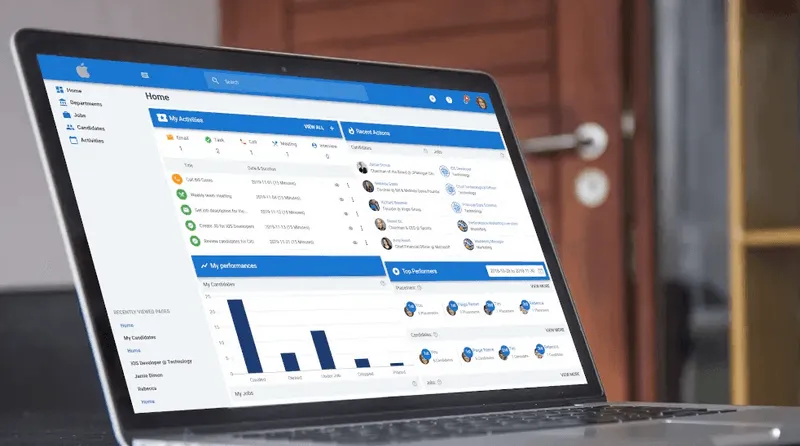
Start with an all-in-one desk that runs both pipelines. Manatal combines applicant tracking and a recruitment CRM in one platform. The CRM is purpose-built for agencies and independents: it includes a customizable sales pipeline to track client leads and deals, contact and company management, LinkedIn sourcing via the People-Match AI Chrome extension, verified email and phone discovery for contacts, a client Guest Portal for collaboration, and placement and revenue tracking. It is fully integrated with the ATS and included in every Manatal plan at no extra cost, which is vital when you are managing overhead as a solo operator.
Recommended Tools for Prospecting, Admin, and Sourcing:
- Sourcing: LinkedIn Sales Navigator (for finding hiring managers) and LinkedIn Recruiter Lite (for passive candidates).
- Contact Data: ContactOut, Lusha, or Hunter.io to find verified personal emails and phone numbers for outreach.
- Outreach Automation: QuickMail or Lemlist to run structured cold-email campaigns without manual follow-ups slipping through the cracks.
- Scheduling: Calendly or Chili Piper to eliminate the back-and-forth when booking client calls and candidate interviews.
- Finance & Admin: QuickBooks, Xero, or Wise Business to handle invoicing, expense tracking, and cross-border payments.
5. Build your target client list and start outreach
Identify hiring managers at companies with active job openings in your niche. Use LinkedIn job postings, company career pages, and specialized job boards to spot who is hiring.
Your first outreach should lead with value. Reference a specific role and offer a relevant "MPC" (Most Placeable Candidate) profile or a quick talent snapshot instead of a generic introduction. Hiring managers respond to specificity, not boilerplate pitches. Qualify the opportunity before sourcing: confirm the budget, timeline, and decision-making process. Get a signed fee agreement before you start working the role.
Recommended Tools for Client Lead Generation:
- B2B Data Providers: Apollo.io or ZoomInfo to pull lists of hiring managers (VP of Engineering, Director of Sales, etc.) at your target companies.
- Job Board Aggregators: Set up alerts on Indeed or Google for Jobs for specific job titles in your niche so you know exactly when a new search opens up.
6. Source and shortlist
Run Boolean searches on LinkedIn to uncover hidden talent. Screen candidates strictly against the role's must-have requirements. Present a tight shortlist of two to four highly qualified candidates rather than flooding the client with mediocre options.
Recommended Tools for Advanced Sourcing:
- AI Sourcing Platforms: HireEZ or SeekOut can help you find diverse talent across the open web (beyond LinkedIn).
- Boolean Generators: Use RecruitEm (free) to instantly generate complex X-Ray search strings to search LinkedIn, GitHub, or StackOverflow via Google.
- Niche Networks: Don't just stick to LinkedIn. Source on GitHub (for developers), Behance/Dribbble (for designers), or Kaggle (for data scientists).
7. Manage candidates to placement
Coordinate interviews, gather feedback, and guide the offer process. Track all activity in your CRM so nothing slips.
Once the offer is accepted, monitor the guarantee window. If the candidate stays, follow up at the end of that period and ask for a referral to the client's next open role. Referrals are how solo recruiters build a sustainable book of business.
Recommended Tools for Closing & Compliance:
- Background Checks: If your client requires it, use an API-driven tool like Checkr for fast, compliant background checks.
- Reference Checking: Platforms like SkillSurvey or Zinc automate the reference-checking process, saving you hours of phone calls while generating comprehensive reports for your clients.
{{cta}}
Fee Structures and Earnings Potential for Independent Recruiters
Pricing depends on your model and market.
Contingency fees typically sit between 15% and 25% of the candidate's first-year salary, with 20% a common benchmark. On a $100,000 role at 20%, that is a $20,000 placement fee.
Retained fees are billed in installments across the search rather than only on placement, commonly one-third at engagement, one-third at shortlist, and one-third when the hire starts. Retained engagements are usually exclusive and reserved for senior or hard-to-fill roles.
Include a guarantee clause. Most contingency agreements offer a 30- to 90-day replacement guarantee. If the hire leaves within that window, you source a replacement at no additional fee or refund a portion.
Earnings illustration
What you earn depends on how many placements you close and at what fee level. Here is a rough illustration, not a guarantee:
- 5 placements per year at 20% on $100,000 roles = $100,000 gross
- 10 placements per year at 20% on $100,000 roles = $200,000 gross
Subtract operating costs (software, LinkedIn subscriptions, marketing, taxes, insurance) and non-billable time spent on business development. Most independent recruiters do not place every month, especially in year one, so budget accordingly.
How to Get Clients as an Independent Recruiter
Acquiring clients requires defining your unique value proposition and targeting key decision-makers who fit your niche. Independent recruiters can build a pipeline by running targeted Boolean searches on LinkedIn, executing structured outreach cadences, and managing prospects inside a dedicated ATS and CRM. For a deeper breakdown on building outreach strategies and managing key lead data, read our complete guide on how to get clients for recruitment agency.
Managing Clients and Candidates as a Solo Operator
Running two pipelines at once is the core operational challenge for independent recruiters.
- Commercial pipeline: Track every client lead, starting at first contact and ending at repeat business. Log notes, set follow-up reminders, and record deal values. A recruitment CRM (like the one built into Manatal) handles this natively, with pipeline stages tailored to recruiting rather than generic sales.
- Candidate pipeline: For each active role, manage sourcing, screening, interview coordination, offer negotiation, and onboarding. Keep candidate records linked to the client and job so you can report status clearly. An applicant tracking system makes this manageable at scale.
Use one system for both pipelines. Switching between a generic CRM for clients and a separate ATS for candidates creates data silos and manual work. A unified platform keeps everything in context.
Conclusion
Becoming an independent recruiter means owning every part of your business: sales, delivery, and operations. The upside is full control over your income and client relationships. The tradeoff is that you carry all the risk and wear all the hats.
Success depends on choosing a niche you can credibly serve, setting up a real business structure, pricing your services correctly, and treating client acquisition as an ongoing discipline rather than a one-time task. Run both your commercial and candidate pipelines in a single system so nothing slips.
If you are ready to go independent, start your free trial of Manatal to manage clients, candidates, and placements in one platform.
Frequently Asked Questions
Q: How do you become an independent recruiter with no experience?
A: Start by working at a staffing agency or in an in-house recruiting role first. You need to learn how to source, screen, and close candidates before you can do it independently. Once you have a track record and some industry relationships, the transition is smoother. Follow the step-by-step setup above to formalize your business.
Q: How much do independent recruiters make?
A: Earnings depend on placement volume and fee size. An independent recruiter closing ten placements per year at 20% on $100,000 roles would gross around $200,000 before expenses. First-year independents often close fewer deals while building their client base. Tools with automated AI candidate recommendations and profile enrichment can help solo recruiters speed up candidate screening and close deals faster.
Q: What qualifications or certifications do you need?
A: There are no legal requirements to become an independent recruiter. Industry certifications like AIRS Certified Recruiter or SHRM-CP can add credibility but are not mandatory. What matters more is niche expertise, a track record of successful placements, and a reliable tech stack, such as Manatal’s all-in-one ATS and CRM, to run a professional operation.
Q: How much should an independent recruiter charge?
A: Contingency fees typically sit between 15% and 25% of first-year salary, with 20% a common benchmark. Retained searches are billed in installments across the search rather than as a single fee on placement. Set your rate based on the seniority of roles you fill, the difficulty of the search, and market norms in your niche. Managing these custom deal structures and potential payouts is easy to track using Manatal’s built-in Recruitment CRM.
Q: Do independent recruiters work on contingency or retainer?
A: Both. Contingency is more common for mid-level roles: you are paid only if your candidate is hired. Retained is typical for executive or confidential searches: the client pays a portion upfront in exchange for dedicated focus. Some independents offer both models depending on the engagement, tracking both contract types smoothly through customized sales stages in Manatal.
Q: How do independent recruiters find their first clients?
A: Start with your existing network. Former colleagues, past hiring managers, and industry contacts are the fastest path to your first signed agreement. After that, targeted LinkedIn outreach to hiring managers with active job openings converts well. You can log all client interactions, schedule follow-ups, and convert leads into active roles using Manatal’s commercial CRM and email integration.
Citations
.webp)







.webp)

.webp)


.webp)


