





Every recruiter knows the old drill: log into multiple job boards, pay flat fees for 30-day slots, and pray for candidates. That “post-and-pray” approach wastes budget on unfocused exposure. Programmatic job ads address this by leveraging automated bidding and targeting to buy ads in real time, placing each impression where it will deliver the best result.[1][2] In practice, a programmatic system analyzes candidate behavior, platform performance, and converts ad spend into candidates efficiently.
What Are Programmatic Job Ads?
Think of programmatic job advertising as the "Stock Exchange of Recruiting." Instead of you manually picking a site and paying for a "Post and Pray" 30-day listing, a software algorithm buys the "stock" (the ad space) in real-time, only when and where it’s most likely to get a result.
To see this in action, let’s look at LinkedIn.
Imagine you need a Senior Java Developer in Seattle. Instead of paying for a 30-day "static" post, you use LinkedIn’s programmatic features.
1. The "Smart" Targeting
You don't just put the ad on a board; you tell LinkedIn's algorithm: "Only show this to people in Seattle who have 'Java' as a skill and at least 5 years of experience."
2. The Automated Bid (Maximum Delivery)
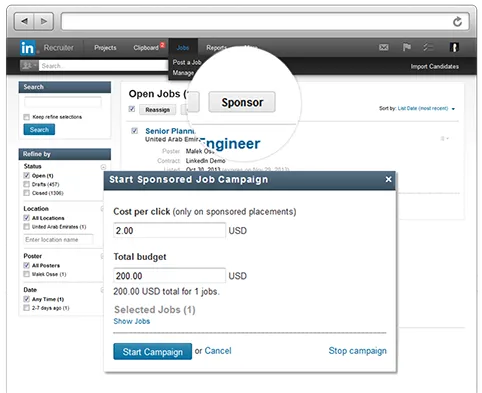
You set a daily budget (e.g., $50/day). LinkedIn then acts as your "automated broker." Every time a qualified developer logs in, LinkedIn enters an auction in milliseconds to show your job ad in their feed or "Jobs You Might Be Interested In" section.
- It bids just enough to win the spot without overspending your $50.
3. Real-Time Pivot
If the algorithm sees that developers are clicking your ad on Tuesday mornings but never on Saturday nights, it will automatically stop bidding on Saturday nights and save your money for Tuesday when it actually works.
4. The Kill-Switch (Budget Caps)
If you get a flood of 20 great applications by Wednesday, and your "Total Budget" was $200, the system sees the limit and instantly turns the ad off. You don't have to remember to "take the ad down" to stop being charged.
On LinkedIn, programmatic ads mean you aren't buying a job post. But you are buying access to a specific professional's attention at the exact moment they are online.
How Programmatic Job Ads Differ from Traditional Postings
Below is a practical comparison of how traditional job posting and programmatic advertising differ in cost structure, execution, and performance control.
- Traditional Posting: Pay a flat fee for each job slot (weekly or monthly) on individual boards. You manually create identical postings on each site and wait for the full term. No automated optimization is involved. Budget is fixed, whether you get 0 or 100 applicants, and ROI is hard to measure.
- Programmatic Ads: Flexible pricing models, most commonly CPC or cost per application, with CPM also used in some setups. You define a daily or total budget and set clear goals, such as pausing a job after a target number of applications. Platforms like Indeed use auction-based delivery and automated optimization to place ads across their networks. Spend is continuously reallocated toward channels that generate better results, improving efficiency as the campaign runs.
Traditional media buying purchases presence. Programmatic purchases probability. Every impression is evaluated against performance goals before money is spent.
The Three Key Benefits for Recruitment Teams
Once the mechanics are clear, the practical upside becomes easier to evaluate. Programmatic advertising changes how recruiting teams spend money, reach candidates, and allocate time. The benefits below are not theoretical. They show up directly in cost control, applicant quality, and day-to-day workload.
- Cost Efficiency (ROI): Programmatic ads dynamically cut waste. You stop paying for boards that produce no applicants. In fact, organizations using programmatic job ads report 20-50% lower cost-per-applicant (CPA) and correspondingly higher ROI.[3] This comes from the ads being automatically pulled from underperforming sources and poured into proven channels. With data-driven bidding, your recruiting budget stretches further.
- Targeting and Reach: Programmatic platforms tap the entire web, such as social media, niche sites, and networks. It’s not just the usual job boards. They use cookies and behavioral signals to reach passive candidates. The result is a higher share of qualified applicants. Studies show that companies relying on AI-driven ad targeting can see significant increases in qualified applicants, such as up to 4x more applications in some cases.[4] In short, programmatic ads find the right talent by targeting the right place at the right time.
Each benefit pairs with measurable control. For example, if a campaign isn’t delivering, the system flags it immediately. You get performance metrics (CTR, CPC, CPA) in one dashboard, rather than juggling spreadsheets for each board. The insights are transparent, so improving ROI becomes a matter of tweaking rules, not just throwing money at static ads.
How Programmatic Campaigns Work with Manatal
While programmatic advertising handles the "upstream" task of finding candidates, Manatal manages the "downstream" workflow of organizing and evaluating them. The platform acts as the central hub where every lead generated by your programmatic ads is captured, screened, and ranked.
The transition from an ad click to a qualified hire follows a seamless, automated path:
- Traffic Generation: Programmatic ads target the right talent across the web and drive them to your career page.
- Centralized Intake: As candidates apply, their data flows automatically into Manatal from all external sources, eliminating manual entry.
- Instant Evaluation: Manatal’s AI Recommendations immediately score and rank applicants based on the specific job requirements you’ve defined.
- Prioritized Review: Recruiters skip the noise and focus their energy exclusively on the highest-fit profiles at the top of the list.
To get the most out of this synergy, it is important to understand how Manatal transforms high-volume traffic into actionable insights:
- Precision Through Definition: The accuracy of candidate ranking depends on the clarity of your job summary. The more detailed your requirements, the more precise the AI scoring becomes.
- Real-Time Dynamic Scoring: Your talent pipeline is never static. As new applicants enter from various programmatic channels, Manatal updates the rankings in real time so you never miss a top-tier lead.
- Transparent Insights: Manatal doesn't just provide a number; it shows recruiters why a candidate ranked a certain way, ensuring that automated efficiency never comes at the cost of human context.
Ultimately, programmatic ads fill your funnel, while Manatal ensures that the funnel doesn’t collapse under its own weight. Together, they turn a broad search into a targeted hire.
{{cta}}
When Programmatic Job Ads Make Sense
Once the workflow is in place, the more important question is whether programmatic is the right lever to pull in the first place. It delivers volume and speed, but only in scenarios where those advantages translate into hiring outcomes. The following cases are where programmatic job ads tend to justify the investment.
- Mass Recruitment: You have dozens (or hundreds) of open roles and high applicant targets (e.g., retail, logistics, customer service). Programmatic caps total spend while flooding the funnel with candidates.
- Hard-to-Fill, Niche Roles: Traditional boards often fail to reach specialized talent. Use programmatic to test channels where those candidates actually spend time. The algorithm will shift the budget to any site delivering niche experts.
- Multi-Client Agencies: Recruiting firms managing budgets across clients will benefit. Programmatic ads automate ad placement for each campaign while letting you enforce ROI rules per client.
These use cases all share one truth: if manual posting wastes money or misses talent, switch to programmatic. It’s best when you need “set it and mostly forget it” ad campaigns with data-driven budgets. Otherwise, you’ll end up budget-chasing on a site that isn’t yielding.
Five Steps to Launch Your First Programmatic Campaign
If programmatic job ads make sense for your hiring goals, execution is what determines whether it delivers efficiency or waste. The mechanics are straightforward, but discipline around budget, tracking, and integration is what keeps campaigns profitable. These five steps provide a structured way to launch without losing control of spend or applicant quality.
- Define Your CPA Goal: Decide the maximum you’re willing to pay per application. For example, set a rule that the campaign should stop when it hits 50 applicants or a $5,000 total spend. Establishing a cost-per-application cap keeps you in control.
- Optimize the Job Description: Make the ad legible and searchable. Use clear titles and keywords relevant to the role (e.g., technical skills or certifications). Post the description on your career page and be sure it’s at least 150 words, so the AI can parse requirements. Remember: a visible, well-written ad gets more clicks.
- Select Your Programmatic Partner: Choose a programmatic recruitment platform (or use Manatal’s advertising module) and link it to your ATS. In Manatal, go to the Integrations or Campaigns section and connect your programmatic ad account. Ensure the job is published on your career site so that application links work.
- Set Your Campaign Rules: Within the platform, create automated rules. For instance: “If a job ad gets fewer than 10 clicks in 72 hours, raise the bid by 20%.” Or “Pause the ad after 30 applications.” Use built-in rule engines to enforce spend targets. Always start with a budget pacing rule and a stop-loss (max spend or applicants) rule.
- Analyze and Adjust: After launch, review performance daily or weekly. Compare which ads are hitting the CPA goal. In Manatal’s analytics (or your ad dashboard), filter by campaign and job to see cost per click and applicant. If an ad underdelivers, tweak the description or the bid. If one channel is outperforming, increase its budget share. Keep refining rules each week.
Following these steps makes your first campaign data-driven. You’ll see how clicks, applications, CPC, and CPA all move in real time. Use those metrics to tighten rules and reuse what works for the next role.
Programmatic Readiness Checklist
Before launching anything, validate that the foundation is solid. Programmatic advertising amplifies both strengths and weaknesses in your hiring process. If your benchmarks, infrastructure, or intake workflow are unclear, increased traffic will expose those gaps quickly. Use this checklist to confirm you are operationally prepared.
If you can check each box, you’re ready. If not, fix the gaps first: allocate a clear budget, track your current metrics, update your career site, and activate your ATS features. Only then will programmatic ads reach their potential.
Conclusion
Programmatic job advertising replaces guesswork with control, but only when it is paired with the right operating model. On its own, it optimizes spend and distribution. Combined with a structured ATS workflow, it turns volume into decisions recruiters can act on. The takeaway is simple: programmatic works when budgets are capped, expectations are clear, and candidate intake is engineered for scale. Teams that treat it as a system, not a shortcut, gain predictable hiring economics. Teams that do not will simply burn money faster.
Frequently Asked Questions
Q: How do programmatic job ads work?
A: Programmatic job ads use software to buy job ad placements automatically instead of locking into fixed job board slots. You set rules such as budget, cost per application, geography, or applicant targets. The system then bids on individual ad impressions in real time and shifts spend toward the channels producing the best results. As performance changes, bids and placements adjust automatically to stay within your cost goals.
Q: What benefits do programmatic job ads offer to employers?
A: Programmatic job ads give employers tighter cost control and broader reach. Instead of paying upfront for exposure, you pay based on clicks or applications and can pause campaigns once targets are met. The system reallocates spend away from underperforming channels and toward sources delivering qualified applicants. The result is better budget efficiency and clearer visibility into cost per click and cost per application.
Q: What platforms or tools are best for creating programmatic job ads?
A: The best platforms allow real-time bidding, performance-based budget allocation, and clear rule setting. You should be able to define cost-per-application targets, cap total spend, automate pause rules, and monitor metrics such as click-through rate, cost per click, and cost per application in one dashboard. Strong platforms also distribute ads beyond traditional job boards to search, social, and niche sites, so reach is not limited to a single channel.
Citations
.webp)







.webp)

.webp)


.webp)


