


Talent acquisition strategies built on previous quarter assumptions will fall short as global hiring momentum fragments and major state-backed capital deployments reshape recruitment priorities. Severe workforce exits, regional currency strains, and shifting industry demands are creating a highly uneven talent market across major economies. To maintain an edge, talent acquisition leaders must immediately realign headcount planning, sourcing channels, and retention budgets with these economic realities.
5 Core Market Shifts
In our Recruitment Trends Report (July), we have identified five major shifts:
- South Korea Tech Expansion: A $576 billion public-private semiconductor investment is building 16 new fabrication facilities, driving global competition for hardware engineers and AI specialists.
- UK Labor Stabilization: The UK unemployment rate holds steady at 4.9% with moderating wage growth, despite persistent post-Brexit trade drags and low overall job vacancies.
- US Hiring Slowdown: US job growth slowed sharply to 57,000 additions in June, with a lower unemployment rate (4.2%) driven primarily by 720,000 workers exiting the labor force.
- Sectoral Disconnects: US employment gains are heavily concentrated in healthcare, professional services, and construction, while leisure, hospitality, and retail experience severe contractions.
- Yen Depreciations & SME Bankruptcies: Prolonged yen weakness triggered 45 SME bankruptcies in Japan during H1 2026, expanding the available pool of skilled talent in the region.
Let's Take a Closer Look
1. South Korea's $576B Tech Expansion

In June 2026, the South Korean government, Samsung Electronics, and SK Hynix committed over $576 billion to expand the nation's semiconductor manufacturing ecosystem. The initiative aims to build 16 new fabrication facilities by 2047, expanding on 21 operational fabs to raise South Korea's global non-memory market share from 3% to 10%.
This capital injection is intensifying global competition for silicon architects, hardware engineers, and AI specialists. As these state-backed projects absorb top engineering talent, external organizations face increased cost-of-vacancy metrics and heightened poaching risks.
- Action Plan: Audit technical talent pipelines, fast-track compensation adjustments, and strengthen retention strategies to protect critical engineering and AI talent.
- How Manatal Helps: Manatal’s AI Candidate Sourcing and Recommendation Engine evaluates actual candidate capabilities and competencies rather than relying strictly on exact job titles, enabling hiring teams to surface qualified talent with valuable transferable skills rapidly.
2. U.K. Labor Market Stabilizes Despite Brexit

Ten years after Brexit, structural trade drags persist. U.K. goods exports to the EU remain 14% below 2019 levels, product export ranges have dropped by 53.8%, and business investment remains 12% to 13% below expected trends. Despite these long-term headwinds, the U.K. labor market shows cautious signs of stabilization: unemployment held at 4.9%, inflation came in below expectations, and moderating wage growth allowed the Bank of England to maintain steady interest rates.
However, job vacancies remain near historic lows outside of pandemic levels, indicating constrained job mobility and cautious hiring behavior.
- Action Plan: Focus recruitment and retention strategies on specialist roles in supply chain, customs, and regulatory compliance, where complex post-Brexit operations keep talent demand consistently high despite broader market lulls.
- How Manatal Helps: Manatal's Sourcing Hub provides instant access to over 700 million candidate profiles, pairing AI-powered skills matching with a centralized database to eliminate regional talent bottlenecks.
3. US Hiring Momentum Losing Steam

The US job market cooled significantly in June 2026, adding just 57,000 nonfarm payroll jobs. Well below the Dow Jones forecast of 115,000 and down sharply from revised gains in April (148,000) and May (129,000). While the headline unemployment rate fell to 4.2%, the drop was not caused by robust job creation. Instead, approximately 720,000 individuals exited the labor force entirely, artificially lowering the rate.
- Action Plan: Adapt talent strategy to address a shrinking active candidate pool by shifting investment toward internal mobility, cross-training, and upskilling existing staff to fill critical roles.
- How Manatal Helps: Manatal combines AI resume parsing, duplicate detection, and automated applicant ranking to help recruitment teams efficiently organize talent pipelines and keep candidate profiles active during slower, selective hiring periods.
4. Hiring Trends by Industry: Winners & Losers

Industry performance in the US diverged sharply in June. Healthcare and social assistance led job creation (+47,000), followed by professional and business services (+36,000) and construction (+11,000, supported by data center expansion). Conversely, consumer-facing sectors experienced deep cuts, with leisure and hospitality losing 61,000 jobs, while retail and information sectors fell by a combined 7,500 jobs.
- Action Plan: Reallocate recruitment resources toward high-growth sectors (healthcare, construction, professional services) while sourcing talent from contracting sectors for roles requiring transferable analytical or service competencies.
- How Manatal Helps: Manatal’s Recruitment CRM centralizes sales pipelines, candidate communication history, and client contacts in a single hub, giving recruitment agencies real-time visibility into high-demand industry sectors.
5. Weak Yen Drives Japanese Bankruptcies
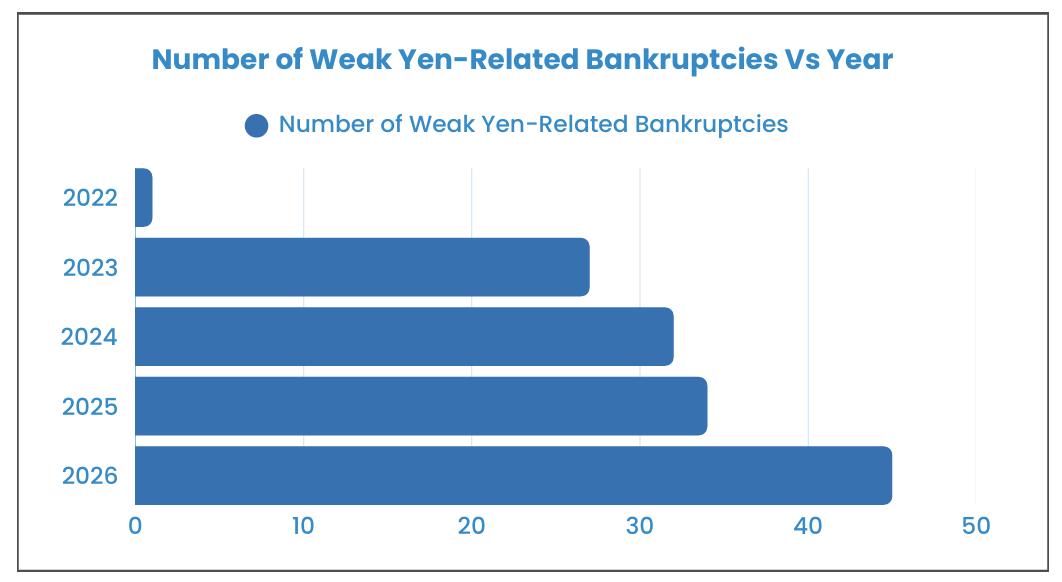
Prolonged depreciation of the Japanese yen has severely squeezed import-dependent small and medium-sized enterprises (SMEs). Tokyo Shoko Research reported 45 weak-yen-related bankruptcies in the first half of 2026, a 32.3% year-over-year increase and the highest first-half total recorded since tracking began in 2022. Over half of these cases (23) occurred in wholesale, followed by retail, manufacturing, and transport.
While these insolvencies reflect macroeconomic strain, they are simultaneously expanding the local pool of experienced, skilled professionals looking for immediate employment opportunities.
- Action Plan: Capitalize on the expanded pool of available skilled talent in affected regions, utilizing contract, temporary, or project-based staffing arrangements to manage talent acquisition flexibly.
- How Manatal Helps: Manatal’s AI Interviewer automates first-round screening and applicant scoring, enabling recruitment teams to process and evaluate large volumes of incoming candidates accurately and consistently.
Conclusion
Global hiring is experiencing a structural division between mega-capitalized growth zones and contracting consumer sectors. To navigate these market shifts, organizations must move away from generic sourcing models and adopt precise, data-driven recruitment practices. Download the complete Manatal Monthly HR Trends Report to access full datasets, industry breakdowns, and localized strategy frameworks.
.webp)








.webp)

.webp)


.webp)


