





A bad sales hire costs you roughly 3-5x their annual salary. [1] That figure accounts for the base pay, the wasted onboarding, the burned leads, and the quota gap that your remaining team now has to absorb. Good salespeople are almost never unemployed. The top 10% of reps, the ones who consistently hit 120% of quota, get poached before they have time to update their LinkedIn. They are not refreshing job boards; they are closing deals. This guide covers what actually works for sales recruiting strategies: how to define the role correctly before you source anyone, how to find candidates who aren't looking, how to run an interview process that a professional salesperson can't charm their way through, and how to close the hire without losing them at the offer stage.
Step 1: The Sales Role Type
According to Channel Pro Network, there are two main types of sales roles. Get this wrong, and you will hire the wrong person every time, regardless of how good your sourcing is.
- The Hunter: Outbound-focused, quota-carrying, and thrives on rejection. SDRs and new-business account executives fit here. These candidates should have a demonstrable record of building a pipeline from zero, not inheriting an existing book. Ask them how many cold calls they made per day in their last role. A real Hunter will give you a number without hesitating.
- The Farmer: Relationship-focused, expansion-oriented, skilled at navigating complex accounts over months. Account Managers and Customer Success Managers with upsell targets fit here. These candidates protect NRR (Net Revenue Retention). Their interviews should probe for account planning, not cold outreach volume.
Before you approve a job req, answer these two questions:
- Is this role responsible for generating a new pipeline or managing existing revenue?
- What does a 12-month performance review look like for this person, and what specific metrics would confirm success?
Manatal's AI job descriptions generator from a prompt. Give it the Hunter or Farmer parameters you defined above, and it produces a structured job description in under two minutes, including the specific skills and experience fields that matter for that position. It also automatically scores candidates against those criteria the moment they enter the pipeline
{{cta}}
Step 2: Source Passive Candidates
Your best candidate is closing a deal for someone else right now. They are not reading your job posting. Outbound recruiting is the core of any serious sales recruiting strategy. The recruiters winning this fight have stopped treating LinkedIn as a social network and started treating it as a prospecting database.
Manatal's Chrome Extension in the candidate sourcing feature cuts that process. You browse LinkedIn, identify a target profile, and import their enriched data directly into the ATS in one click. No copy-paste. No lost candidate records. The profile populates with available social and professional data automatically, and you can begin outreach sequencing from inside the platform.
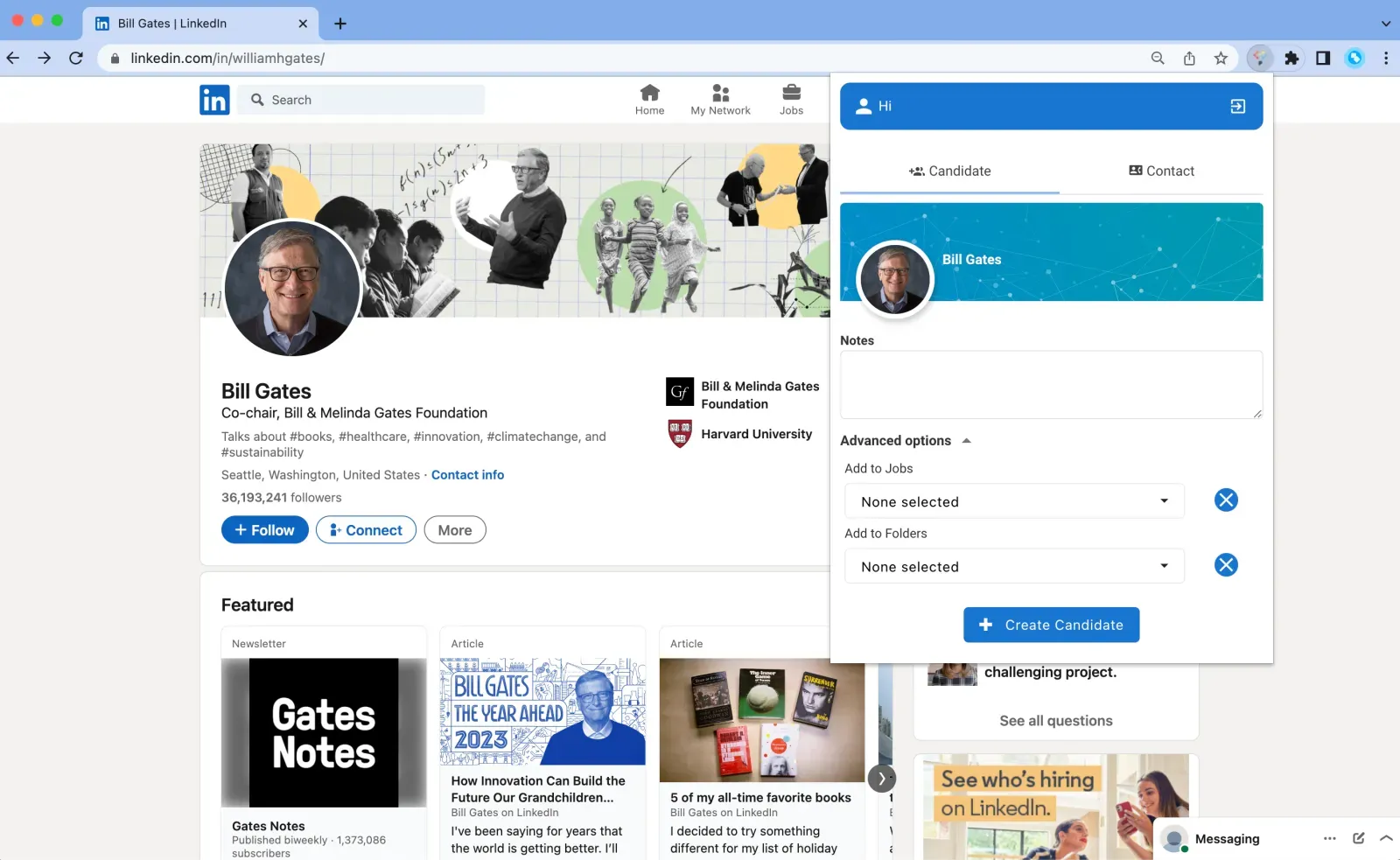
The message itself matters. Do not open with the role. Open with something specific to them. "I noticed you finished Q4 at 134% of quota at [Company]. We're building an outbound team at [Your Company], and I'd like to talk about what we're building." That is four times more likely to get a response than "We have an exciting opportunity."
Specificity is the only thing that works on people who get recruiters in their inbox daily.
Other sourcing channels worth prioritizing:
- Sales communities and Slack groups: RevGenius, Pavilion, Sales Hacker. Real reps discuss real frustrations here. Read the threads. You will find people complaining about their current comp plans, their bad managers, and their capped commissions. Those are your candidates.
- Conference attendee lists: Dreamforce, SaaStr, Outbound. Exhibitor and speaker lists in particular. The reps whose companies send them to conferences are often their top performers.
- Your own customers: A customer who loves your product and works in sales is a warm candidate. They already know your value prop. They can sell it because they have lived it.
Step 3: Run Simulations, Not Interviews
Salespeople are professional interviewers. The candidate has had many of these conversations. They have polished answers for every question you think is clever. The best sales recruiting strategies replace interviews with simulations.
The Mock Discovery Call
This is non-negotiable for any AE or SDR hire. Give the candidate 24 hours of notice. Tell them they will be selling your product back to you in a 15-minute call. Provide them with basic product information. See what they do with it.
What to watch for:
- Do they ask questions before pitching? A good rep runs discovery before demoing. If they launch straight into features, they are a "feature pitcher," which is the most common failure mode in enterprise sales.
- Do they handle objections or fold? Interrupt them mid-pitch and say, "I'm not sure we have the budget for this right now." A strong candidate will ask when budget resets, who else is involved in the decision, and what would need to be true for this to be a priority. A weak one will say "I understand, let me know if anything changes."
- Do they close the call? They should ask for a defined next step before the 15 minutes end. Not a vague "I'll follow up." A specific ask: "Can we schedule 30 minutes with your VP of Sales next Thursday?"
The mock call reveals things that two hours of behavioral interviews never will. Tone, adaptability, and preparation. You will know within ten minutes whether you have a real rep in front of you.
The Sales Interview Scorecard
Use this scoring framework across every candidate. It removes the gut-feel bias that causes bad hires.

Question: "Tell me about a deal you lost."
- Green flag: Takes ownership. Describes what they learned and what they would do differently. Can articulate specifically where the deal went wrong.
- Red flag: Blames the product, the marketing team, or the prospect for "not getting it." No ownership. No lesson.
Question: "Walk me through how you build a pipeline from zero in a new territory."
- Green flag: Gives a specific process. "I start with ICP mapping, then I pull a list from [tool], then I sequence by trigger events." Numbers are present.
- Red flag: Generic answer. "I reach out to a lot of people and follow up consistently." No system, no data.
Question: "What was your OTE at your last role, and what did you actually take home?"
- Green flag: Answers directly. Can explain the variance between OTE and actual earnings and describe the specific deals that moved the number.
- Red flag: Deflects or gives a range. If they cannot speak to their own earnings with precision, they will not be able to speak to your product's ROI with prospects.
Question: "What do you know about our product?"
- Green flag: Knows something specific. Has looked at your pricing page, read a case study, and identified a use case relevant to their background.
- Red flag: Nothing. A candidate who did not spend 20 minutes on your website before an interview will not spend 20 minutes researching a prospect.
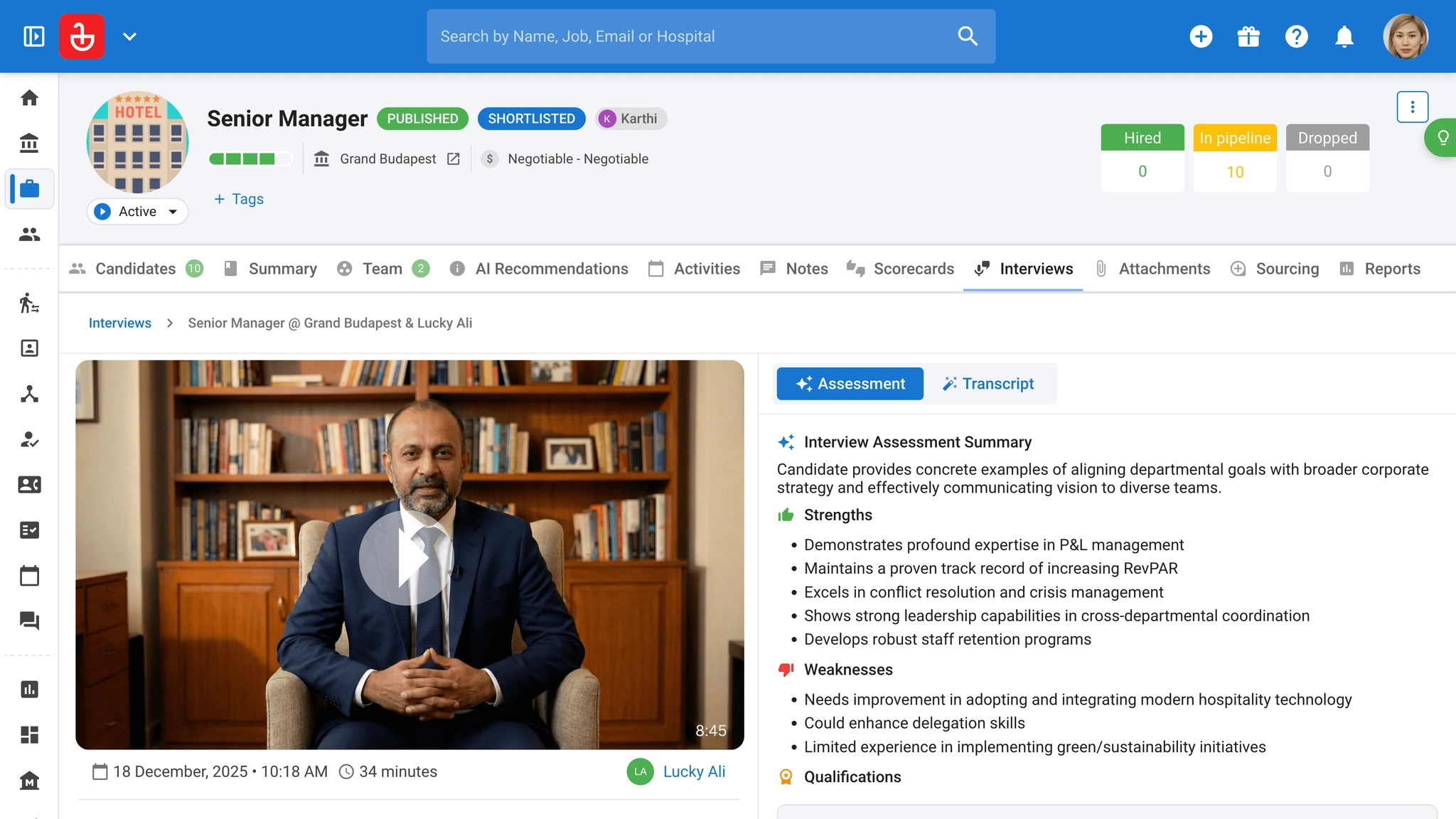
If you are screening a high volume of candidates and need to run initial filters before getting to the simulation stage, Manatal's AI Interviewer conducts automated video screening 24/7. You build the interview questions inside the platform, the candidate completes them on their own schedule, and Manatal returns an unbiased assessment with scoring. This is not a replacement for the mock discovery call. It is the filter that ensures you spend time only on mock calls with candidates worth the 15 minutes.
Step 4: Close the Hire Transparently
Good salespeople see through vague compensation packages immediately. If your offer says "competitive OTE" without defining the base salary, variable compensation structure, quota, and ramp period, you will lose the candidate. They know what that vagueness means. It means either the commission structure is confusing or the quota is set to fail them.
Show the math. Explicitly.
A real offer conversation for a sales hire should include:
- Base salary: the exact number, not a range
- OTE: clearly defined as base + variable at 100% of quota
- Quota: what 100% looks like in dollars or ARR
- Ramp period: how quota is structured in months one through three (e.g., 50% / 75% / 100%)
- Commission rate: the percentage per deal closed, whether it is tiered, and at what threshold accelerators kick in
- Average rep attainment: what your current reps are actually earning, not the OTE ceiling
The last point is the one most companies skip. Share your average rep attainment honestly. If your average rep hits 70% of quota, say so and explain why. If you hide that number and the candidate figures it out by month six, you will lose them and get a Glassdoor review in the same week.
The 3 Soft Skills Every Sales Recruiting Strategy Must Test For
Skills assessments and mock calls confirm technical ability. But three traits predict long-term sales performance more than any certification or work history. Test for them deliberately.
- Rejection Tolerance. Ask candidates to describe the worst streak they have had in sales. How long did it last? What did they do during it? A rep who has never faced a prolonged slump either has not been in the role long enough or is not telling you the truth. You want someone who has been through a bad quarter and has a specific recovery plan, not someone who has only known good conditions.
- Ownership. This comes through in every answer about failure. Great salespeople take ownership of outcomes, both good and bad, because ownership is the only thing that drives behavioral change. Test for it in the debrief after the mock call. Ask "what would you do differently?" and listen for "I" statements, not "they" statements.
- Coachability. After the mock discovery call, give direct feedback on two specific things they did wrong. Watch the reaction. Defensiveness is the predictor of a rep who will hit a ceiling. Curiosity and note-taking are the predictors of a rep who will compound over time.
Sourcing at Scale: Manage the Pipeline, Not Just the Candidate
Sourcing passive sales candidates across LinkedIn, referrals, and communities creates a fast pipeline management problem. You have 20 profiles bookmarked, 3 intro messages sent, 1 candidate waiting for a call, and another who needs an offer by Friday. Without a centralized system, one of those deals will fall through.
Manatal lets you post to multiple job boards from a single dashboard while managing inbound and outbound pipelines in one place. Sponsored posts on LinkedIn, Indeed, and other platforms run from a single interface. You monitor performance across all of them without logging into separate portals. On the outbound side, the Chrome Extension imports candidate profiles directly from LinkedIn into the ATS, and Manatal's AI candidate enrichment appends additional data to the profiles automatically.
Conclusion
Recruiters who are still relying on inbound applications for sales roles are not filling their pipelines. They are reacting to whoever happens to show up. The companies building sales teams that consistently outperform are running outbound recruiting the same way their sales teams run outbound prospecting: defined ICP, disciplined sequencing, simulation-based qualification, and a close that treats the candidate like a professional.
Start sourcing sales candidates in Manatal. Free 14-day trial, no credit card required.
Frequently Asked Questions
Q: What is the difference between sales recruiting strategies for startups vs. enterprise companies?
A: Startups need Hunters who can build a pipeline with zero brand recognition and minimal tooling. Enterprise companies typically need Farmers or hybrid AEs who can manage complex multi-stakeholder deals over long cycles. Your sales recruitment strategy should reflect the motion, not just the headcount target. A startup that hires an enterprise AM expecting outbound aggression will be disappointed every quarter.
Q: How long does sourcing candidates for a sales role typically take compared to other functions?
A: Sourcing candidates for top-performing sales roles takes 30–50% longer than hiring for most non-revenue functions, because the best reps are already employed and not actively looking. Effective candidate sourcing strategies account for this by building a warm pipeline before the seat is officially open, not after the previous rep gives notice.
Q: What goes into a candidate sourcing strategy specifically built for recruiting salespeople?
A: What goes into a candidate sourcing strategy for sales roles is different from general hiring. It requires identifying target companies with a similar sales motion, mapping their top performers by activity signals (awards, promotions, LinkedIn engagement), and reaching out with role-specific messaging rather than generic outreach. Volume matters less than precision when recruiting senior-level salespeople.
Q: How do you measure the success of your recruitment sales process after a hire is made?
A: Track three metrics at 30, 60, and 90 days: ramp attainment (what percentage of ramped quota the rep is hitting), pipeline generation rate (how much ARR they are self-sourcing), and retention at 12 months. If your recruitment sales process is working, 80% of hires should reach full quota attainment by month four. Below that threshold, the problem is either in your assessment process or your onboarding, and you need to determine which before the next hire.
Q: Should you use a recruitment agency or build an internal team when learning how to recruit sales professionals at scale?
A: Use an agency to fill urgent senior roles where speed matters and the cost-per-hire is justified by the revenue impact. Build internal capability for recurring roles such as SDRs and mid-market AEs, where volume and consistency matter more than speed. The companies that figure out how to recruit sales professionals without relying entirely on agencies develop a structural hiring advantage that their competitors cannot buy.
Citation:
.webp)







.webp)

.webp)


.webp)


