





Most recruiters lack time to find the right talent inside a growing resume pile. A talent matching platform scores candidates against a role's real requirements and ranks them, so hiring teams review the strongest fits first. The sections below cover what these platforms do, how the AI works, what results teams report, and how to buy one.
What Is a Talent Matching Platform?
A talent matching platform is software that uses AI to score and rank how well candidates fit a role. It evaluates skills, experience, and other signals instead of relying on keyword filtering alone. The platform reads job requirements and candidate data, then produces a match score and a ranked shortlist a recruiter can act on. The same technology can also match existing employees to internal roles, though this guide focuses on external hiring.
External Hiring vs. Internal Mobility
The label "talent matching platform" covers two different jobs, and the tools you find while searching may not do the one you need. In hiring and talent acquisition, the platform matches external applicants and sourced candidates to open requisitions. In internal mobility, it matches current employees to gigs, projects, and open roles inside your own company.
This guide focuses on the hiring use case: filling open roles with people outside the organization. If you want the broader context on that function, see our guide to what a talent acquisition platform is. Internal-mobility marketplaces solve a related but separate problem, so treat the two categories differently when you shortlist vendors.
How AI Talent Matching Works
Under the surface, AI talent matching runs a pipeline that turns messy resumes into a comparable, scored shortlist. Keyword search checks whether a term appears; matching estimates how closely a whole profile fits the requirements. Interest in these tools is climbing: Gartner reports that AI and cost pressures are the two forces driving the top talent-acquisition trends for 2026.[1]
The steps usually look like this:
- It parses each resume or profile into structured fields such as job titles, skills, and dates.
- It builds a skills profile from the CV plus enrichment data drawn from public and social sources.
- It matches that profile to the job's requirements using semantic relevance and Boolean filters.
- It returns a match score and a ranked shortlist showing where each candidate meets or misses criteria.
- It learns from recruiter acceptance and rejection decisions to improve future rankings.
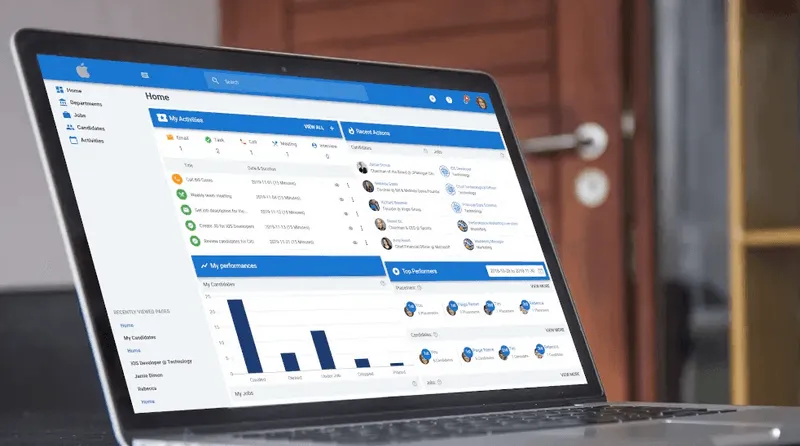
Manatal's AI Recommendations & Matching handles this work inside the ATS. It reads a job's requirements, scores candidate profiles against them, and surfaces best-fit talent through AI Advanced Search with semantic and Boolean relevance scoring.
Match quality depends on the data feeding it. That is why candidate enrichment, which standardizes profiles from public and social sources, matters before you score anyone.
A matching score is where evaluation starts. The best recruiters use the ranked shortlist to spend time on the right people, then confirm fit with judgment and a skills check. A platform that hides how it scores, or runs on thin candidate data, produces confident-looking matches you cannot defend.
{{cta}}
What a Talent Matching Platform Improves
When the data is clean and a recruiter stays in the loop, teams report gains in three areas. The business case shows up in results. SHRM reports that 35% of organizations using skills-first hiring exceed their financial goals, versus 27% of those that do not.[2]
- Speed and cost: According to LinkedIn’s Future of Recruiting report, AI-enabled talent teams save an average of 20% of their workweek, though most reinvest those time savings back into deeper candidate screening rather than cutting overall recruitment costs.[3]
- Match quality: SHRM's skills-first research shows demonstrated skills are now the top factor in hiring decisions, ahead of education, which fell to sixth.[2]
- Fairer shortlists: A Gartner survey found only about 26% of candidates trust AI to evaluate them fairly, so human review still matters.[4]
How to Set Up an AI Talent Matching Workflow
A matching engine only works if you feed it clean data and verify its output. A workable starter stack pairs an ATS with AI relevance scoring, such as Manatal, with sourcing layers like LinkedIn Recruiter or Indeed Hiring Platform, pre-hire assessment platforms like TestGorilla or HackerRank, and an HRIS to store downstream employee records.
Follow these six steps to build a reliable, human-in-the-loop AI matching workflow.
Step 1: Construct a Structured Skill Matrix
Unstructured job descriptions cause AI matching algorithms to misinterpret requirements. Defining clear criteria upfront ensures the engine evaluates candidates against explicit operational parameters rather than loose prose.
How to Run It: Define requisition parameters directly within your ATS or sourcing tool before running any matches. Divide criteria into three distinct categories:
- Must-Have Skills: Hard technical or operational prerequisites (e.g., Python, Series 7 license).
- Nice-to-Have Skills: Preferred competencies that boost ranking but do not disqualify (e.g., AWS certification).
- Parameters: Explicit bounds for seniority, location, time zone, and work arrangement (remote, hybrid, on-site).
Save this breakdown as a standardized role template to maintain data consistency across future hires.
Step 2: Ingest and Enrich Candidate Data
After establishing your structured skill matrix, you need candidate data for the algorithm to match against it. Matching algorithms struggle when relying solely on raw, unformatted CVs or sparse PDF uploads. Ingesting profiles across multiple channels and running automated enrichment ensures the matching layer evaluates full career histories and updated skill sets.
How to Run It: Ingest candidate profiles into your pipeline through three primary channels:
- Connect your ATS directly to sourcing platforms like LinkedIn Recruiter via native API integrations.
- Ingest inbound applicants from your career page and job aggregators like Indeed automatically.
- Import passive leads or past candidates from your existing database.
Activate auto-enrichment settings in your ATS or talent engine to pull missing profile details, updated job titles, and expanded skill tags so every profile is formatted against the skill matrix you created in Step 1.
Step 3: Execute the Matching Engine and Rank Candidates
With your skill matrix configured and enriched candidate profiles loaded from steps 1 and 2, you are ready to generate match scores. Running the matching engine isolates top-tier profiles and surfaces qualified candidates that basic keyword filters miss.
How to Run It: Trigger the AI matching feature for your target requisition in your ATS. The platform evaluates each enriched profile against your structured criteria, returning a numerical relevance score (e.g., 0–100%) and a ranked candidate list. Filter the pipeline view by score thresholds, focusing first on candidates in the top percentile bracket, and review auto-generated match summaries detailing why each profile was scored high or low.
Step 4: Conduct Human Oversight and False-Positive Auditing
To ensure high pipeline quality, validate the Step 3 automated rankings internally before escalating candidates to hiring managers. Algorithms excel at pattern recognition, but they can misinterpret non-traditional background paths, career gaps, or ambiguous job titles. Human verification prevents qualified candidates from being rejected and catches misaligned profiles early.
How to Run It: Assign a recruiter to review the top 20–30 ranked matches from Step 3 individually using a structured validation checklist:
- Verify that "must-have" criteria are genuine matches (e.g., confirming "Java" refers to the programming language, not a coffee company).
- Override incorrect scores or misattributed tags in the system.
- Flag false positives and document the specific reason for disqualification within profile notes.
Only candidates who pass this human audit advance to technical verification.
Step 5: Validate Shortlisted Candidates via Skills Assessments
After your recruiters verify candidate fit, take the validated shortlist and move them to skill verification. Resume profiles and AI match scores measure candidate relevance only. Integrating standardized skills tests validates that top matches possess the practical skills required for the role.
How to Run It: Trigger an automated assessment invitation through integration tools like TestGorilla or HackerRank directly from your ATS stage workflow when moving human-audited candidates from Step 4 into the "Shortlisted" phase. Set hard score benchmarks based on role requirements. Candidates who pass the assessment automatically advance to the hiring manager screen, while those who fail to meet the threshold are routed to a rejection or talent-pool stage.
Step 6: Log Decision Feedback to Train the Engine
As candidates move through testing and proceed to final hiring decisions, capture every outcome to feed back into the system. AI matching engines rely on reinforcement data to calibrate future recommendations. If recruiters accept or reject recommendations without logging reasons, the algorithm continues repeating scoring errors.
How to Run It: Enforce mandatory decision tagging across your recruiting team for every candidate moved out of the match pipeline, whether rejected after the Step 4 human audit or after the Step 5 skills assessment. When rejecting a candidate, select a structured reason code (e.g., "Lacks required framework experience," "Overqualified," "Location mismatch"). When advancing a candidate, tag their strongest qualifying traits. This feedback loops directly back into your matching platform, training the engine to refine future candidate rankings for that job family. Sync final hire milestones to your core HRIS to close the talent lifecycle loop.
How to Choose a Talent Matching Platform
Vendors in this space differ more than their marketing suggests, so weigh a few concrete criteria before you commit.
- Skills matching: Check whether it matches against a real skills taxonomy or just keyword overlap.
- Score transparency: Confirm you can see why a candidate ranked where they did.
- Data coverage: Look at how well it enriches profiles from public and social sources.
- Integrations: Make sure it connects to your existing ATS and HRIS.
- Compliance: Ask about bias auditing and support for hiring regulations.
- Use-case fit: Decide whether you need acquisition matching, internal mobility, or both.
For example, platforms like Gloat and Reejig center on internal mobility, while acquisition-focused matching often lives inside an ATS such as Manatal.
Conclusion
A talent matching platform earns its place when it turns a crowded database into a defensible shortlist for a specific role. Get the inputs right, keep a recruiter on the final call, and treat the score as guidance rather than a verdict. Start with a structured requirement and clean candidate data, and the ranking will do useful work. See how Manatal scores and ranks candidates against your open roles, with AI matching, semantic search, and candidate enrichment built into one recruiter-friendly ATS.
Frequently Asked Questions
Q: How is a talent matching platform different from an applicant tracking system?
A: An ATS organizes and tracks applicants through your pipeline, while a talent matching platform adds AI scoring and ranking on top. Many modern systems combine both; Manatal, for example, includes matching inside its ATS.
Q: Are there free talent matching AI platforms?
A: While fully featured AI matching software typically requires a paid subscription, top platforms provide risk-free trials to evaluate their engines on live candidate data. Manatal offers a 14-day free trial with full access to its AI Recommendation Engine, allowing you to test automated candidate scoring and resume parsing without a credit card. This lets talent teams verify how accurately the AI extracts job requirements and ranks pipeline candidates against active roles before committing to a plan.
Q: How accurate is AI candidate matching?
A: Matching accuracy depends on how effectively a platform evaluates context rather than relying on brittle keyword matching. Manatal’s AI Recommendation Engine uses semantic matching to parse skill equivalents, scoring candidates against job descriptions while delivering transparent, requirement-level breakdowns. Recruiters can further fine-tune accuracy by setting required versus preferred criteria and customizing weightings for skills, experience, and education to align rankings with exact hiring priorities.
Q: Is AI talent matching legal and compliant with hiring laws?
A: It can be, but the rules are tightening. In the US, EEOC guidance applies Title VII anti-discrimination law to AI screening, and New York City's Local Law 144 requires independent bias audits for automated hiring tools. The EU AI Act treats recruitment AI as high-risk, so keep a human in the loop and document decisions.
Q: What data does a talent matching platform use to make matches?
A: It combines resumes and CVs, structured skills data, enrichment from public and social profiles, and the job's requirements. Manatal's candidate enrichment, for instance, pulls from 20+ social and public platforms to fill out each profile before scoring.
Citations
.webp)







.webp)

.webp)


.webp)


