





A recruiter opens a job posting to find 400 applicants, but resumes only show past employers, not actual capability. To avoid relying on subjective gut decisions, modern hiring teams use candidate assessments to close this gap. According Burning Glass Institute, recruiters routinely face hundreds of applications per role with no reliable way to verify capability. Implementing objective evaluation tools solves this bottleneck, providing a distinct competitive advantage in identifying top talent.[1] This article breaks down exactly how to use candidate assessments, which methods hold up under scrutiny, how to choose the right tool, and how to integrate them seamlessly into your hiring workflow.
Understanding Candidate Assessment
Candidate assessment evaluates a job applicant's skills, knowledge, and behavior against specific role requirements to replace resume guesswork with objective evidence. To understand how these evaluations fit into your hiring workflow, it helps to break down how they differ from initial filters and how technology delivers them:
- Screening vs. Assessment: Screening acts as the selection process, using tools like AI resume parsing to narrow a large applicant pool based on basic qualifications, keywords, or years of experience. Assessment then takes over to deeply evaluate the specific candidates who successfully pass that first filter.
- Delivery: To execute these evaluations, hiring teams utilize candidate assessment tools. These digital platforms automate the delivery of the tests, score the candidate responses, and centralize the data for objective decision-making.
The Methods of Candidate Assessment
Not all assessment methods predict job performance equally well. Here is what each one measures and what it is actually good for.
- Skills and work-sample tests: Candidates complete tasks that mirror actual job duties, like writing code or handling a mock support ticket. 2026 research validates that practical competency tests are the single strongest predictor of successful hiring outcomes, vastly outperforming traditional credentials. If you implement only one assessment type, work samples should be your priority.[2]
- Cognitive and aptitude tests: These tests measure core reasoning, problem-solving, and numerical or verbal skills. While they are fast to administer across many roles, they do not evaluate job-specific skills or work styles.
- Personality and behavioral assessments: These instruments map work-style tendencies using established models like the Big Five. They help guide interview conversations and reveal team fit, but using them as hard filters introduces bias and causes mis-hires.
- Situational judgment tests (SJTs): Candidates review realistic work scenarios and select their response. SJTs effectively evaluate decision-making and judgment, though the ideal answers often depend heavily on your specific organizational culture.
- Topgrading interview: This method uses identical questions, asked in the same order, and scored against a uniform rubric for all candidates. It eliminates the bias of freeform conversations, which frequently reward confidence instead of actual capability.
Curated Candidate Assessment Tools by Category
We have compiled and categorized a list of candidate assessment tools. Use this list to explore what is available and see how different platforms might fit into your hiring process. The evaluation criteria outlined later can help you to determine the best match for your team’s specific needs.
Video interviewing (async or structured)
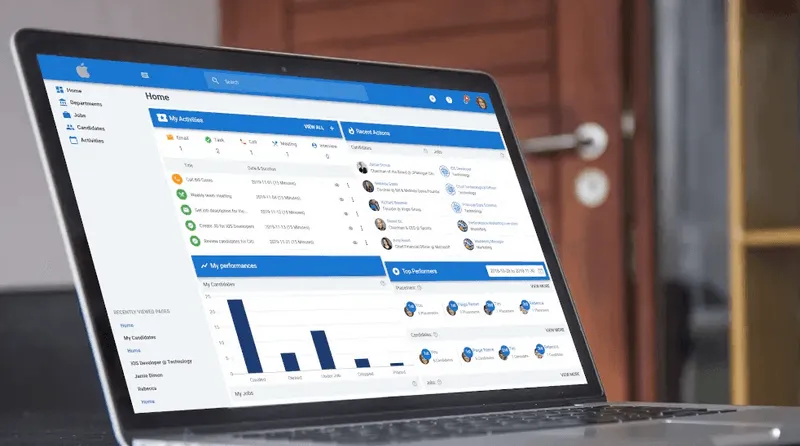
Manatal AI Interviewer
Manatal AI Interviewer runs automated, standardized screening interviews and delivers scored results directly inside the Manatal platform.
Key features:
- Structured screening at scale: every candidate answers the same questions under the same conditions, available around the clock.
- Multilingual interviews: supports screening across multiple languages without separate setup per language.
- Native ATS integration: results are scored and delivered directly inside the Manatal platform, next to the candidate profile, with no separate login or manual score entry.
- Best used as a complement: suited to scaling the structured-interview method described earlier in this guide, not as a replacement for skills or work-sample testing.
{{cta}}
Spark Hire
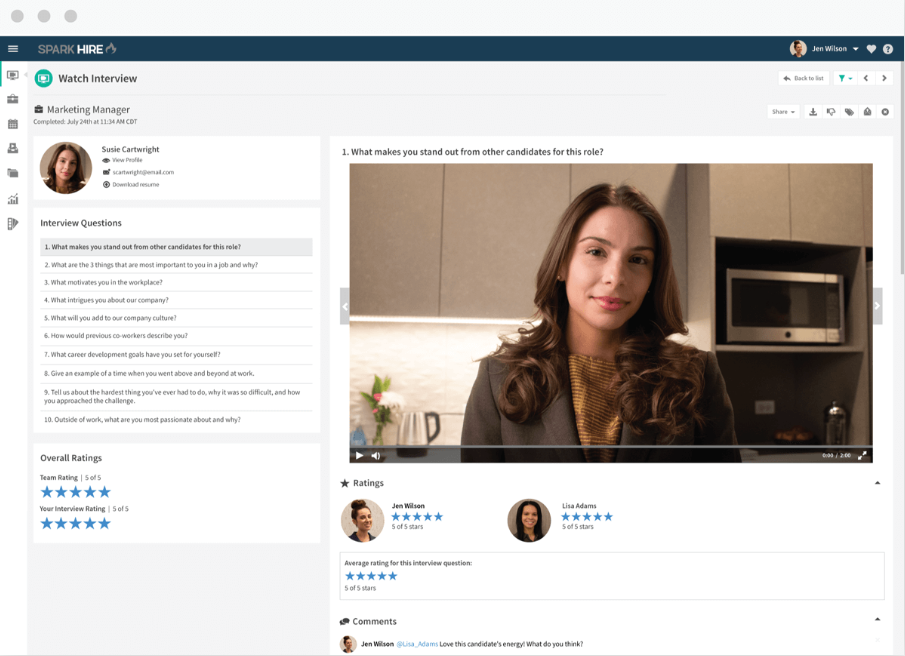
Spark Hire is a video interviewing and applicant tracking platform offering both one-way (asynchronous) and live video interviews.
Key features:
- One-way interviews: candidates record responses to pre-set questions on their own schedule, useful for replacing early-stage phone screens.
- Live interviews: scheduled, real-time video interviews for later hiring stages.
- AI-assisted review: automatic transcription and summarization of video responses to speed up reviewer time.
- ATS integration: connects with 100+ recruiting and HR tools, and also offers its own built-in applicant tracking system.
Willo
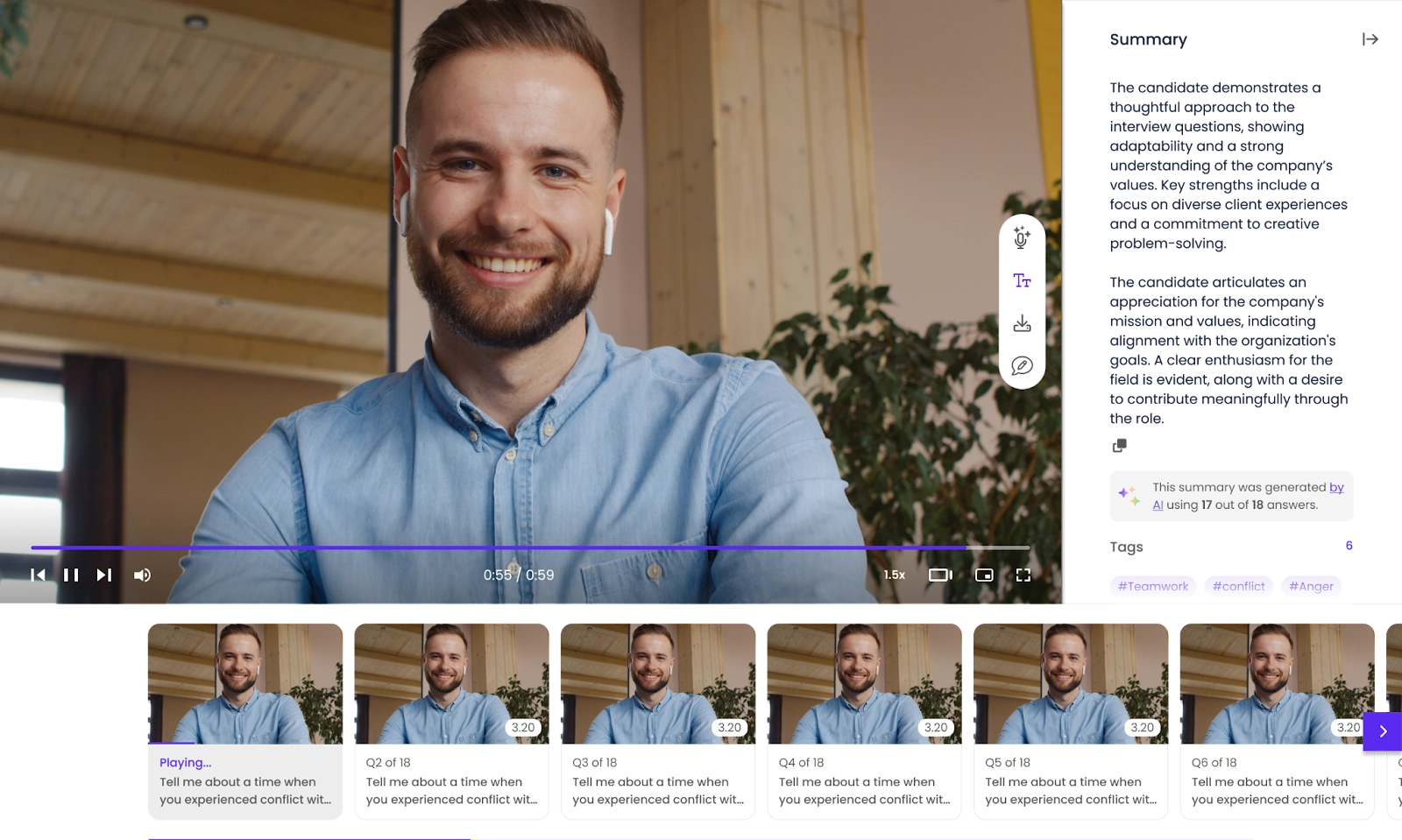
Willo is an asynchronous video interview and candidate screening platform.
Key features:
- Structured async interviews: candidates respond to text, audio, video, or file-based questions on their own time.
- Scorecards: customizable rubrics that let hiring teams rank and compare candidate responses consistently.
- Multilingual support: localized for a large number of languages, useful for global hiring.
- Identity verification: an option to confirm candidate eligibility before or during the interview.
Talview
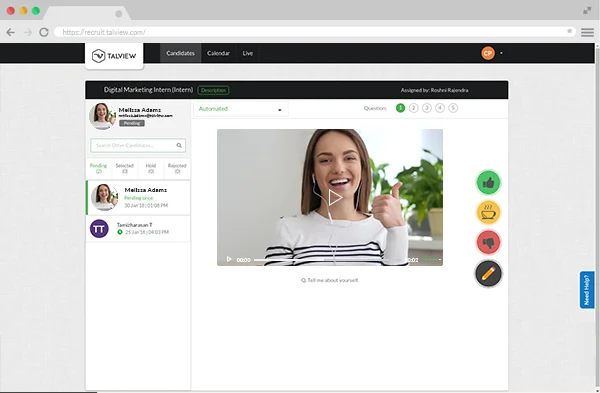
Talview is an AI-driven interviewing and proctoring platform aimed at high-volume and higher-stakes remote hiring.
Key features:
- Live and async video interviewing: structured interviews with built-in scheduling and an interview builder.
- Proctoring: a multi-layered framework including face recognition, secure browser lockdown, and behavior monitoring, aimed at detecting impersonation and deepfakes.
- Coding assessments: a coding editor with dual-camera monitoring for technical screening.
- Scale-oriented: built for high-volume hiring scenarios, including recruitment chatbot integrations for scheduling.
Skills and technical (coding and work-sample)
HackerRank
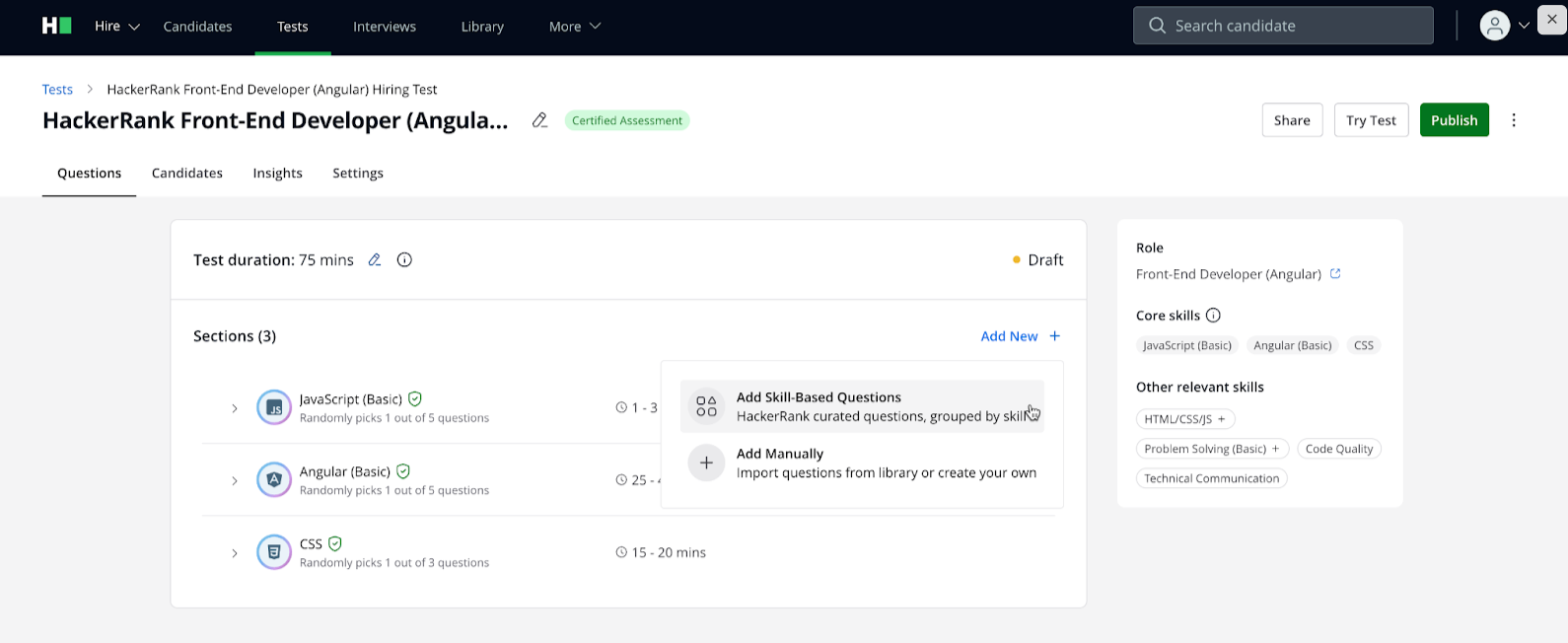
HackerRank is a technical assessment and interview platform built for engineering hiring, from initial screening through live technical interviews.
Key features:
- Question library: coding tasks across 40+ programming languages, spanning algorithms, data structures, SQL, and role-specific domains.
- Live interviews: a shared, collaborative coding environment for real-time technical interviews, separate from the automated screening product.
- Integrity tools: tab-switch detection, copy-paste flagging, and configurable rules for when AI tool use is permitted during a test.
- ATS integration: connects with major applicant tracking systems so scores appear alongside the candidate profile.
Codility
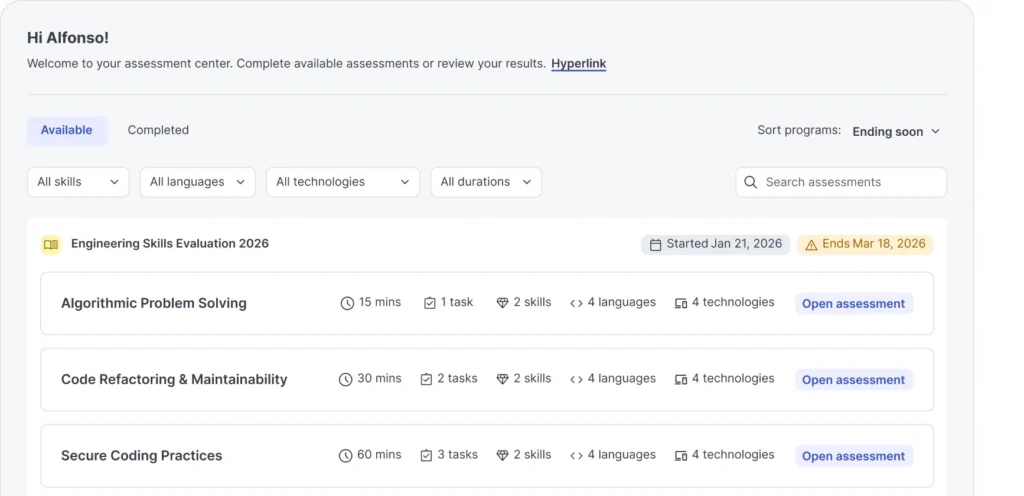
Codility is a technical assessment and interview platform that evaluates coding ability through real-world tasks and a shared development environment.
Key features:
- Task library: coding and work-simulation tasks across 80+ languages and frameworks, developed with input from occupational psychologists.
- Live interviews: a shared VS Code-based environment for structured technical interviews, including terminal access and pair programming.
- Integrity controls: identity verification, plagiarism detection, and configurable AI-use settings per assessment.
- Skills intelligence: an option to apply the same assessment methodology to existing engineering teams, not just candidates.
CodeSignal
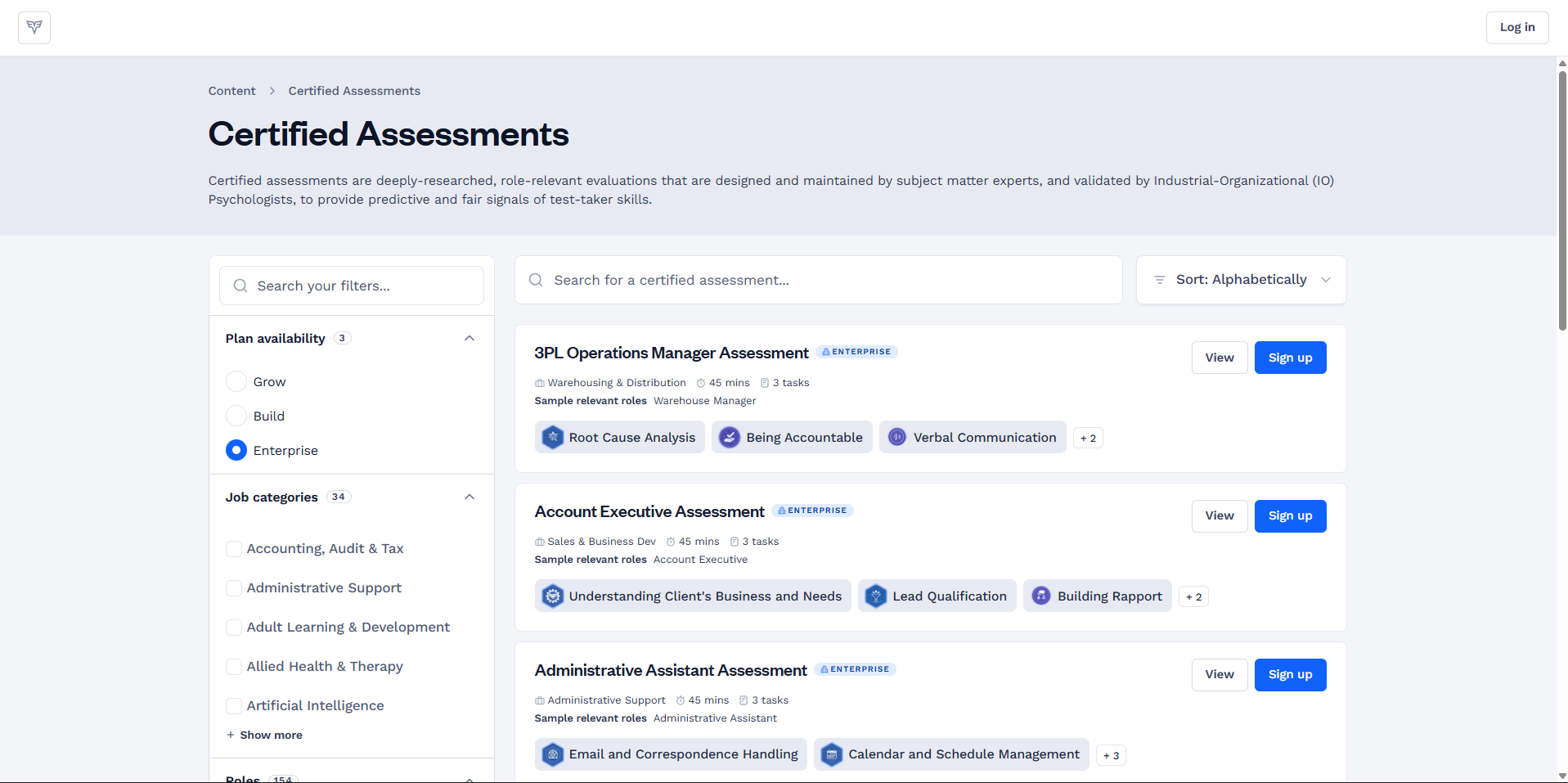
CodeSignal is a technical assessment and interview platform that evaluates coding skill through a full-featured IDE and standardized scoring.
Key features:
- Real-world IDE: candidates write, run, and debug code in an environment built to resemble day-to-day development work.
- Standardized scoring: assessments are developed by subject-matter experts and reviewed by I/O psychologists for consistency across candidates.
- Anti-cheating measures: identity verification, plagiarism detection, and behavior-pattern flagging.
- ATS integration: connects with major applicant tracking systems to sync results automatically.
Broad skills, cognitive, and personality
TestGorilla
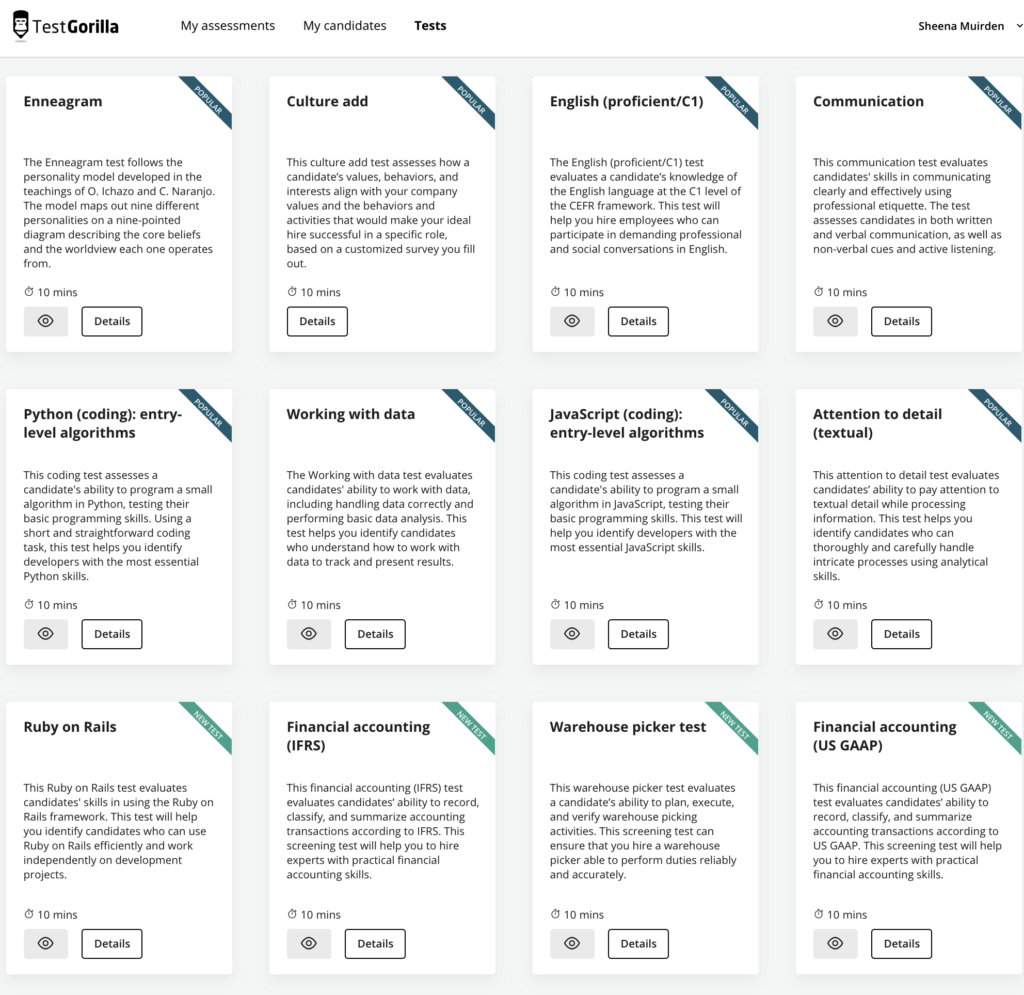
TestGorilla is a skills assessment platform that combines a large pre-built test library with custom questions and AI-scored interviews.
Key features:
- Test library: several hundred tests covering cognitive ability, technical skills, language, personality, and role-specific competencies.
- AI interviews: structured video interviews where an AI agent asks follow-up questions and scores responses against criteria the employer sets.
- Resume scoring: an option to score resumes against the job description alongside test results.
- Anti-cheating tools: behavior logging and identity checks built into the assessment flow.
Criteria Corp
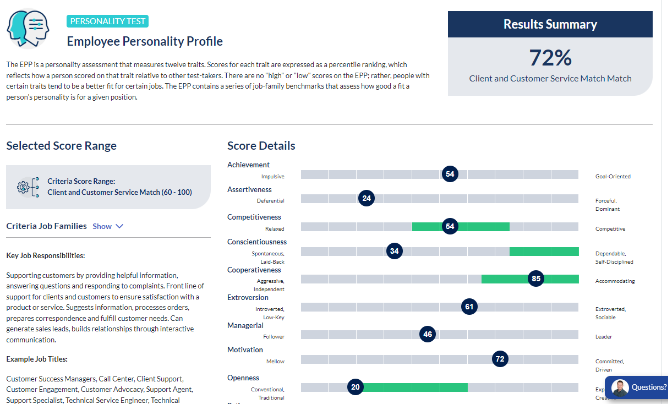
Criteria Corp is a pre-employment testing platform focused on cognitive aptitude, personality, and emotional intelligence assessments.
Key features:
- Cognitive aptitude testing: the Criteria Cognitive Aptitude Test (CCAT) measures reasoning, problem-solving, and learning ability.
- Personality assessments: several instruments based on the Big Five model, aimed at understanding work style and role fit.
- Emotional intelligence testing: a separate assessment measuring the ability to perceive and manage emotions in a work context.
- Proctoring add-on: an optional layer for verifying candidate identity during remote testing.
Bryq
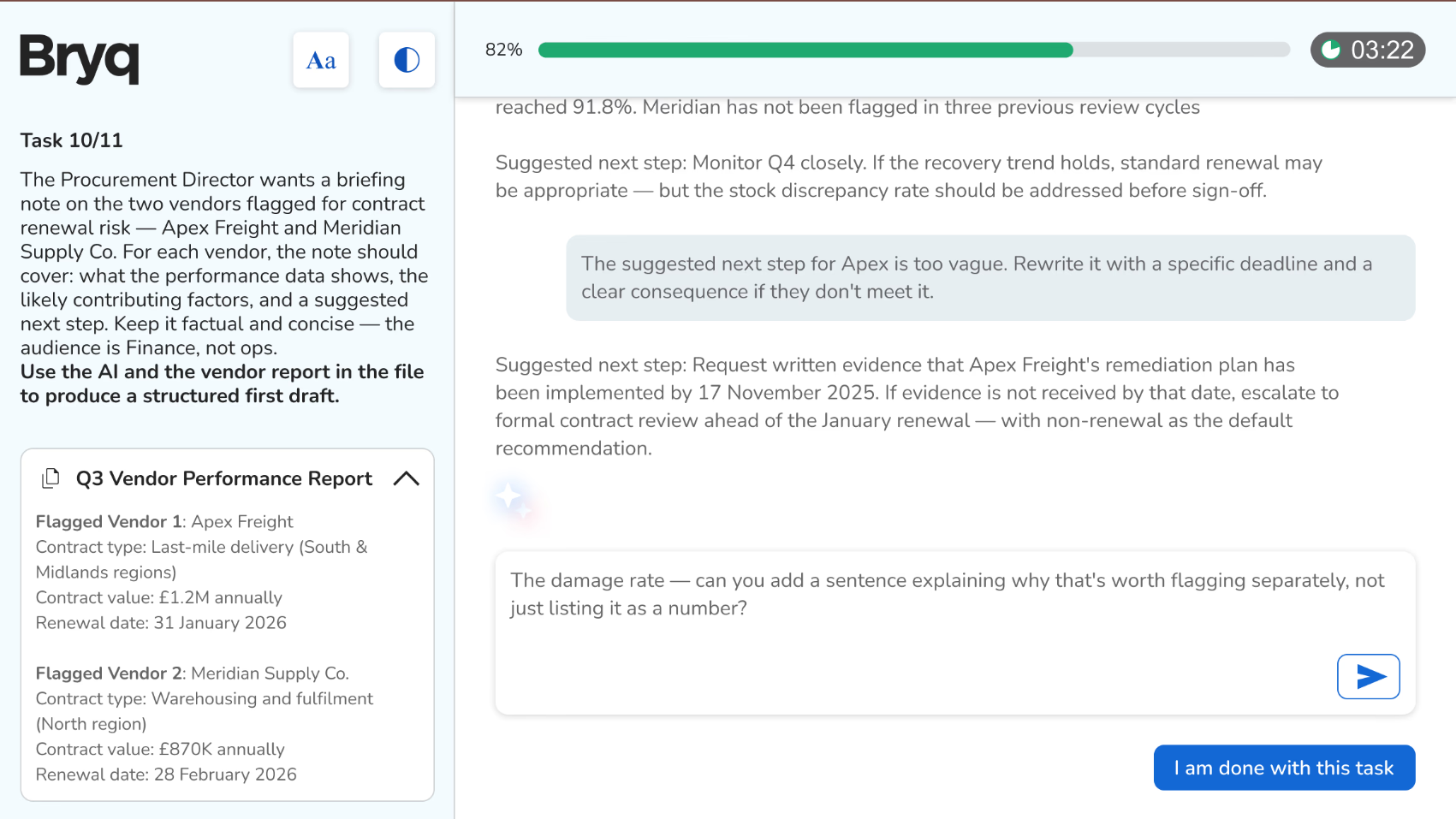
Bryq is a talent assessment platform that combines cognitive ability, behavioral traits, and job-relevant skills into a single candidate profile.
Key features:
- Integrated profile: cognitive, personality (based on the Big Five and 16PF models), and skills results are combined into one scored profile per role.
- AI proficiency assessment: a scenario-based module measuring how candidates work with AI tools, scored across several dimensions.
- Role matching: an AI-built "ideal candidate profile" for each role, generated from the job description or from existing top performers.
- ATS integration: connects with several major applicant tracking systems.
Pymetrics
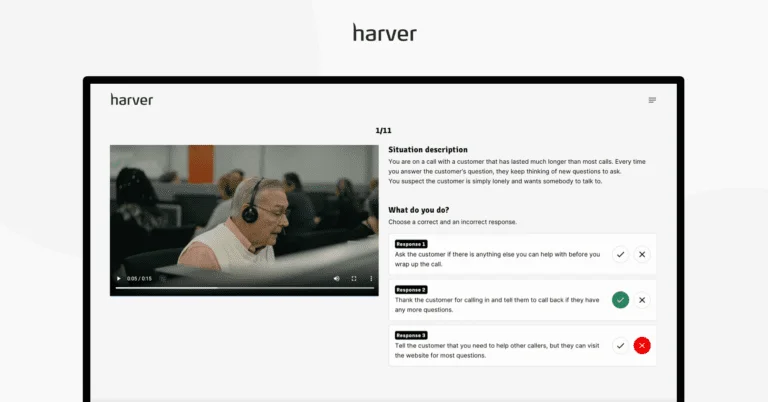
Pymetrics (now part of Harver) is a game-based behavioral assessment that measures cognitive and emotional traits through short interactive tasks rather than self-reported questionnaires.
Key features:
- Neuroscience-based games: roughly 12 short games measuring traits such as attention, risk tolerance, and decision-making.
- Behavioral rather than self-report data: traits are inferred from how candidates play, not from answers to direct questions.
- Bias-auditing tooling: the company has published open-source tools for auditing algorithmic fairness in its matching models.
Predictive Index
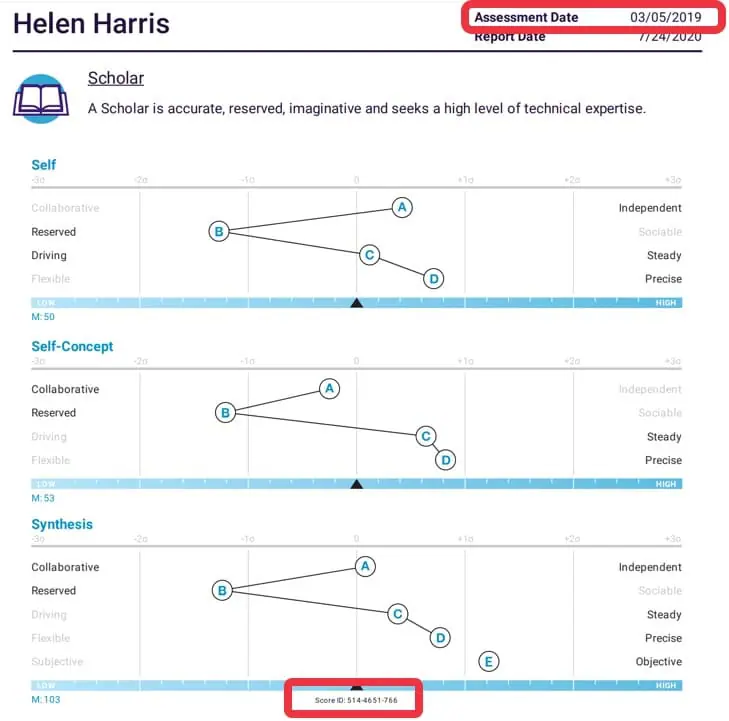
The Predictive Index is a workplace assessment system combining a behavioral survey and a cognitive ability test.
Key features:
- Behavioral assessment: a short adjective-based survey mapping candidates to four workplace drives (dominance, extraversion, patience, formality).
- Cognitive assessment: a timed test measuring verbal, numerical, and abstract reasoning as a proxy for learning speed.
- Job targets: hiring managers can define the behavioral profile a role calls for, then compare candidates against it.
- Long track record: the behavioral assessment has been in commercial use for several decades.
Traitify
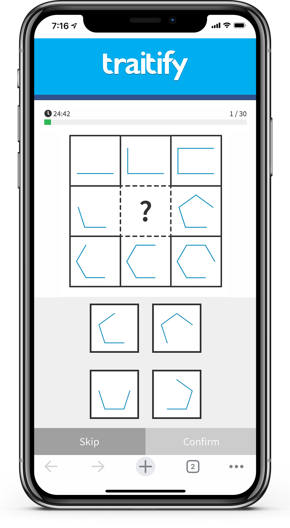
Traitify (by Crosschq) is a visual, image-based personality and cognitive assessment designed to be completed in a few minutes.
Key features:
- Image-based format: candidates respond to images rather than text-heavy questionnaires, which the vendor reports improves completion rates.
- Big Five grounding: the personality assessment is based on the Five Factor model of personality.
- Cognitive assessment: a separate, shorter module measuring learning and problem-solving ability.
- Mobile-first design: built to work on phones as well as desktop browsers.
Multi-signal and auto-scored skills plus simulations
Canditech
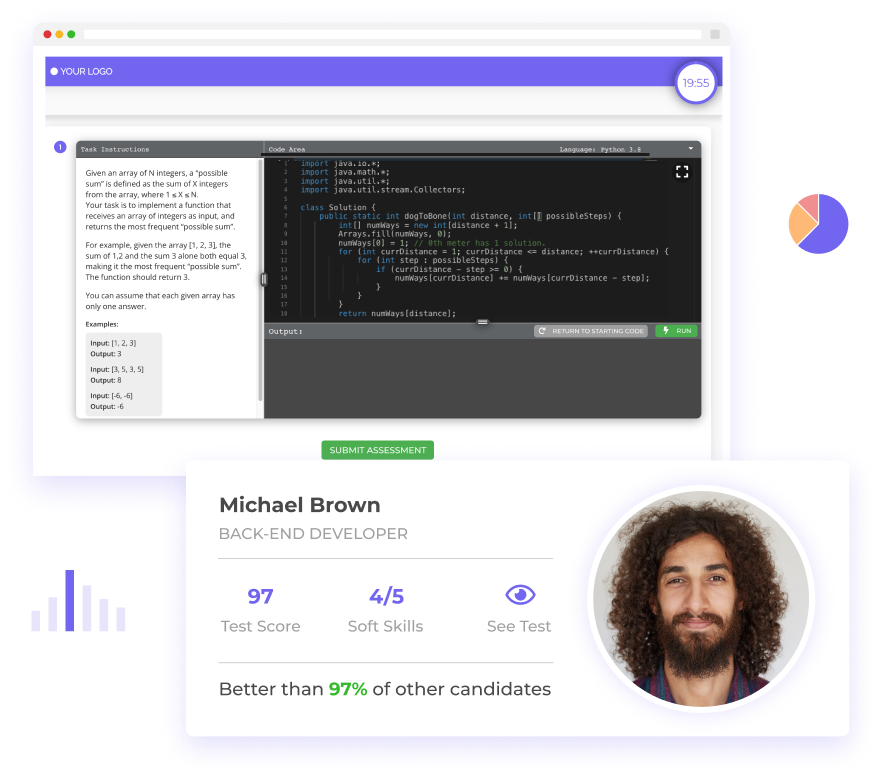
Canditech is a skills assessment platform that combines a test library with role-specific job simulations and automated scoring
Key features:
- Job simulations: tasks designed to mirror real work, including a live SQL environment and other role-specific exercises.
- AI-assisted scoring: pre-trained or custom AI agents can check and score open-ended candidate responses.
- Anti-cheating controls: configurable detection for AI tool use, tab switching, and copy-paste activity.
- ATS integration: connects with a range of applicant tracking systems for sending assessments and syncing results.
iMocha
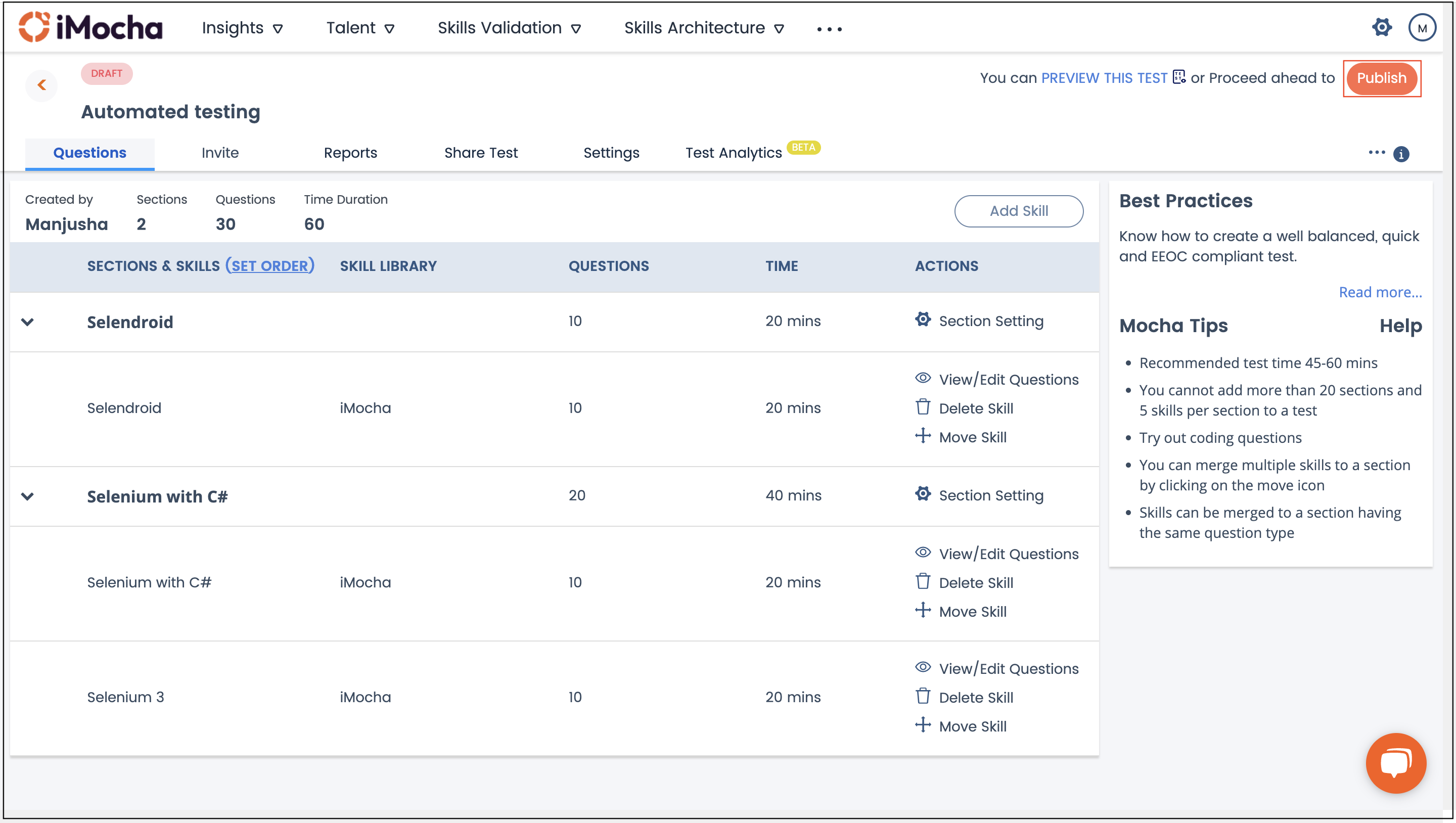
iMocha is a skills assessment and intelligence platform covering technical, cognitive, and soft-skill evaluation, plus AI-driven interviews.
Key features:
- Test library: thousands of assessments spanning coding, cognitive ability, domain knowledge, and communication skills.
- Smart proctoring: webcam and screen monitoring, tab-switch detection, and automated flagging of anomalies.
- AI interviews: on-demand, AI-conducted interviews that candidates can complete asynchronously.
- Skills intelligence: the platform can also be used to map skill gaps across an existing workforce, not just candidates.
eSkill
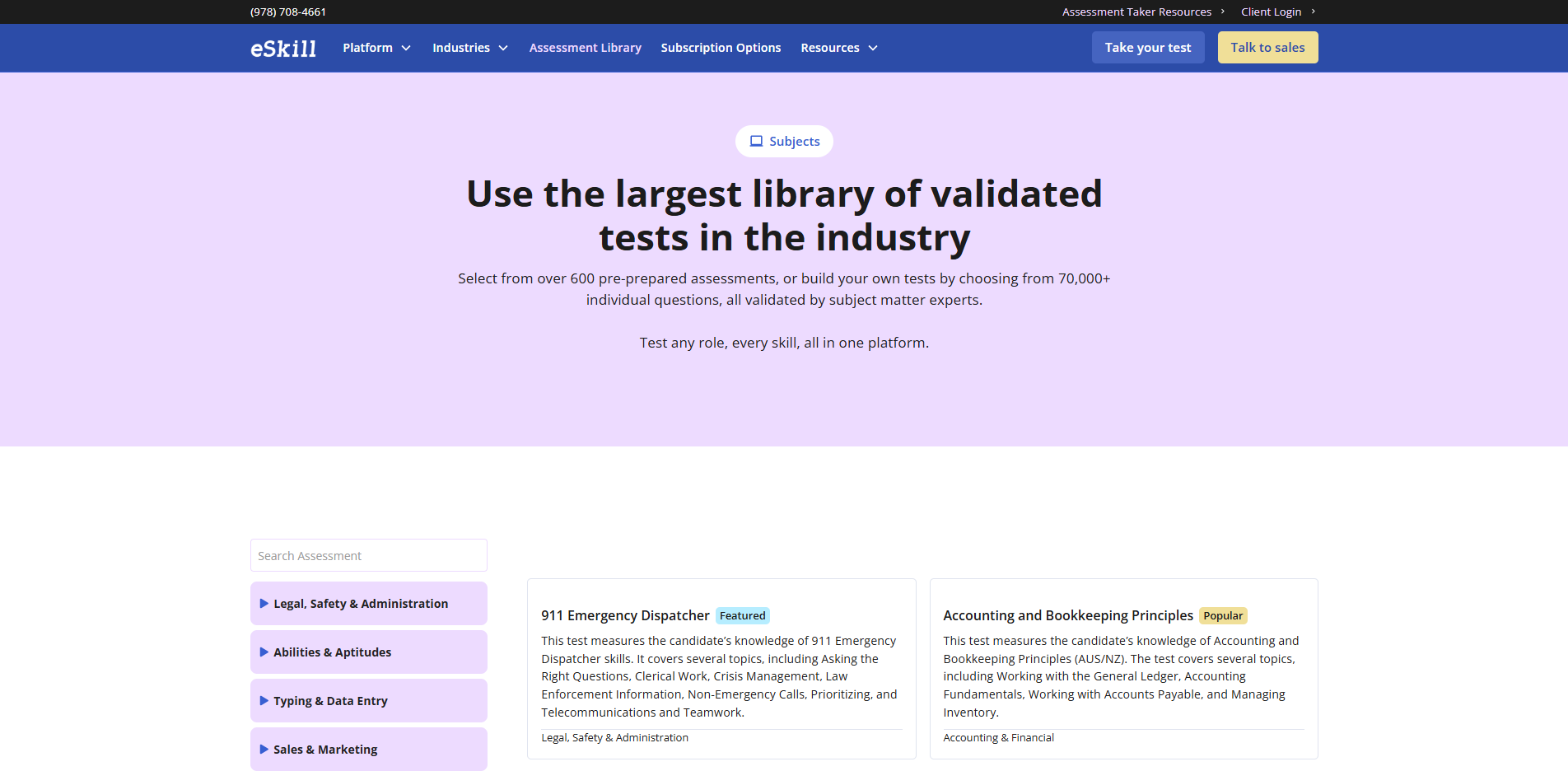
eSkill is a customizable pre-employment testing platform built around a large question library and role-specific test assembly.
Key features:
- Question library: tens of thousands of questions across hundreds of subject areas, from technical skills to office software to industry-specific knowledge.
- Custom test building: employers can mix questions from the library with their own to match a specific role.
- Proctoring: AI-assisted monitoring paired with identity verification.
- Reporting: results can be reviewed by subject, by question, or by time-to-complete.
Vervoe
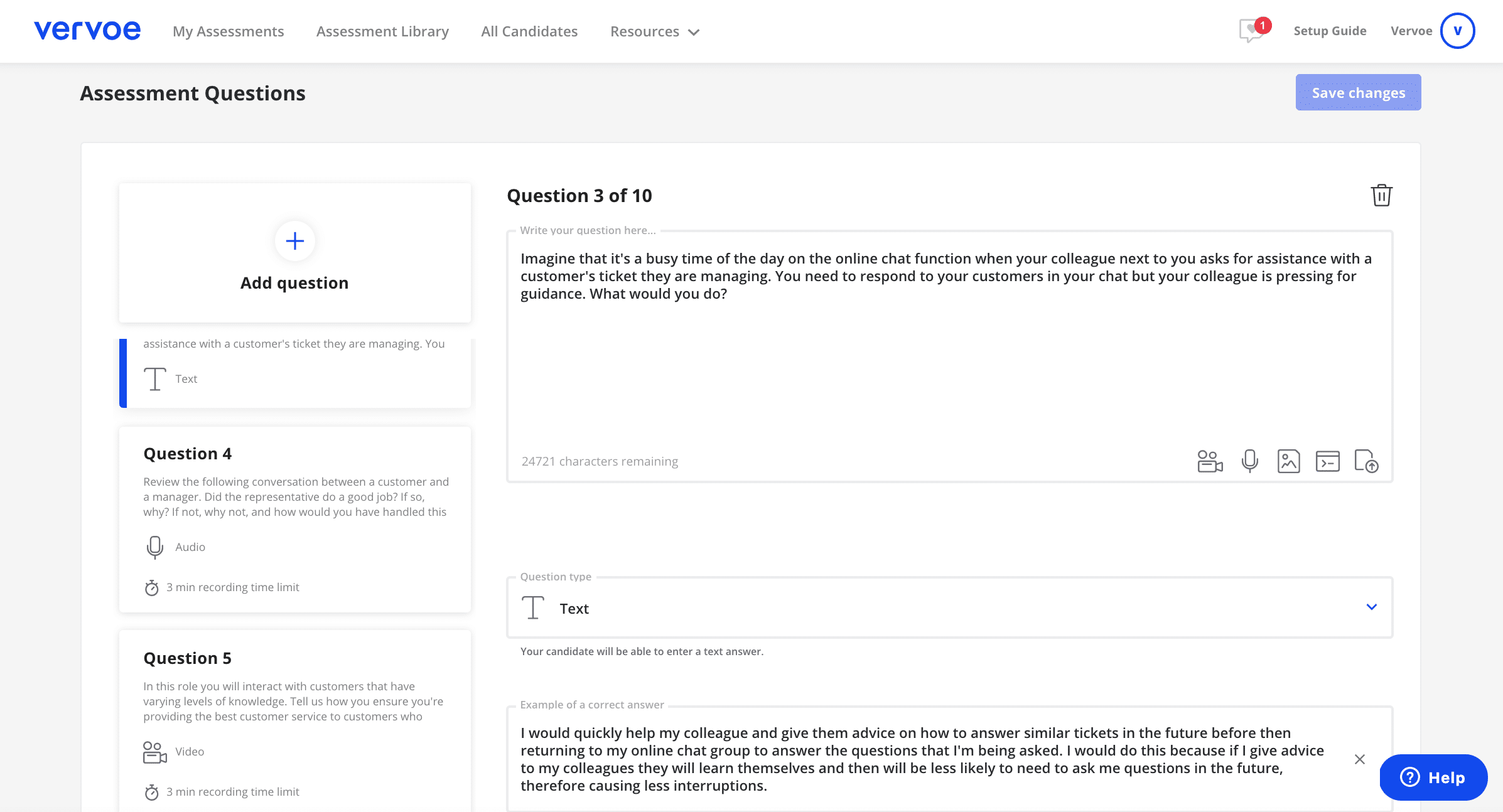
Vervoe is a skills assessment platform that uses AI to grade candidate performance on realistic, task-based questions.
Key features:
- Task-based question types: spreadsheet exercises, coding challenges, presentations, and video responses, in addition to conventional formats.
- AI grading: written and video responses are scored automatically, with the option to train the model on an employer's own graded examples.
- Assessment library: several hundred templates built by I/O psychologists, or a custom assessment generated from a job description.
- Anti-cheating suite: plagiarism detection, geolocation checks, and question randomization.
Testlify
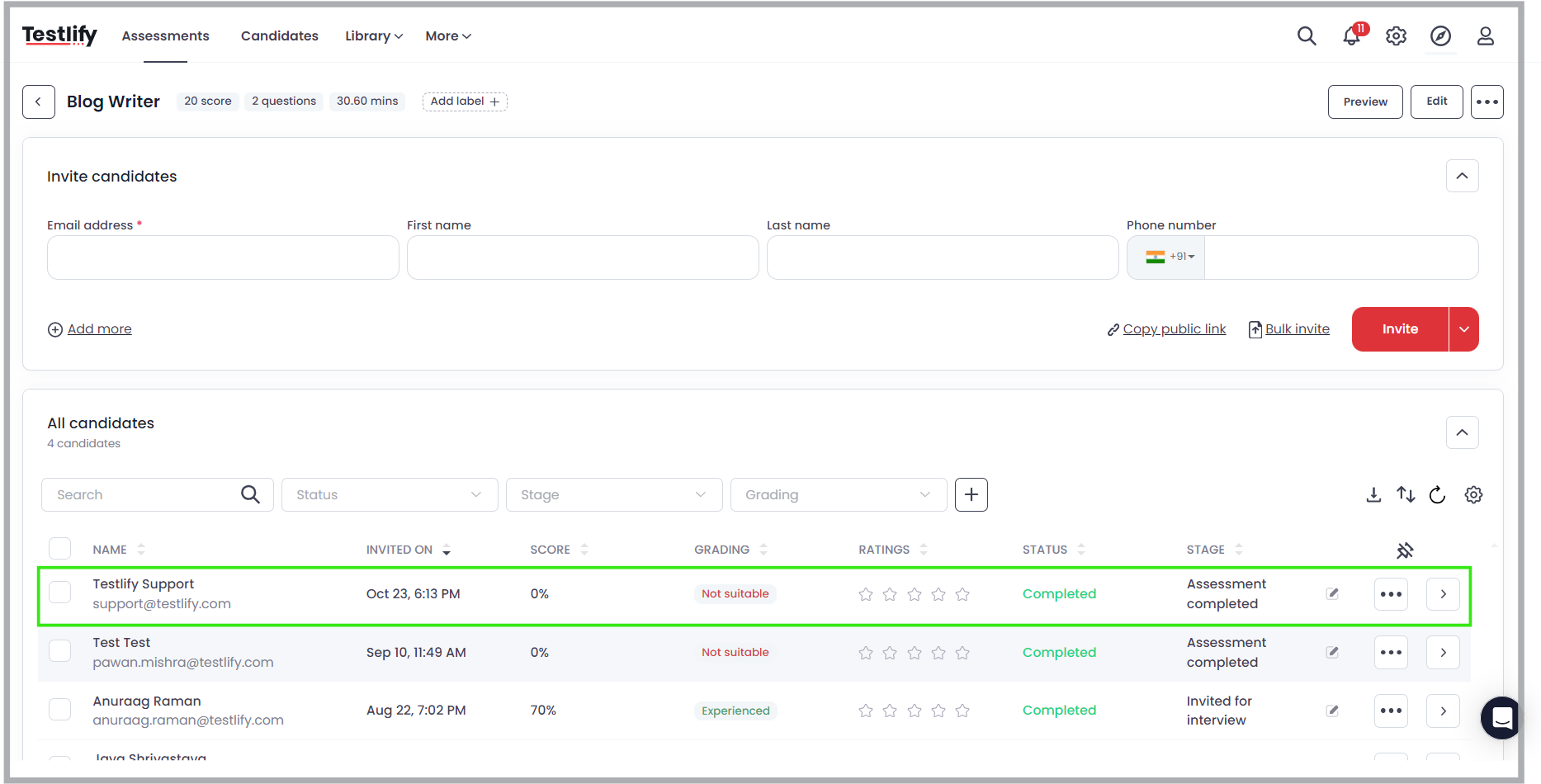
Testlify is a skills assessment and interviewing platform combining a large test library with AI-driven conversational interviews.
Key features:
- Test library: several thousand tests spanning coding, cognitive ability, personality, and role-specific skills.
- AI interviews: conversational assessments in chat, audio, or video format for evaluating communication and reasoning at scale.
- ATS integration: connects with a wide range of applicant tracking and HR systems.
- White-label option: employers can brand the candidate-facing assessment experience.
TestTrick
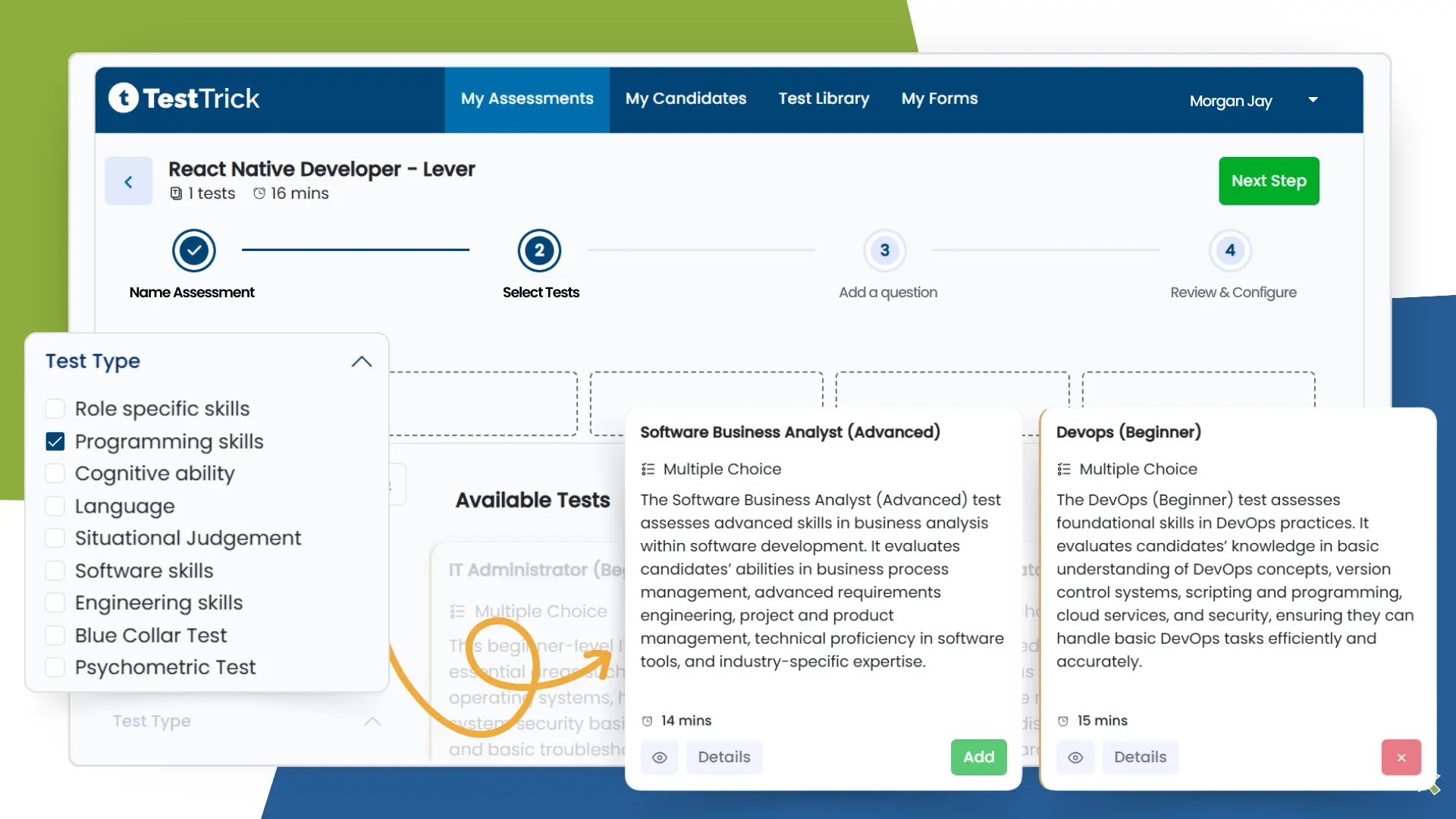
TestTrick is a skills assessment platform combining coding tests, psychometric tools, and one-way video interviews with built-in proctoring.
Key features:
- Test library: several hundred pre-built tests across technical, cognitive, and soft-skill categories, plus a custom test builder.
- Proctoring suite: webcam and screen monitoring, tab-switch detection, and browser lockdown.
- Code playback: a feature that lets reviewers see how a candidate's coding solution was built, step by step.
- ATS integration: assessments can be triggered directly from a connected applicant tracking system.
Note: TestTrick, iMocha, and Talview all lead with proctoring capabilities such as webcam monitoring, screen recording, tab-switch detection, and identity verification. These are worth prioritizing when test integrity or remote impersonation risk is a specific concern, rather than a general nice-to-have.
SMB-oriented
EmployTest
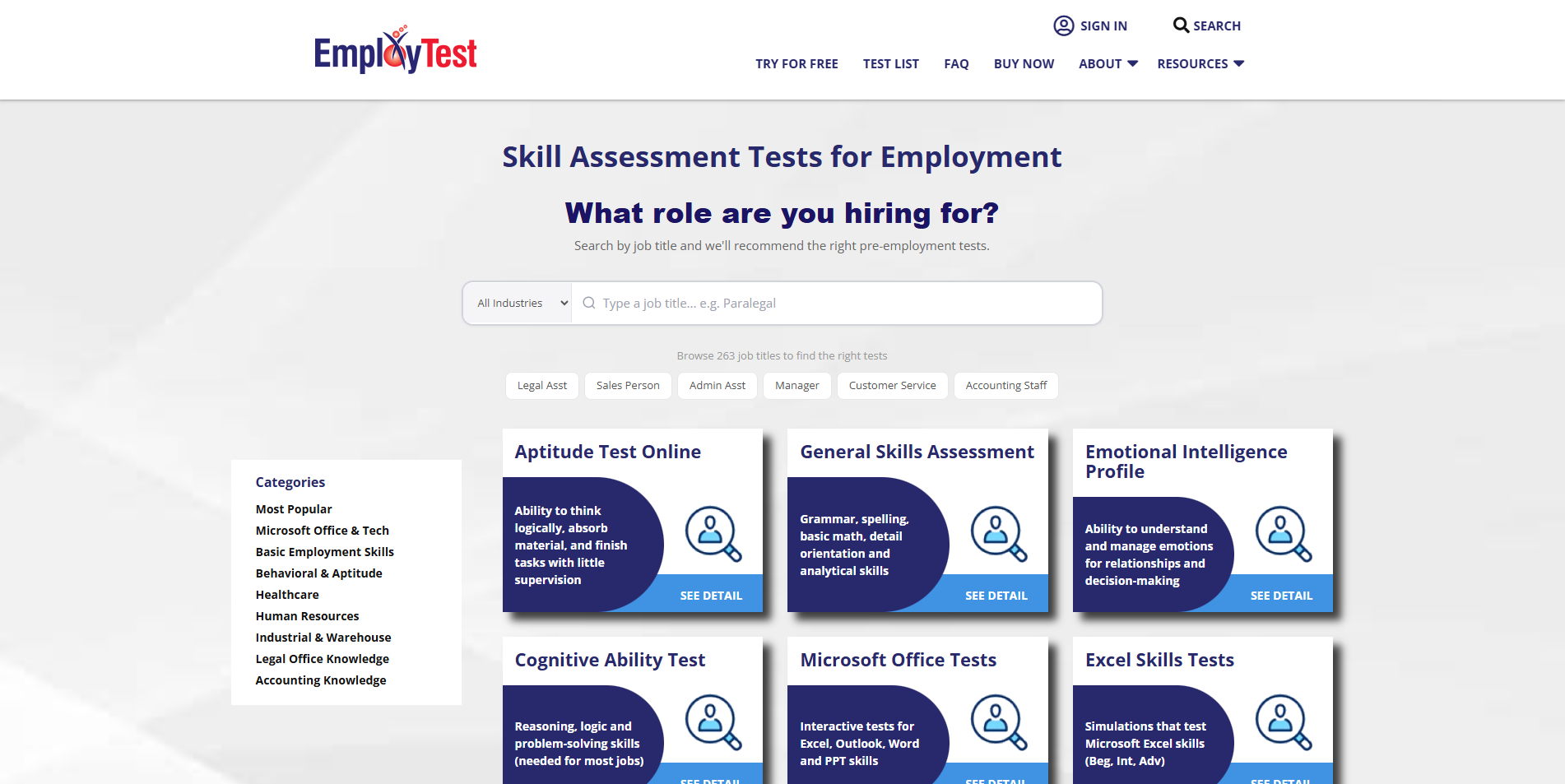
EmployTest is a pre-employment testing platform aimed at small and mid-sized businesses that don't want an annual licensing commitment.
Key features:
- Credit-based pricing: tests are purchased in small batches rather than through an enterprise contract, with credits valid for a year.
- Test library: assessments covering cognitive ability, job-specific skills, and interactive simulations of tools like Microsoft Office.
- EEOC-aligned test design: tests are built to follow US Department of Labor and EEOC guidelines.
- Support model: phone and email support included regardless of purchase volume.
How to Choose a Candidate Assessment Tool
Start by identifying your primary bottleneck; this operational constraint should dictate your evaluation method, which in turn determines the tool. Buying a personality test platform will not fix a volume problem, and a cognitive test will not tell you if someone can write production-ready code.
Once you know what you need, evaluate tools against these criteria:
- Validation evidence: Does the vendor publish or reference validity data for its tests, or is "AI-powered" doing all the marketing work?
- Role relevance and customization: Can you tailor tests to the actual skills the role requires, or are you stuck with generic templates?
- ATS integration: Do scores flow into your applicant tracking system automatically, or does someone have to copy and paste them?
- Candidate experience and completion time: A 90-minute assessment for an entry-level role will lose candidates before they finish it.
- Scoring transparency: Can you see why a candidate scored the way they did, or just a final number?
- Proctoring and anti-cheating: Necessary for high-stakes technical tests, less critical for lower-stakes screening.
- Pricing model: Per-user, per-candidate or credit-based, and flat-rate pricing all behave differently at scale. Model your actual hiring volume against each before committing.
Before rolling a recruitment assessment tool out, define a few practical settings: the pass threshold, how much weight each assessment carries relative to interviews and experience, where in the funnel the assessment sits, and a reasonable time limit.
Conclusion
Selecting a candidate assessment tool requires identifying your specific hiring bottleneck and matching it to the correct evaluation method. Focus on clear criteria like validation evidence, ATS integrations, and candidate completion times rather than marketing hype. Before launch, establish practical rules for passing thresholds and funnel placement to ensure consistency. Ultimately, replacing gut feel with structured testing results in faster screening and objectively better hires.
Frequently Asked Questions
Q: What is the overall assessment of a candidate?
A: An overall candidate assessment is a structured evaluation of an applicant's skills, technical knowledge, behaviors, and role fit using objective data rather than resume inference. It aggregates findings from multiple evaluation methods, such as work samples and structured interviews, to build a verifiable profile of actual capability. Platforms like Manatal support this process by centralizing automated screening results and scores directly alongside the candidate profile for evidence-based decision-making.
Q: Are there free candidate assessment tools?
A: Most established platforms operate on paid credit-based, per-candidate, or subscription models, though many offer limited free trials for evaluation. True free tiers are rare and typically restrict candidate volume, disable integration capabilities, or limit access to validated test libraries. Organizations should audit these functional constraints against their active hiring volume before attempting to build a long-term selection workflow around a free tool.
Q: Which type of assessment best predicts job performance?
A: Validated personnel selection research shows that skills and work-sample tests are the single most effective predictors of on-the-job performance. By requiring applicants to perform direct role requirements, such as writing code or responding to a mock customer ticket, these exercises provide objective proof of capability. This method yields significantly higher predictive validity than relying on resume keywords, years of experience, or unstructured interview rapport.
Q: What are the 4 rules of candidate assessment?
A: Successful deployment relies on four operational rules: defining a clear pass threshold, weighting the test score against interviews, determining its exact funnel placement, and setting a reasonable time limit. Configuring these parameters upfront ensures the evaluation process remains highly consistent and legally defensible for every applicant. Manatal helps enforce these rules by delivering standardized screening automatically and embedding the scoring rubrics directly into the hiring pipeline.
Citations
.webp)






.webp)

.webp)


.webp)


