





When the job market has more qualified people than vacancies, they negotiate harder on pay, expect faster decisions, and walk away from slow or unclear processes.[1] This is a candidate-driven market, and in 2026, it describes the reality for employers hiring skilled talent across most industries. This guide explains what a candidate-driven market is, whether the labor market still favors candidates, what causes the imbalance, and how recruiters and hiring managers can win scarce talent with a repeatable, tool-anchored workflow.
What Is a Candidate-Driven Market?
A candidate-driven market exists when the number of open roles exceeds the number of available, qualified candidates. In this environment, candidates hold negotiating leverage over pay, benefits, flexibility, and hiring speed. They can afford to be selective because they typically have multiple options and can walk away from any employer that moves slowly or offers less than competitors.
The opposite is an employer-driven market, where more people are looking for work than there are roles to fill. Employers can be more selective, set stricter requirements, and move at their own pace because candidates compete for limited positions.
Are We Still in a Candidate-Driven Market in 2026?
The answer depends on the role and the skills required. Overall hiring demand has cooled since the peaks of 2021 and 2022, but skilled and specialized talent remains scarce. According to ManpowerGroup's 2026 Talent Shortage Survey, which surveyed 39,000 employers across 41 countries, 72% of employers globally report difficulty filling roles, down only modestly from 74% in 2025.[2]
The hardest-to-find skills have shifted. For the first time, AI development and AI literacy top the global shortage list, overtaking traditional engineering and IT capabilities. This signals that the market is not uniformly candidate-driven; it is skills-specific. Employers hiring for AI, machine learning, cybersecurity, healthcare, and skilled trades face acute competition for talent. Employers hiring for generalist roles where applicant volume is high may face less pressure.
For most employers reading this, the practical takeaway is clear: if your open roles require specialized skills, you are operating in a candidate-driven market and need to compete on speed, fit, and candidate experience.
What Causes a Candidate-Driven Market?
Four factors drive a candidate-driven market:
- Structural skills shortage: Educational pipelines fail to meet talent needs. The SHRM 2025 Talent Trends Report shows approximately 70% of organizations face recruitment challenges due to skills gaps, while World Economic Forum research indicates about 60% of workers require major reskilling.[3][4]
- Low unemployment in specialized functions: Specialized fields remain severely undersupplied. Gartner's Future of Work Trends Report notes that roles in AI, cybersecurity, healthcare, and skilled trades face constant talent deficits, giving candidates multiple competing offers.[5]
- Demographic shifts: Aging populations shrink the senior labor pool. Insights from SHRM HR Leadership Research and Gallup's State of the Global Workplace Report confirm that lower birth rates and retirements mean fewer workers enter the market than leave it.[6][7]
- Fast-moving skill demands: Rapid AI adoption renders older skill sets obsolete. Gartner HR Research highlights an outsized surge in demand for critical AI capabilities, forcing employers to compete for candidates who combine tech literacy with critical judgment.[8]
These causes are structural, not cyclical. Even when hiring freezes occur, the underlying shortage persists in specialized domains.
Key Levers to Win Top Talent in a Candidate-Driven Market
Top talent holds the leverage in a candidate-driven market. Traditional, drawn-out recruitment processes guarantee you will lose highly qualified professionals to faster competitors. Winning requires talent teams to treat candidates like premium leads, focusing on speed, transparency, and active selling rather than passive screening.
1. First-Mover Advantage With AI Shortlisting
Manual resume screening creates bottlenecks. If you take three days to review an application, the candidate is already interviewing elsewhere. You must engage qualified applicants before your competitors even open their resumes.
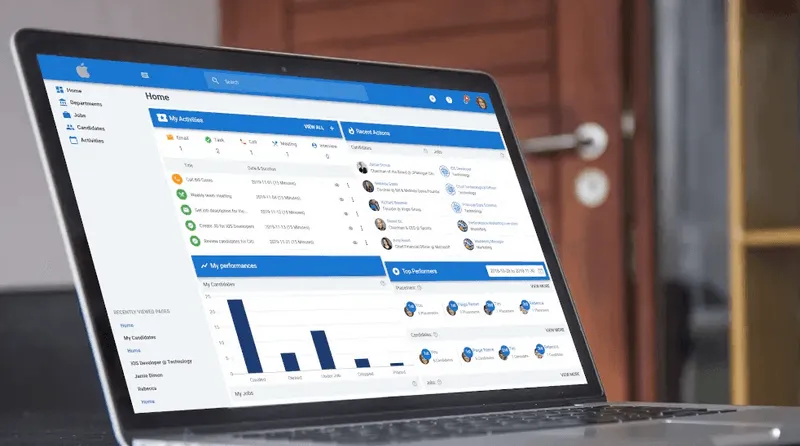
How to Run It: Deploy Manatal AI Recommendations to automatically extract requirements from your job description and score incoming applications. Open your ranked shortlist daily and immediately launch outreach to the highest-scoring candidates. Use customizable weighting to prioritize the exact skills or experience the hiring manager needs.
2. Radical Pay Transparency
High-demand professionals will not engage in lengthy hiring processes for roles with hidden compensation. Hiding salary bands shrinks your applicant pool and leads to expensive, late-stage drop-offs when expectations inevitably clash.
How to Run It: Establish competitive pay bands using real-time compensation tools like Pave or Levels.fyi for tech roles, or enterprise benchmarking databases like Payscale and Mercer. Set standard pay fields inside your ATS to require range entries before job requisitions go live, ensuring automatic compliance on job boards. Publish the defensible salary range directly in the job posting, and state the compensation band in your initial outreach message to establish trust and filter out mismatched expectations immediately.
3. Aggressive Interview Compression
Time kills deals. A four-week interview loop is a major liability when top candidates receive multiple offers within days. You must condense the evaluation timeline without sacrificing assessment quality.
How to Run It: Set strict stage SLAs: contact shortlisted candidates within 24 hours and complete all interviews within 7 to 10 days. Run technical and behavioral screens in parallel rather than sequentially. Use calendar integrations to book the next round immediately upon completing a successful stage.
{{cta}}
4. Active Selling Throughout the Funnel
Assessing the candidate is only half the job; you must convince them to choose your organization over competing offers. Generic interviews that feel like interrogations will push top talent toward companies that make them feel valued.
How to Run It: Shift the interview narrative to align with the candidate's career goals. Pitch growth opportunities, flexibility, and team dynamics in every round. Send brief, personalized check-ins between stages to maintain momentum and keep candidates warm.
5. Pre-Approved, Same-Day Offers
Administrative delays during the offer stage invite counter-offers from current employers or competing recruiters. If you wait days to get final executive sign-off, you risk losing the candidate at the finish line.
How to Run It: Secure finance or executive approval for the maximum salary band before you even post the role. Once the final human checkpoint is complete and the hiring manager makes a decision, extend a verbal offer within hours of the final interview, followed immediately by an e-signature contract.
How to Win Top Talent in a Candidate-Driven Market
Winning in a candidate-driven market requires a multi-dimensional approach. Generic advice ("be fast," "sell your company") is not enough. Each lever below addresses a distinct part of the problem.
1. Compress Time-to-Offer
Slow processes lose candidates. Skilled candidates lose interest and disengage when a hiring process drags, and the ones weighing multiple offers rarely wait around for a decision. In Cronofy's 2024 Candidate Expectations Report, a survey of 12,000 candidates across seven countries, 42% said they had left a recruitment process because it took too long to schedule an interview.[9]
Set stage-level SLAs (e.g., screen within 48 hours, complete interviews within 10 business days, extend offer within 24 hours of final interview). Measure elapsed time at each stage and identify bottlenecks.
2. Benchmark Compensation and Publish Ranges
In a candidate-driven market, underpaying is a quick way to lose candidates to competitors. Before posting a role, benchmark the offer against market data. Publish the pay range in the job posting. Candidates expect transparency; withholding compensation signals that you are not competitive or not serious.
3. Lead With Your Employer Brand and EVP
Salary alone does not win candidates who have multiple offers. Flexibility, career growth, meaningful work, and team culture matter. Communicate these in job postings, career pages, and conversations throughout the process. A strong employer brand and a clear value proposition give candidates a reason to choose you when compensation is comparable across offers.
4. Prioritize Candidate Experience and Communication
Poor communication causes candidates to withdraw. When candidates are left waiting without updates, they assume the role is a dead end and move on to employers who keep them informed. Set expectations early (timeline, process, next steps), respond to messages quickly, and close the loop with every candidate, including those you reject. Candidates who receive a respectful "no" are more likely to reapply later or refer others.
5. Build Talent Pipelines Before You Need Them
Starting cold on each requisition is a disadvantage. Maintain an ongoing talent pool of qualified candidates from previous pipelines, referrals, and passive outreach. When a role opens, you can tap this pool first and move faster than competitors who start sourcing from scratch.
How to Measure Whether Your Strategy Works
Track these metrics to confirm your candidate-driven market strategy is working:
- Offer acceptance rate: The percentage of extended offers that candidates accept. A declining rate signals compensation, process, or experience problems.
- Time-to-offer: Elapsed days from first candidate contact to offer extended. Shorter is better. Benchmark against your own stage SLAs and watch the trend over time rather than a single snapshot.
- Candidate drop-off/ghosting rate: The percentage of candidates who withdraw or stop responding at each stage. High drop-off in early stages often indicates slow scheduling or poor communication. High drop-off late in the process may indicate compensation misalignment or a better competing offer.
- Quality of hire: Performance and retention of new hires at 6 and 12 months. A fast process is worthless if it consistently produces poor hires. Track quality alongside speed to ensure you are not trading one for the other.
Conclusion
A candidate-driven market rewards employers who move quickly, communicate clearly, and compete on more than salary. The 2026 labor market is not uniformly candidate-driven, but for roles requiring specialized skills, the imbalance is structural and persistent. Employers who treat speed, fit, and candidate experience as operational priorities (not just nice-to-haves) will win the candidates they need, while those who rely on slow, unclear processes will lose them to faster competitors.
Start by auditing your current time-to-offer and drop-off rates. Identify the bottlenecks. Implement stage SLAs. Use AI-assisted matching to accelerate screening without sacrificing judgment. And measure the results.
Frequently Asked Questions
Q: What is the difference between a candidate-driven market and an employer-driven market?
A: In a candidate-driven market, open roles outnumber qualified candidates. Candidates hold leverage and can negotiate harder on pay, benefits, and flexibility. Employers compete for talent and must move quickly to secure hires. In an employer-driven market, candidates outnumber open roles. Employers can be more selective, set stricter requirements, and move at their own pace because candidates compete for limited positions.
Q: Are we still in a candidate-driven market in 2026?
A: For specialized skills, yes. According to ManpowerGroup's 2026 Talent Shortage Survey, 72% of employers globally report difficulty filling roles. AI, machine learning, cybersecurity, healthcare, and skilled trades remain undersupplied. For generalist roles with high applicant volume, the market may feel more balanced or employer-driven. The answer depends on the skills you are hiring for. To navigate these varying dynamics across different functions, recruitment platforms like Manatal help teams track talent pipelines in real time and automatically parse applicant skill sets to prioritize high-demand talent efficiently.
Q: What causes a candidate-driven market?
A: Four main causes: structural skills shortages (educational pipelines not keeping pace with demand), low unemployment in specialized functions, demographic shifts (aging workforces and fewer new entrants), and fast-moving skill demands (especially AI and automation). These factors are structural, not cyclical, which is why the shortage persists even when overall hiring cools.
Q: What is an example of a candidate-driven market?
A: AI and machine learning hiring in 2026 is a clear example. AI skills now top the global shortage list, according to ManpowerGroup. Candidates with AI development or AI literacy skills receive multiple offers, can negotiate higher compensation, and often choose roles based on flexibility, growth opportunities, or mission alignment rather than salary alone. Employers hiring for these roles compete on speed, experience, and employer brand, not just pay, frequently using AI-powered sourcing tools like Manatal to identify and engage passive AI talent before competitors do.
Citations
.webp)







.webp)

.webp)


.webp)


