





Organizations that separate payroll, employee records, and recruitment systems create data silos that slow decisions and obscure retention risks. HCM and talent management become fragmented when operational data sits in one system, and performance or hiring insights live in another. Integrating Human Capital Management with talent management connects workforce operations to strategic decision-making, allowing HR teams to detect turnover patterns earlier, align compensation with performance, and build structured employee records from day one. When hiring data, payroll information, and performance outcomes move across systems in a controlled way, workforce planning shifts from reactive reporting to informed action.
Differences between HCM and Talent Management
Before discussing integration, we need clarity on what each function actually does. These terms are often used interchangeably, but they serve distinct purposes. Understanding that distinction makes the case for integration much clearer.
HCM handles the operational core of workforce management. It includes:
- Payroll
- Benefits administration
- Time and attendance
- Compliance reporting
- Employee records
- Workforce planning
In practical terms, HCM is your system of record. It ensures employees are paid accurately and the organization meets regulatory obligations. Without it, nothing functions.
But HCM alone does not drive performance or retention. It maintains the workforce. It does not develop it.
Meanwhile, talent management focuses on growth and capability across the employee lifecycle, including:
- Recruitment
- Onboarding
- Performance management
- Learning and development
- Succession planning
- Engagement
Here’s the connection: talent management depends on accurate workforce data. And that data lives inside HCM. When the two operate separately, strategy runs on partial information. That’s where integration becomes critical.
The Importance of Integrating HCM and Talent Management
Once you understand the distinction, the limitation of separation becomes obvious. Disconnected systems distort decision-making and cause inconvenience.
A Unified Workforce View
When systems integrate, employee data doesn’t just sit in separate modules. It moves across functions automatically, connecting payroll, performance, and career progression into one continuous record.
That connection changes how decisions are made. Compensation can be evaluated against documented performance. Career planning reflects tenure, skills, and past evaluations. Promotions and internal moves are tracked within the same profile rather than patched together from different systems.
Instead of reconciling spreadsheets to piece together context, leadership sees a complete employee narrative in one place. And that unified visibility is what makes proactive retention possible.
Turning Retention from Reactive to Proactive
Without integrated data, HR often finds out about problems at the point of resignation. Exit interviews become the first real signal that something was wrong.
For example:
- High performers whose compensation hasn’t evolved
- Employees whose development activity has stalled
- Strong contributors repeatedly passed over for internal movement
Once performance data sits alongside compensation history and career progression, these patterns stop being anecdotal. They become measurable and can be managed.
Operational Efficiency That Enables Strategic Focus
The integration of HCM and talent management does more than improve visibility. It also removes friction from day-to-day HR operations.
Instead of re-entering data across multiple systems, information moves automatically. New hire details transfer from recruitment into onboarding and payroll. Performance outcomes update employee records. Promotions reflect instantly in compensation structures.
The administrative layer becomes lighter because duplication disappears. What this really changes is capacity. When HR teams spend less time reconciling systems, they gain time to focus on workforce design, succession planning, and skills development.
And that’s where recruitment becomes critical. Because the quality of data entering the system determines how effective every downstream process will be.
Key Features of Integrated HCM and Talent Management Software
When evaluating an HCM platform, focus on four fundamentals: intelligence, scalability, integration, and usability. The system should not only store workforce data but actively help you interpret it, scale with growth, connect with other tools, and drive consistent adoption across teams.
Core Capabilities to Prioritize
- AI-Driven Workforce Analytics: Identifies turnover patterns, skill gaps, and retention risks using integrated employee data.
- Scalable Architecture: Supports headcount growth and organizational change without requiring system replacement.
- Open API Integrations: Connects seamlessly with recruitment, learning, engagement, and payroll tools to prevent new data silos.
- Strong User Experience: Encourages adoption through intuitive dashboards and self-service workflows for employees and managers.
- Agentic AI Workflows: Automates structured processes such as onboarding validations and risk flagging, reducing manual oversight.
To make these capabilities actionable, configure AI models to monitor integrated performance and compensation data, and review workforce dashboards on a fixed cadence to adjust retention strategies proactively.
Recruitment’s Role in Strengthening HCM and Talent Management
Many HCM platforms manage payroll and compliance effectively, but treat recruitment as a lightweight add-on. This often limits sourcing flexibility and structured interview data capture.
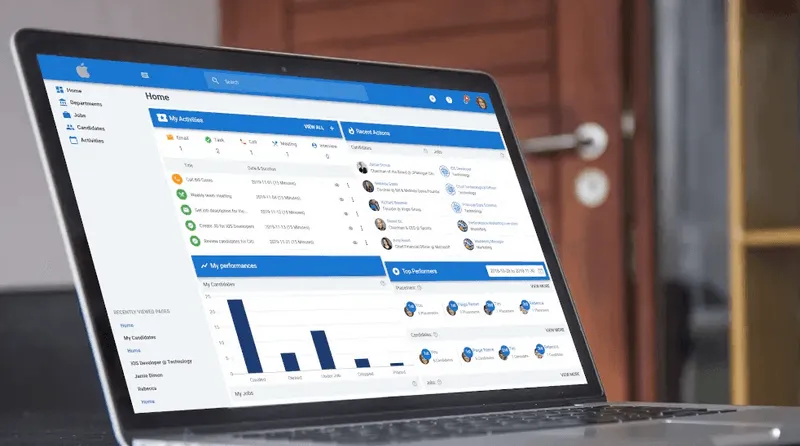
This is where HRMS integration becomes critical. Manatal operates as a dedicated talent acquisition layer that connects directly with HRMS platforms. Through its HRMS integrations and OpenAPI connectivity, structured hiring data can be transferred once a candidate is marked as hired. This may include:
- Candidate profile information
- Resume data
- Interview evaluations
- Job role and department details
- Compensation information captured during hiring
Instead of manually re-entering data into the HRMS after every hire, recruitment data flows into the employee record based on integration configuration.
The practical impact is straightforward:
- Onboarding begins with complete candidate data
- Payroll setup uses accurate, structured information
- Employee records are consistent from day one
- Lifecycle reporting connects recruitment source to long-term performance
Rather than replacing your HRMS, Manatal strengthens the recruitment layer and ensures that hiring data enters your workforce system cleanly. In an HCM talent management framework, this preserves data integrity across the entire employee lifecycle.
{{cta}}
Implementation Complexity and Cost Considerations
Unified suites typically involve longer initial implementation cycles due to broader configuration requirements. However, vendor management is centralized.
A modular approach allows faster ATS deployment but requires integration planning, field mapping, and data governance oversight.
Hidden costs often emerge in reporting layers. When systems are not deeply integrated, organizations may require external business intelligence tools to unify workforce data.
Decision-makers should evaluate total cost of ownership over a multi-year horizon rather than focusing solely on software licensing.
Assessing Your Integration Maturity
Not every organization requires a unified suite. The key is understanding your integration maturity.
Level 1: Disconnected Systems
- Manual data entry between ATS and HRMS
- Fragmented lifecycle reporting
- Retention analysis conducted retrospectively
Level 2: API-Connected Systems
- Structured data transfer from recruitment to HRMS
- Reduced administrative duplication
- Basic lifecycle reporting across systems
Level 3: Unified Workforce Intelligence
- Recruitment, performance, and compensation data analyzed together
- Internal mobility tracked using structured skill data
- Retention indicators monitored proactively
Most organizations operate at Level 1 or 2. Progression depends on improving data flow, not consolidating every tool into one platform.
Selecting the Optimal Tech Stack for Your Needs
Choosing between a bundled HCM suite and a modular ecosystem depends on hiring complexity, payroll structure, and reporting needs.
The strongest architecture is one where recruitment data enters the workforce system cleanly and remains structured across the employee lifecycle.
Conclusion
Integrating HR systems into a unified HCM and talent management strategy can unlock your workforce's potential. HCM manages operations and compliance, while talent management focuses on engagement and retention. Merging these enhances decision-making, employee experience, and development, leading to better recruitment and a motivated workforce. This approach not only manages resources but also cultivates human capital, driving innovation and growth. Consider a free trial with Manatal to see how AI-driven recruitment can enhance your HCM strategy and talent acquisition.
Frequently Asked Questions
Q: What is the difference between HCM and talent management?
A: HCM focuses on workforce administration, such as payroll, benefits, and compliance. Talent management focuses on attracting, developing, and retaining employees. Integration connects operational accuracy with strategic workforce decisions.
Q: Should recruitment sit inside HCM?
A: If hiring volume is low and workflows are simple, embedded recruitment functionality may be sufficient. However, organizations managing structured interviews, talent pools, agency collaboration, or high-volume sourcing typically require a specialized ATS integrated with their HCM. The decision depends on recruitment complexity and reporting depth, not just system convenience.
Q: What are the benefits of integrating ATS with HCM?
A: Integration reduces manual data entry, improves onboarding accuracy, and enables lifecycle reporting that connects recruitment source to performance and retention outcomes. Over time, this improves workforce planning and recruitment budget allocation.
Citations
.webp)






.webp)

.webp)


.webp)


