





Most companies discover their readiness gap the week a key leader resigns, when there is no obvious successor and no bench to draw from. Succession planning closes that gap by treating leadership continuity as a standing process rather than a scramble. The sections below cover what it is, why it matters now, and how to run it, along with the output of each step.
What Is Succession Planning?
Succession planning is the ongoing process of identifying critical roles and building a ready pool of candidates to fill them before those roles open. That pool is mostly internal, with external candidates added where no one inside is ready.
It differs from replacement planning, which is reactive and names one backup per role once a vacancy looms. It also differs from workforce planning, which forecasts headcount and skills across the whole organization rather than continuity for named roles.
Why Succession Planning Matters in 2026
Start with the gap. In 2025, just 22% of HR leaders reported that their organization had a formal succession plan, according to SHRM. [1] Most companies are exposed to a departure they have not planned for.
That exposure lands when development is already the priority. Leadership and management development was named the number-one priority for HR leaders in 2025, according to Gartner. [2]
The payoff splits into four distinct dimensions:
- Business continuity: a ready successor keeps critical work moving when someone leaves, reducing operational risk.
- Retention and engagement: a visible growth path gives high performers a concrete reason to stay.
- Lower hiring cost: an internal bench cuts the external search and onboarding spend a surprise vacancy creates.
- Knowledge retention: a planned transition transfers institutional know-how instead of losing it at the door.
Types of Succession Planning
A complete plan accounts for more than one scenario:
- Emergency succession: a fast, interim plan for a sudden and unplanned exit.
- Long-term strategic succession: a developed pipeline for critical roles you expect to turn over.
- Beyond the C-suite: business-critical non-executive roles need successors too, not only top leadership.
- Family-business ownership transfer: a distinct case where ownership, not just a job, changes hands.
The Succession Planning Process
Follow these steps sequentially to evaluate roles, assess internal talent, and build clear development pathways while generating concrete assets at every stage.
1. Identify Business-Critical Roles
Evaluating every position equally dilutes development resources and distracts from core operational risks. Prioritizing roles based on business impact and vacancy risk ensures talent development efforts focus where leadership gaps would cause immediate disruption.
How to Run It: Score every leadership and operational function using a 1–5 scale across two variables: Impact if Vacant (revenue, operations, regulation) and Vacancy Risk (retirement timeline, flight risk, skill scarcity). Multiply these scores using the Gartner Critical Role Framework or McKinsey Value-at-Risk Model to calculate a total risk rating.
Read more about: Critical Role Identification Frameworks
Identify business-critical leadership roles in your talent management software
2. Define Success Profiles
Generic job descriptions reflect past requirements rather than future strategic priorities. Success profiles establish clear, forward-looking criteria so high-potential candidates build the exact capabilities required on their first day in the role.
How to Run It: Interview executive sponsors and top-performing incumbents to document what each role requires over the next 3–5 years. Adapt the Lominger/Korn Ferry Competency Model or SHRM Success Profile Templates to list 3–5 core technical skills, operational competencies, and leadership behaviors needed on Day 1.
3. Map Talent on a 9-Box Grid
Subjective manager evaluations introduce bias and obscure the difference between current performance and future leadership capacity. Plotting employees on a standardized grid provides an objective view of organizational bench strength.
How to Run It: Evaluate employees during talent reviews by scoring past performance (KPIs over 12–24 months) against future potential (capacity for complex leadership). Plot candidates into the GE 9-Box Grid or your HRIS talent module to isolate high-potential "Stars."
4. Assign Readiness Timelines
Identifying internal candidates without measuring their readiness creates a false sense of pipeline security. Assigning concrete timelines ensures targeted intervention for candidates who need structured development before stepping into key roles.
How to Run It: Compare your high-potential shortlist against each role's success profile to identify capability gaps. Use a Bench Strength Analysis Framework to place each candidate into a readiness window: Ready Now (0–6 months), Ready Soon (1–2 years), or Future Horizon (3+ years).
5. Build Individualized Development Plans (IDPs)
Formal classroom training alone fails to build complex operational capabilities. Implementing a structured experiential learning framework ensures candidates close capability gaps through active execution and executive mentorship.
How to Run It: Close capability gaps using the 70-20-10 Learning Model: 70% experiential (stretch projects), 20% exposure (executive mentoring), and 10% formal training (certifications). Set clear completion deadlines for each action item using a standard 70-20-10 IDP worksheet.
Track Individualized Development Plans (IDPs) in your HRIS
6. Establish Communication and Maintenance Protocols
Unmanaged succession data becomes obsolete quickly, while mismanaged disclosures lead to broken expectations or employee turnover. Establishing centralized tracking and clear communication protocols keeps pipeline data accurate and candidate expectations aligned.
How to Run It: Store candidate assessments, readiness ratings, and IDPs in a central Talent Management Information System (TMIS). Decide on your disclosure strategy (transparent vs. confidential) and conduct structured career conversations with candidates to align expectations without making contractual guarantees.
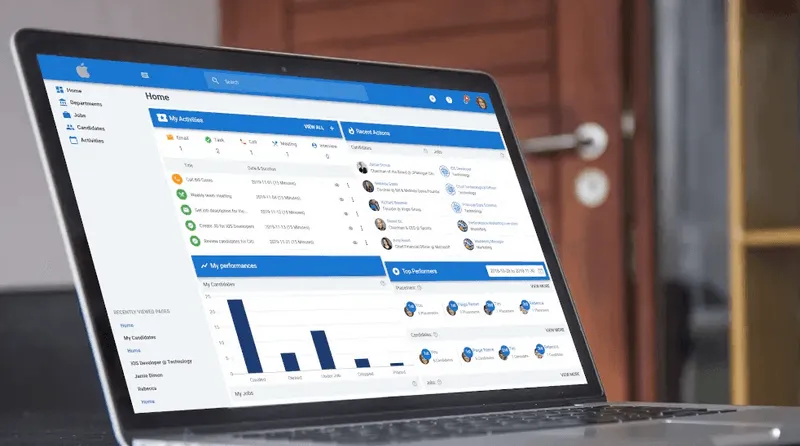
Leverage your Talent Management Information System (TMIS) to centralize succession pipelines across every business unit. Automate candidate readiness updates, track IDP milestone completions in real time, and maintain full visibility over your leadership pipeline to maintain business continuity.
7. Execute Annual Audits & Event-Driven Reviews
Schedule annual talent calibration sessions during QBR People Audits to re-evaluate performance ratings and development progress. Automatically trigger off-cycle reviews after executive departures, major promotions, or corporate reorganizations to keep data accurate.
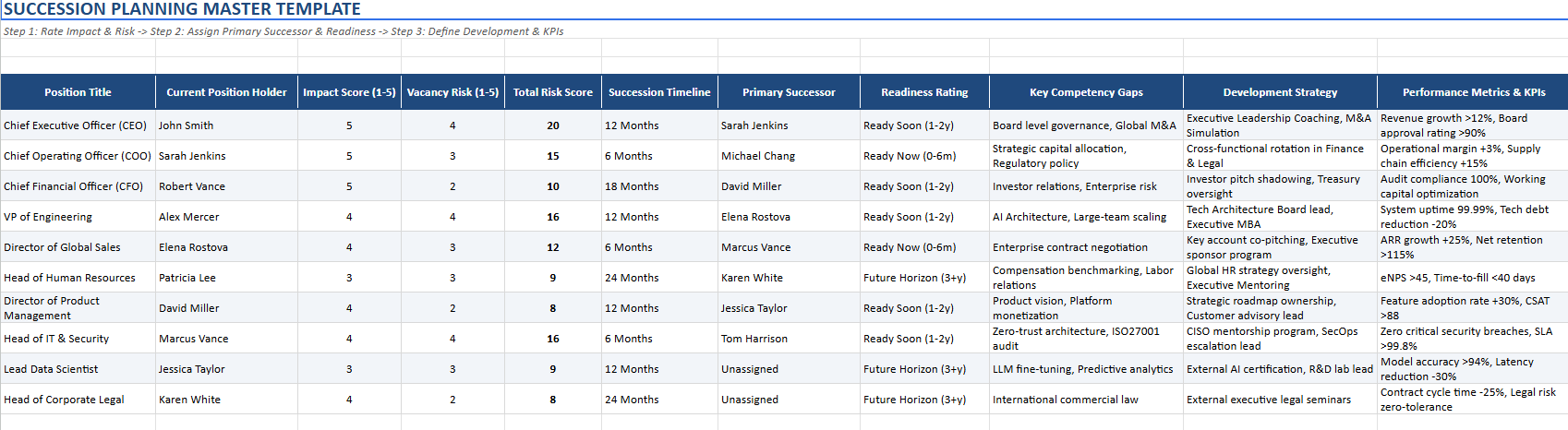
Keep your plan actionable by downloading this customizable succession planning template. It consolidates every step into one living document you can easily edit and update over time.
Succession Planning Strategies
Single-successor charts create hidden key-person dependencies and leave organizations vulnerable during sudden leadership departures. Building a resilient succession strategy requires multi-candidate talent pools, future-oriented competency alignment, and proactive external pipelines. Relying on simple replacement lists obscures skill gaps and forces reactive executive hiring.
1. Dual-Candidate Bench Construction
Naming a single successor creates a single point of failure if that individual departs or underperforms. Developing multi-candidate pools per critical seat ensures operational continuity and fosters healthy internal competition.
How to Run It: Assign at least two high-potential candidates to every critical role pipeline. One "Ready Soon" (1–2 years) candidate and one "Future Horizon" (3+ years) candidate. Rotate both through structured cross-functional projects to build parallel leadership capabilities across the pool.
2. Future-State Competency Mapping
Developing successors to replicate an incumbent’s current skillset leads to strategic misalignment as business models evolve. Mapping competencies against 2-to-3-year organizational projections ensures successors are equipped to lead future operational priorities.
How to Run It: Audit corporate strategy documents for upcoming digital transformations, expansion goals, or market shifts. Redefine target succession profiles using projected future capabilities rather than current job descriptions, and adjust individual development plans annually to match these evolving metrics.
3. Inclusive Pipeline Diversification
Homogeneous successor slates narrow strategic decision-making and reinforce organizational groupthink at senior levels. Structuring diverse candidate pipelines broadens leadership capabilities and expands the available talent pool for critical seats.
How to Run It: Implement demographic and functional diversity criteria for talent review calibrations. Track slate composition across all critical roles and pair high-potential diverse candidates with executive sponsors to ensure equitable access to high-visibility stretch assignments.
4. External Fallback Pipeline Integration
Waiting until an internal gap becomes an active vacancy forces rushed, high-cost executive recruitment. Building an external fallback pipeline early guarantees ready-to-hire talent if internal candidates are not ready within a 1-to-2-year window.
How to Run It: Identify critical roles lacking "Ready Now" internal candidates and treat the gap as a proactive sourcing initiative. Store external leadership-caliber candidates in Manatal's Candidate Database, utilizing AI Recommendations to automatically score saved profiles against your role's success profile.
{{cta}}
Succession Planning Tools and Software
These tools mostly do a few concrete jobs: they visualize the 9-box grid, hold talent profiles, and track readiness. They can also model org-chart scenarios and connect performance and learning data in one view. For a small organization, a shared spreadsheet covers the first version fine.
Larger teams often run succession as one module inside a broader suite. If that fits you, our guide to talent management systems shows where succession sits among performance, learning, and analytics. To feed readiness ratings with real signals, connect the tooling to your talent analytics and existing performance data.
Common Succession Planning Mistakes
Most failed plans share the same handful of errors. Each has a direct fix:
- Planning only for the C-suite. Extend the plan to business-critical non-executive roles that would stall work if vacated.
- Naming a single successor. Build a pool of two or more candidates per role to remove single-point risk.
- Treating it as a one-time document. Review it on a set cadence so it stays a living process, not a filed spreadsheet.
- Stopping at identification. Attach a funded development plan to every successor, because a name on a chart is not a plan.
- Handling disclosure poorly. Be honest about development without promising a role, so trust survives the conversation.
Conclusion
A succession plan names who could step up; a recruitment platform keeps real candidates ready when the internal bench runs thin. Manatal's Candidate Database and AI Recommendations give you a maintained external pool, scored against each role's success profile. Built-in GDPR, CCPA, PDPA, and SOC 2 Type II compliance come standard. Start for Free and turn your succession gaps into a live pipeline.
Frequently Asked Questions
Q: What are the 5 steps of succession planning?
A: Identify business-critical roles, define each role's success profile, assess and shortlist candidates, rate their readiness, and build a development plan for each successor. Two supporting habits, documenting the plan and reviewing it on a cadence, keep those five steps from going stale.
Q: What are the 5 D's of succession planning?
A: In family-business and ownership contexts, the 5 D's are Death, Disability, Divorce, Disagreement, and Distress: five events that can force an unplanned transition. They are a risk checklist for owners, separate from the step-by-step process a company uses to develop internal successors.
Q: What is the difference between succession planning and replacement planning?
A: Replacement planning is reactive and names one backup per role for the moment a seat empties. Succession planning is proactive and develops a pool of candidates over time, so continuity never depends on a single name or a single day.
Q: What are the key trends in succession planning for 2026?
A: Readiness is judged by skills rather than tenure, and plans now reach past the C-suite into business-critical roles. Readiness tracking is also more data-driven than gut feel.
Q: How often should you update a succession plan?
A: At least once a year, plus after any major structural change: a reorg, an acquisition, or the loss of a key leader. A static plan decays as roles, people, and readiness shift; a plan you never revisit describes a company that no longer exists.
Q: What tools do you need for succession planning?
A: At minimum, a 9-box grid, a role success-profile template, and a readiness tracker, all of which a spreadsheet can hold at first. When a role has no ready internal successor, a recruitment platform like Manatal maintains the external successor pipeline so you are not sourcing from zero.
Citations
.webp)






.webp)

.webp)


.webp)


