





Research in recruitment experience highlights that application simplicity, communication, and transparency influence candidate engagement. [1] Organizations can actively deliver on these factors through their touchpoints, with a career page as an effective tool to reinforce their image and communicate brand messages to candidates. The company careers page examples below are analyzed for their utility: reducing application drop-off, filtering for higher-quality candidates, and removing friction from the hiring funnel.
7 Top Careers Page Examples and the Strategies Behind Them
1. Nike: Omnichannel Brand Consistency as a Trust Signal
Nike’s career page stays true to their brand identity, which many people are familiar with. Every visual decision on that page, the black and white color palette, the typography, and the logo placement, mirrors what you would see on Nike.com, in a Nike store, and across Nike's social profiles.
For recruiters, brand inconsistency between your careers page and your other channels signals organizational dysfunction. Link your career page to every brand channel. Use the exact same logo, color values, and typographic choices. The goal is to eliminate any visual gap between your careers page and the rest of your brand presence.


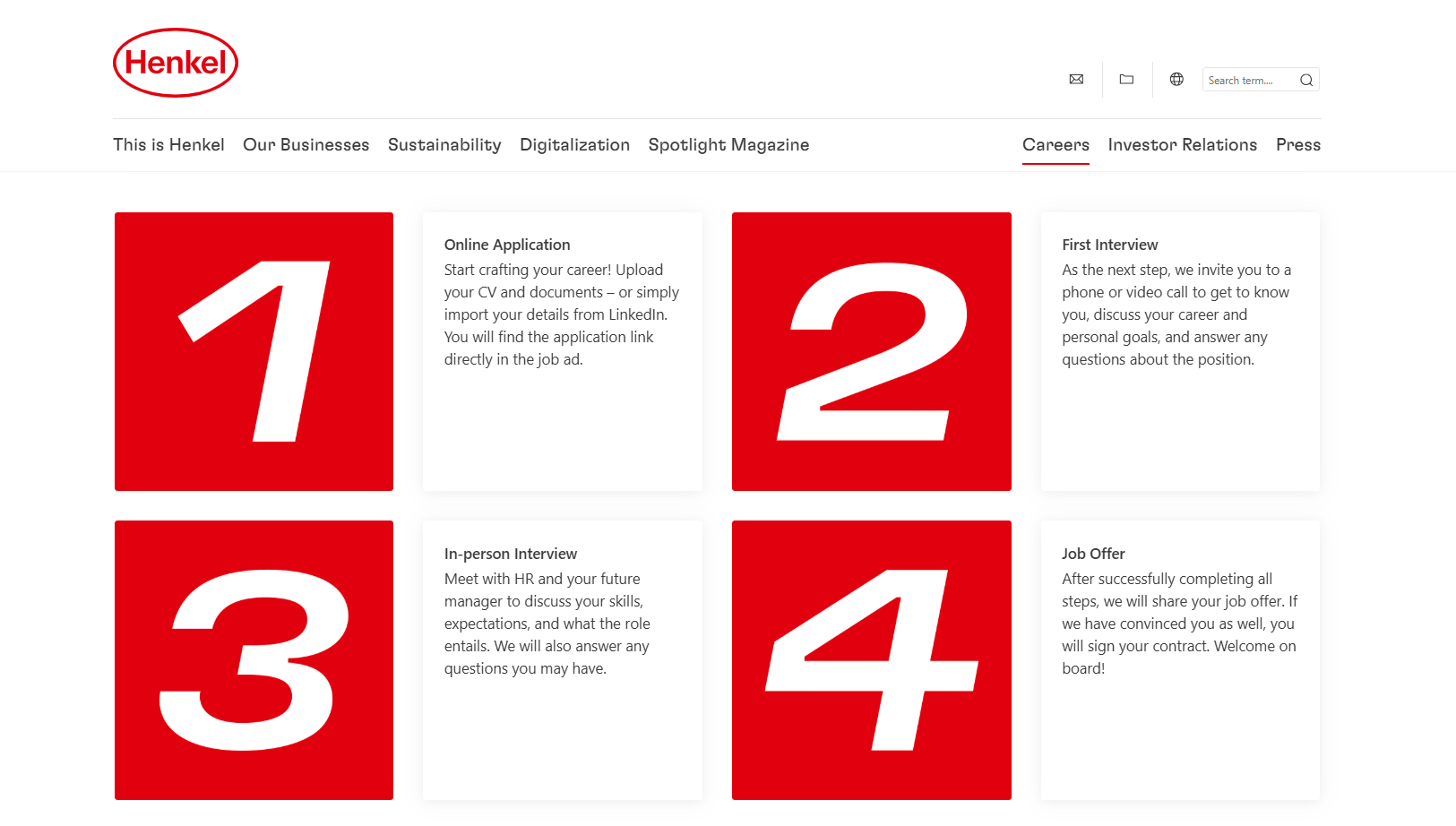
2. Henkel: Transparency to Reduce Application Drop-Off
Candidates abandon applications when they cannot see the next steps. [2] Among its well-built landing pages, Henkel addresses this by publishing its recruitment steps upfront, including online application, interviews, and offer stages, helping candidates understand what to expect before and during the hiring journey.
Add a "What to Expect" section to your careers page. Map the stages: application review, screening call, technical assessment, panel interview, offer. Candidates who know what the process looks like are more likely to complete it.

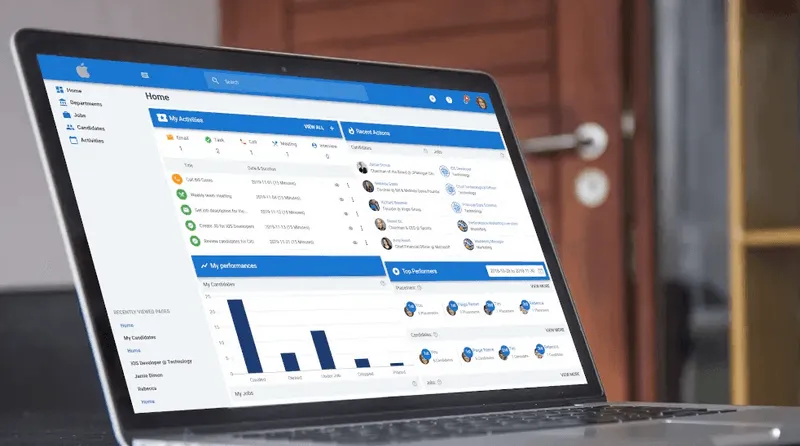
Looking at company career page examples like Nike and Henkel might make building a custom career site feel out of reach, especially if you do not have developers available to manage the technical side. Manatal's Career Page Builder bridges the gap. Instead of dealing with manual website updates or brand inconsistencies across platforms, Manatal lets recruiters design a fully branded, mobile-responsive career landing page in minutes.
{{cta}}
3. TikTok: Short-Form Video as a Pre-Screening Tool
TikTok opens its careers page with a video, not a wall of text about the company's mission. That video shows real employees in real offices across multiple countries. It pre-screens for cultural fit before a candidate ever fills out a form.
Employee-generated video content increases time-on-page by an average of 2.6x compared to static image carousels. [3] More time on a page means more time for a candidate to connect with your employer brand before deciding to apply. Do not produce a corporate video with a hired crew and a voiceover artist. Many companies now use an AI video generator to create similar engaging employer-branding videos quickly and at scale.

4. Airbnb: Structured Role-Scoping to Reduce Recruiter Workload
Each job listing on Airbnb's career site includes the country the role is based in, the core responsibilities, and the minimum requirements. Airbnb's structure pushes pre-qualification to the page itself. Candidates who do not meet the minimum requirements see that upfront and self-select out. The result is a smaller applicant pool with a higher average quality.
Add location filters to your job listings. Write explicit minimum requirements, not aspirational ones. Use clear, specific language about what the role involves day-to-day.


5. SpaceX: Mission-Driven Copy as a Talent Filter
SpaceX uses its mission statement as the opening for its careers page to filter potential candidates. The focus on reducing space travel costs and colonizing Mars attracts applicants driven by purpose rather than those motivated by salary or job security.
Mission-driven recruitment copy does not work for every company. But if your organization has a clear reason for existing beyond generating revenue, put that reason at the top of your career page. Let it do the filtering before your recruiters ever get involved.

6. Apple: Departmental Segmentation as a Custom Career Pages Strategy
Apple routes candidate to department-specific landing pages depending on where they want to work: Apple Retail, Apple AI, Hardware, Software and Services, etc.
If your organization has meaningfully distinct functions, build dedicated career landing pages for each. A page for engineering candidates should not look or read the same as a page for sales candidates. The job is different. The person you want is different. Treat them that way.

7. Meta: The Candidate Poll as a CRO Instrument
Meta uses a poll on its careers page as a conversion rate optimization (CRO) tool to collect data on candidate intent. Positioned at the bottom of the page, the poll helps gauge genuine interest by asking if visitors plan to apply for a role at Meta.
Add a passive feedback mechanism to your careers page. It does not have to be a poll. An exit-intent survey, a "What brought you here today?" prompt for passive visitors, or a simple thumbs up/down on job descriptions.

Why Your Career Landing Page is Your Most Recruiting Funnel
Companies that optimize their career pages often see meaningful improvements in candidate conversion rates, although the exact uplift varies depending on the existing experience, application flow, and audience. [4]
Three things determine whether your career page converts or bleeds:
- Speed and mobile responsiveness. Over 65% of job applications are now initiated on mobile devices. [5] A career page that renders poorly on a phone is not a minor inconvenience. It kills your pipeline before your recruiters even know a candidate existed.
- Real-time job syncing. When HR teams manually update job listings on a website, roles stay live long after they are filled. These "ghost jobs" generate frustrated applicants, wasted ad spend, and a broken first impression. An ATS-integrated career page eliminates this: once a vacancy is closed in your system, it automatically disappears from your public page.
- Candidate intent clarity. A visitor who lands on your careers page is not yet an applicant. They are evaluating you. Your page needs to answer three unspoken questions in the first scroll: Who are you? What is it like to work here? Why should I apply instead of somewhere else?
Career Page Template: The Minimum Viable Structure
If you are building from scratch, this career page template gives you the architecture that high-performing pages share:
- Section 1 (Hero): Employer value proposition headline, one-line supporting statement, search bar for open roles.
- Section 2 (Why Us): Three to four concrete reasons to work here. Use specific claims: team size, growth rate, average tenure, and benefits that differentiate you from competitors.
- Section 3 (Culture Evidence): Employee video testimonials or photo series from real teams. No stock imagery.
- Section 4 (Open Roles): Filterable job listings synced directly from your ATS.
- Section 5 (Hiring Process): A visual timeline of your hiring stages with estimated durations for each.
- Section 6 (Passive Candidate CTA): A talent pool sign-up for visitors who are interested but do not see a current opening.
- Section 7 (Thank You Page): A post-application confirmation with a specific response timeline, recruiter contact information, and a talent pool opt-in for candidates who were not selected.
The Pre-Launch Checklist for Your Career Page
Before you publish or relaunch your career page, run through this:
- Are open positions pulled dynamically from your ATS with no manual updates required?
- Does the page load in under three seconds on a 4G mobile connection?
- Is the apply button visible without scrolling on a standard phone screen?
- Does your thank-you careers page set a specific response timeline?
- Is there a talent pool opt-in for candidates who do not see a relevant open role?
- Does the visual identity on your career page match your LinkedIn, website, and social profiles exactly?
- Have you removed every stock photo and replaced it with images of actual employees and actual workspaces?
Conclusion
Most career pages are built once and ignored for years. The companies whose career pages actually convert treat them the way growth teams treat landing pages: with A/B tests, heat maps, time-on-page tracking, and regular iteration based on drop-off data. Your career page is not finished when it goes live. It is version one.
Build your branded career page with Manatal. Start your 14-day free trial today.
Frequently Asked Questions
Q: What can we learn from top career page examples regarding brand consistency?
A: Top career page examples, like Nike, show that maintaining identical visual branding (colors, logos, and typography) across all channels builds immediate trust with candidates and eliminates signs of organizational dysfunction.
Q: How do effective career page examples help reduce application drop-off?
A: Leading career page examples reduce drop-off by providing transparency. For instance, Henkel maps out its exact recruitment steps up front so candidates know what to expect, which keeps them engaged throughout the hiring funnel.
Q: Can small HR teams replicate these advanced career page examples without a developer?
A: Absolutely. While looking at enterprise career page examples can feel intimidating, tools like Manatal’s Career Page Builder allow HR teams to easily design fully branded, mobile-responsive pages in minutes without needing any coding skills.
Q: What is a technical feature shared by high-converting career page examples?
A: Real-time job syncing is crucial. High-performing career page examples are integrated with an ATS (such as Manatal) so that open positions are updated automatically, eliminating "ghost jobs" and manual website updates.
Citations:
.webp)







.webp)

.webp)


.webp)


