




Aptitude Research reports that many organizations still struggle with inconsistent interview practices and limited use of structured evaluations, making interviewer bias an ongoing hiring challenge. [1] This article covers what interviewer bias is, the specific types you'll see in your hiring process with examples, and a practical workflow to reduce and measure it. If you've ever wondered why strong candidates get passed over or why your new hires keep resembling the last five, the answer often sits in the interview itself.
What is Interviewer Bias?
Interviewer bias is when an interviewer's personal beliefs, preferences, or impressions shape a candidate's evaluation instead of role-relevant evidence. The interviewer's reaction, not the candidate's qualifications, drives the rating. Interviewer bias can be conscious or unconscious. It can push evaluations in either direction: an interviewer might over-credit a candidate who shares their background or under-rate one whose communication style feels unfamiliar. The common thread is that the evaluation drifts from job-relevant criteria toward personal reaction.
Common Types of Interviewer Bias
- Affinity Bias: Favoring candidates with shared backgrounds, hobbies, or schools (often masked as "culture fit").
Error: Creates an echo chamber and eliminates diverse perspectives. - Confirmation Bias: Searching for evidence to prove a first impression formed in the opening minutes.
Error: Turns an objective evaluation into a self-fulfilling prophecy. - Halo Effect: Letting one impressive trait (e.g., a top school or company name) boost ratings across all skills.
Error: Overestimates a candidate based on isolated prestige. - Horns Effect: Allowing a single mistake or weak trait to drag down unrelated skill ratings.
Error: Treats a minor, recoverable mistake as an absolute disqualifier. - First-Impression Bias: Judging a candidate within the first few minutes based on small talk or handshakes.
Error: Hires based on initial surface charm instead of actual ability. - Contrast Bias: Rating a candidate relative to the person interviewed right before them instead of the job requirements.
Error: Scores fluctuate based on interview order rather than qualification. - Recency Bias: Remembering and rating the most recent candidates more favorably because details are fresh.
Error: Makes interview timing more important than actual performance. - Nonverbal & Style Bias: Confusing polished delivery, accent, or ideal tech setups (lighting, fast Wi-Fi) with competence.
Error: Mistakes in presentation style and privilege for job capability.
Why It Matters: Quality, Diversity, And Legal Risk
Unchecked interviewer bias negatively impacts hiring outcomes across three main areas:
- Lower Hire Quality: Qualified candidates are screened out for reasons unrelated to job performance. Evaluating candidates against past hires rather than objective criteria narrows the talent pool.
- Reduced Diversity: Affinity bias leads interviewers to favor candidates with similar backgrounds. Over time, this creates homogeneous teams that lack diverse perspectives.
- Increased Legal Risk: Subjective scoring and inconsistent interview questions make decisions difficult to defend legally under EEOC guidelines and Title VII. Without standardized documentation, organizations may face greater legal risk if hiring decisions cannot be supported with consistent, job-related evidence.
Research by Goldin & Rouse showed that blind auditions increased women’s advancement by roughly 50%, demonstrating how removing identifying information can reduce bias in selection decisions. [2] To drive fairer recruitment, Manatal ATS offers built-in redaction CV features that remove sensitive personal details, helping recruiters evaluate candidates more consistently based on job-relevant qualifications rather than personal identifiers.
{{cta}}
Six-Step Workflow to Reduce Interviewer Bias
Standardizing every stage of the interview process eliminates cognitive biases and reliance on "gut feelings," ensuring data-driven, fair, and high-quality hiring decisions.
Step 1: Build a Standardized Question Bank with Scoring Rubrics
Draft a fixed set of behavioral interview questions and situational interview questions linked directly to your target competencies. Define explicit rubric anchors for each question:
- 1 Point (Weak): Vague, lacks concrete metrics, shifts blame.
- 3 Points (Acceptable): Clear action taken, meets basic requirements.
- 5 Points (Strong): Demonstrates strategic impact, owns outcomes, articulates key learnings.
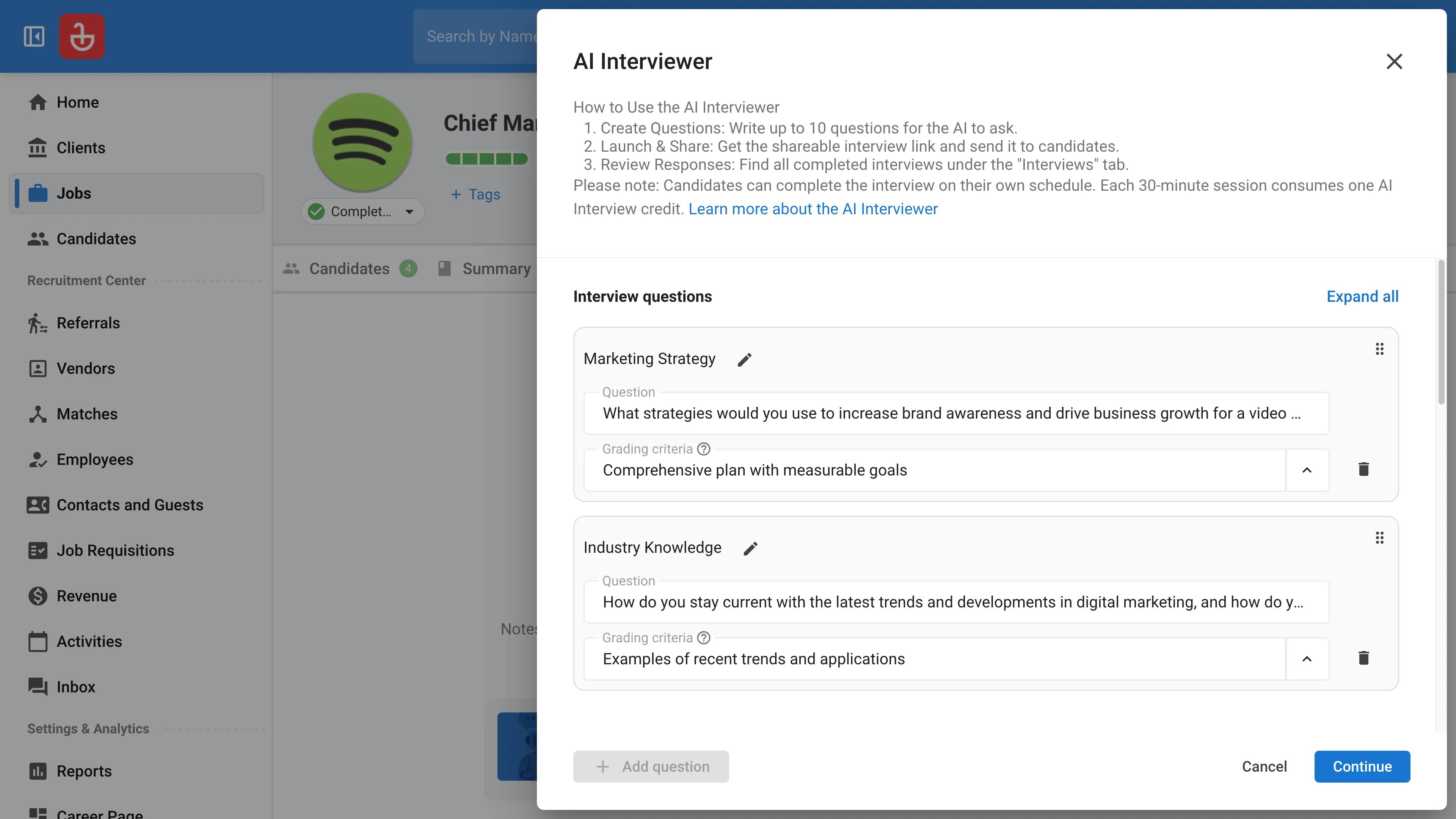
Use Manatal AI Interviewer to automatically generate tailored interview questions and standardized screening assessments, ensuring every candidate is evaluated against the exact same objective criteria from the start.
Read our guide to avoid illegal interview questions.
Step 2: Assign a Diverse Panel and Segment Responsibilities
Distribute specific competencies across panel members so no single interviewer bears the burden of assessing every trait. Assigning distinct evaluation areas helps reduce the impact of individual blind spots on the overall evaluation score. Use Manatal’s collaboration and team management tools to assign specific scorecard sections and permissions to each panelist, helping prevent individual blind spots.
Step 3: Execute Standardized Interviews & Lock Scores Immediately
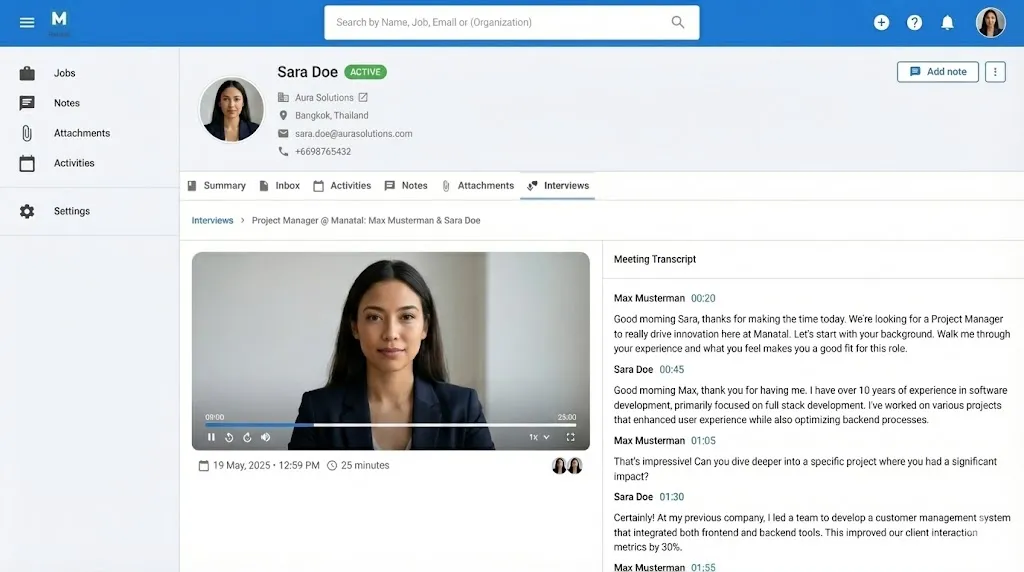
Ask all candidates identical questions in the same sequence, with fixed time limits per section. Evaluate answers strictly against rubric anchors. Utilize Manatal AI Notetaker during the interview to capture accurate, real-time transcripts so panelists can focus entirely on evaluation. To prevent dominant panel voices from influencing individual feedback (anchoring effect), require each interviewer to complete and lock in their evaluation scorecard within 15 minutes of the interview ending, strictly before discussing the candidate with other panelists.
Step 4: Hold Evidence-Based Calibration Debriefs
Host a debrief session where panel members compare ratings. When scores diverge, leverage Manatal AI Notetaker Transcripts to instantly review verbatim quotes and resolve discrepancies using documented facts instead of gut feelings.
Step 5: Keep Humans in the Loop for Final Hiring Decisions
Utilize structured scorecards and interview intelligence software to collect objective data, but reserve the final hiring decision for the panel and hiring manager. Ensure the ultimate candidate selection maps directly to documented scorecard evidence.
Step 6: Audit Interviewer Data Periodically
Track scoring distributions across evaluators on a quarterly basis. Identify interviewers who consistently score significantly above or below panel averages, and conduct calibration alignment sessions to correct scoring drift over time. Using Manatal scorecard, identify interviewers who consistently score above or below panel averages and run calibration sessions to correct scoring drift.
.png)

How To Measure Interviewer Bias
Once interviews are scored consistently, bias becomes visible in the data.
- Start by comparing pass rates by interviewer: If one interviewer advances 80% of candidates and another advances 30%, the gap may reflect different calibration, not different candidate pools.
- Track average scores by interviewer over time: An interviewer who scores consistently higher or lower than the panel norm may be applying personal standards rather than shared criteria.
- Check score gaps by candidate group to catch adverse impact early: If candidates from a particular demographic consistently receive lower scores, that pattern is an early warning. You cannot fix what you cannot see; structured scoring makes the pattern detectable.
- Run periodic calibration reviews by pulling a sample of past interviews and having the panel re-score them together. Discuss where ratings diverged and why. This surfaces unspoken assumptions and keeps the team aligned.
- Structure gives judgment something to work with: evidence, consistency, and a record you can audit.
Conclusion
Interviewer bias closes when you build a repeatable system, not when you send the team to a workshop. Awareness matters, but process changes do the work. Standardized questions remove improvisation. Shared scorecards turn gut reactions into comparable evidence. Recorded interviews let you check ratings against what was actually said. And interviewer-level data surfaces drift before it compounds.
Ready to structure your interviews and reduce bias in your hiring process? Start a 14-day free trial.
Frequently Asked Questions
Q: What are the most common types of interviewer bias?
A: Affinity, confirmation, halo effect, first impression, contrast, recency, and nonverbal bias. Standardizing evaluations through Manatal’s Candidate Scorecards prevents these personal impressions from overriding job-relevant evidence.
Q: What is interviewer-induced bias, and is it the same thing?
A: In research and survey methodology, interviewer-induced bias refers to the interviewer influencing how a respondent answers questions. In hiring, the term typically means the interviewer misjudging the candidate based on personal factors. The underlying concept of interviewer influence applies to both, but the context differs. Utilizing Manatal AI Interviewer for standardized first-round screenings reduces interviewer influence during early-stage screening by standardizing question delivery and evaluation.
Q: How does interviewer bias affect hiring decisions?
A: Qualified candidates get screened out for non-job reasons. Hires cluster around people who resemble the existing team, narrowing the talent pool and limiting diversity. Inconsistent, subjective scoring also creates legal exposure under EEOC and Title VII standards.
Q: How do you reduce interviewer bias in interviews?
A: Structure the process: standardized questions, predefined scoring criteria, diverse panels, and captured interview records. These changes force evaluation into shared, comparable evidence rather than private impressions.
Q: Does unconscious bias training actually reduce interviewer bias?
A: Research shows the link between changing implicit attitudes and changing actual behavior is negligible. Awareness training alone does not reliably reduce biased decisions. Process-driven tools like Manatal Structured Scorecards and AI Notetaker are far more effective because they force evaluations to rely on objective, captured evidence.
Citations:
.webp)






.webp)

.webp)


.webp)


