





While internal HR focuses on cultural fit and long-term retention for a single employer, staffing is a high-volume, speed-based game. In this industry, if your software slows you down by even a few minutes, you don’t just lose a candidate, you lose the entire placement fee to a faster competitor. This guide breaks down the exact software for staffing agencies need in 2026, organized by function.
Top Software for Staffing Agencies in 2026
To scale in 2026, you need to move away from a "random tool list" and adopt a unified Staffing Tech Stack. You don't just need a tool to track candidates; you need an engine that drives placements and manages client relationships within a single, seamless workflow.
Category A: The Core WorkOS (ATS + CRM)
The ATS (Applicant Tracking System) manages your candidate pipeline: sourcing, screening, interview stages, offers, and placements. The CRM (Client Relationship Management) manages your client pipeline: leads, contacts, open roles, contracts, and revenue forecasts.
Most agencies run these as two separate tools. That decision is expensive. Every time a recruiter closes a placement, they have to update records in two systems. Every time a business developer wins a new client, the information must be manually transferred to the person who oversees recruiting. Data falls through the gaps; placements get missed. The correct answer is a unified ATS + CRM built specifically for recruitment agencies.
Manatal
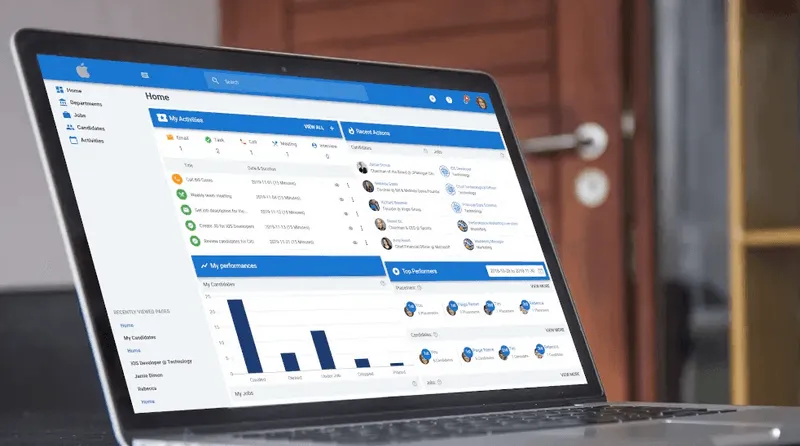
Manatal runs a dual pipeline built specifically for staffing agencies. On the Recruitment CRM side, you track client leads through deal stages, from "Prospecting" to "Active Client," with open roles linked directly to your recruiting pipeline.
.png)
{{cta}}
On the ATS side, AI candidate scoring automatically ranks and screens candidates against job requirements, cutting CV review time for a 200-applicant role from hours to minutes.

Key features for staffing agencies:
- Smart candidate matching and automated resume parsing
- Recruitment CRM with customizable client pipeline stages
- Multi-channel candidate sourcing across LinkedIn, job boards, and referrals
- Branded client portal for shortlist reviews without requiring a client login
- GDPR, CCPA, and PDPA compliance built in
- Link revenues to jobs, clients, and your team to measure ROI across all your team’s recruiting efforts.
.png)
Pricing:
- Professional Plan: $15/user/month (billed annually), suitable for small teams.
- Enterprise Plan: $35/user/month (billed annually), unlimited jobs/candidates, workflow automation, AI recommendations.
- Enterprise Plus Plan: $55/user/month (billed annually), everything in Enterprise plus API access, SSO, advanced report builder, and priority support.
- Custom Plan: Available on request for advanced integrations.
ATS + CRM Comparison Table
Category B: Payroll and Back Office
Temp and contract staffing means you are the employer of record. You carry the payroll tax liability. You handle worker classification. You manage invoicing to clients at one rate and payroll to workers at a lower rate; the spread is your gross margin.
- Deel: handles global payroll and contractor payments across 150+ countries. If your agency places international contractors or runs any cross-border staffing operation, Deel removes the compliance complexity: worker classification, local tax filings, and statutory payments are handled within the platform. Particularly relevant for tech staffing agencies placing remote talent.

- QuickBooks remains the standard for domestic back-office management. Invoice generation, payroll runs, and P&L tracking integrate with most ATS platforms through Zapier or direct API connections. If your operation is primarily domestic, QuickBooks, paired with a dedicated payroll add-on like QuickBooks Payroll, handles the full back-office functions.

Category C: Sourcing and Outreach Automation
Your ATS manages candidates already in your pipeline. These tools build the pipeline in the first place.
- LinkedIn Recruiter is non-negotiable for agencies placing white-collar professionals. InMail response rates for cold outreach average 10-25%, compared to 1-3% for cold email at scale. The Boolean search capabilities let you filter by title, tenure, location, and company type with specificity that generic job boards cannot match. 2026 sources list Recruiter Lite at $170/month, but the full Corporate Recruiter is much higher ($900–$1,080+/month per seat, or $10,000–$15,000+/year).

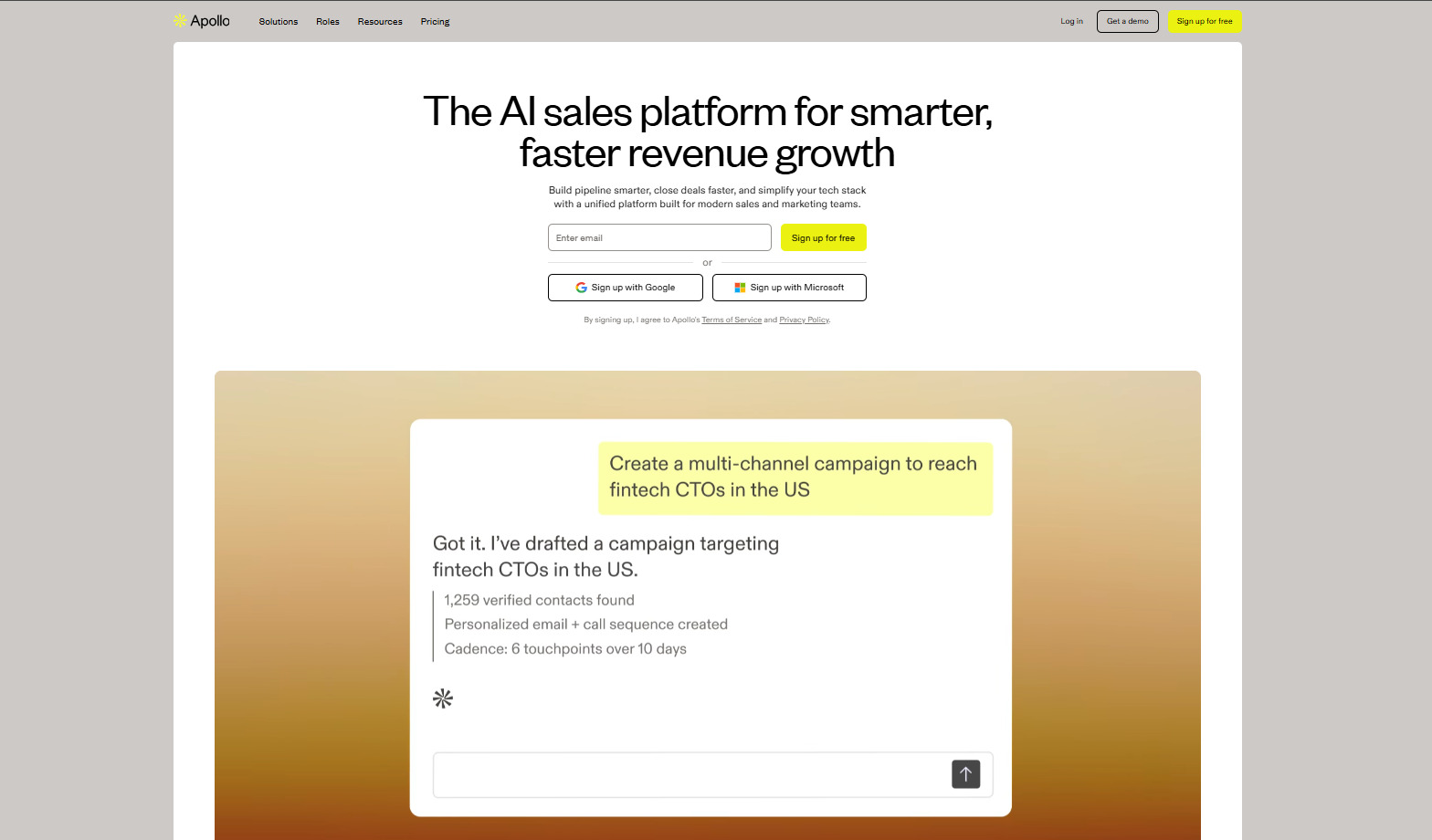
- Apollo.io solves a different problem: B2B sales prospecting. Apollo holds a database of 275+ million contacts with verified work email addresses and direct dials. For agencies running outbound business development, targeting HR directors and hiring managers at companies that fit your niche, Apollo cuts the time to build a target list from a day's work to under an hour. It works best for agencies that treat business development as an active sales motion rather than a purely referral-driven model. Current 2026 pricing starts at $49–$119/user/month, depending on the tier.
Category D: Supporting Tools Worth Evaluating
- Connecteam addresses workforce management for temp and field staffing agencies. Where an ATS handles the placement process, Connecteam handles what happens after the worker starts, including scheduling, time tracking, mobile check-ins, and internal communication. Agencies running high-volume industrial or healthcare temp staffing will find it fills a gap that most ATS platforms leave open.

What to Actually Evaluate Before Buying
Most software buying guides tell you to "align tools to your goals." That is not useful. Here is what to actually examine before signing a contract.
Does it serve recruitment agencies specifically?
The question to ask any ATS vendor: "Where in your platform can I track the bill rate, pay rate, and gross margin on a placement?" If the answer involves exporting to a spreadsheet, the tool was built for corporate HR, not staffing agencies. Agency margins average 15-25% on temp placements and 15-30% on permanent fees. [1] You need to see those numbers at the job level, not after a manual calculation.
What is the actual time-to-productivity for new recruiters?
Ask for the average onboarding time before a new recruiter can work independently on the platform. A tool that requires two weeks of training is a liability in an agency where you may hire and onboard recruiters quarterly. Manatal's onboarding documentation and support structure are built to get a new user operational in under a day. That matters when you are scaling a desk.
Does the pricing model punish growth?
Per-user pricing is standard. The trap is that tools charge separately for each user, each candidate record, and each job posting. At 10 users, the base license looks affordable. At 30 users with add-ons, you are paying for a platform that was sold to you as budget-friendly. Map the total cost at three times your current headcount before committing.
What are the integration points with your existing payroll?
If you use QuickBooks for invoicing and your ATS cannot automatically push placement data to QuickBooks, someone is doing manual data entry between the two systems. That person is your highest-cost data entry operator. Verify integration availability before purchase, not during implementation.
Summarized Recruitment Software for Staffing Agencies
Conclusion
In conclusion, choosing the best tools for your staffing agency can greatly impact your business's success. When selecting software for your staffing agencies, consider features and functionality, user-friendliness, ease of implementation, and customer support. Finally, the software options listed in this article are among the top choices on the market, offering a comprehensive set of features to support your staffing agency's operations. By considering these tips and exploring these software options, you can make an informed decision that sets your agency up for success and growth.
Start a 14-day free trial of Manatal and see the CRM pipeline view for yourself. No credit card required.
Frequently Asked Questions
Q: What is the difference between staffing agency software and standard HR software?
A: Standard HR software is built for internal teams managing their own employees. Staffing agency software is built for businesses that simultaneously manage external clients (who pay placement fees) and candidates (who generate billable hours). The core difference is the dual pipeline: a CRM for client relationships and an ATS for talent, both in one system.
Q: Is staffing management software suitable for small or independent agencies?
A: Yes. Most staffing management software today uses per-user pricing, meaning a two-person agency pays the same as a 50-person firm. Manatal, for example, starts at $15/user/month, making enterprise-grade ATS and CRM functionality accessible without an enterprise budget.
Q: How does recruitment software for staffing agencies handle temp vs. permanent placements differently?
A: Temp placements require time tracking, shift scheduling, and ongoing payroll processing since the agency remains the employer of record. Permanent placements are a one-time fee transaction. The best staffing software handles both workflows, often with configurable pipeline stages and payroll integrations specifically for contract and temp billing cycles.
Q: What data should staffing agency software track at the placement level?
A: At minimum: bill rate, pay rate, gross margin per placement, client name, candidate name, start date, and placement type (temp, contract, or permanent). If your current tool cannot show you margin at the job level without a spreadsheet export, it was built for corporate HR, not agency operations.
Q: How long does it typically take to migrate to the new best staffing software?
A: For most mid-size agencies, a full data migration and team onboarding takes between one and three weeks, depending on the volume of historical candidate and client records. The practical rule: run the new and old systems in parallel for two weeks before fully switching over.
Citation:
.webp)







.webp)

.webp)


.webp)


