





Despite advances in hiring technology, talent acquisition teams still allocate a significant portion of their capacity to routine operational workflows like scheduling and status updates.[1] That is the core hiring efficiency problem: qualified people spend their hours on administrative maintenance instead of judging fit.
In this article, we will take a look at the metrics that measure it and the two systems that move it: an ATS and AI. You will leave with a short implementation path you can start this week.
The Metrics That Measure Hiring Efficiency
Track these by role type and seniority, not as one company-wide average. A single blended number hides the bottleneck. A quick junior fill and a slow executive search average out to a figure that describes neither.
- Time-to-fill: the calendar days from opening a role to an accepted offer. It tells you how long the full process runs.
- Time-to-hire: the days from first contact with a candidate to their acceptance. It tells you how fast the process moves once someone enters it.
- Cost-per-hire: total recruiting spend divided by hires made. It tells you what each hire costs across ads, tools, and recruiter time.
- Offer-acceptance rate: the share of offers candidates accept. It tells you whether targeting, experience, and pay match the market.
- Candidate drop-off rate: the share of candidates who exit before a decision. It tells you where the process loses people.
- Quality-of-hire: retention and ramp-to-productivity after the hire. It tells you whether efficiency gains held up in the real job.
- Time-to-decision: the days a candidate waits between stages for a yes or no. It tells you where internal delay, not candidate supply, is the bottleneck.
Time-to-decision is the modern, underused one. Most teams watch time-to-fill and miss that the delay sits in their own calendars. For a wider view of what to monitor, see our guide to recruitment KPIs.
How to Improve Hiring Efficiency
To shrink time-to-decision and reduce cost-per-hire, you must remove internal friction points across your pipeline. Implement these five operational steps:
1. Audit and Cap Pipeline Stages
Long candidate pipelines create drop-off and drag out time-to-fill. Limit your hiring workflow to a maximum of 3 to 4 stages (e.g., Initial Screen → Technical/Work Sample → Panel Interview). Enforce a strict 24-hour Service Level Agreement (SLA) for interviewers to submit candidate feedback.
- Tools to use: Map your pipeline bottleneck using Lucidchart or Miro. Set automated scorecard submission alerts in Slack or Microsoft Teams to enforce your feedback SLA.
2. Automate Interview Scheduling
Back-and-forth emails to align candidate and interviewer calendars add 3–5 days of latency per candidate. Shift to self-service scheduling links backed by pooled calendar availability.
- Tools to use: Deploy Calendly or SavvyCal synced with Google Calendar or Outlook, or use native scheduling links directly inside Manatal to automate multi-interviewer availability.
3. Lock In Structured Scorecards Before Sourcing
Evaluating candidates without standardized criteria leads to endless debate, additional interview rounds, and biased hiring decisions. Define 4–5 core competencies and exact pass/fail standards before opening the job requisition.
- Tools to use: Optimize job requirement phrasing with Textio, build standardized evaluation templates in Notion or Google Docs, and upload scorecards directly into your ATS to lock evaluation criteria.
4. Deploy AI-Powered Automated Screening
Manual first-round screening drags out time-to-decision and creates major pipeline bottlenecks. Automated 24/7 video screening lets you evaluate candidates asynchronously against exact grading rubrics, transcribing and scoring responses without adding administrative load or juggling calendars.
- Tools to use: Use Manatal AI Interviewer to set up on-demand screening interviews, automatically transcribe responses, and receive objective AI candidate evaluations mapped to your criteria.
5. Streamline Sourcing Outreach with AI Drafting
Drafting personalized initial outreach messages and screening questions manually drains recruiter bandwidth. Use AI prompts anchored directly to your job description to generate high-converting candidate communications in seconds.
- Tools to use: Use ChatGPT or Claude to generate personalized outreach variants and screen prompts, or use Manatal's AI Candidate Recommendations feature and to target and engage top talent instantly.
{{cta}}
How an ATS Improves Hiring Efficiency
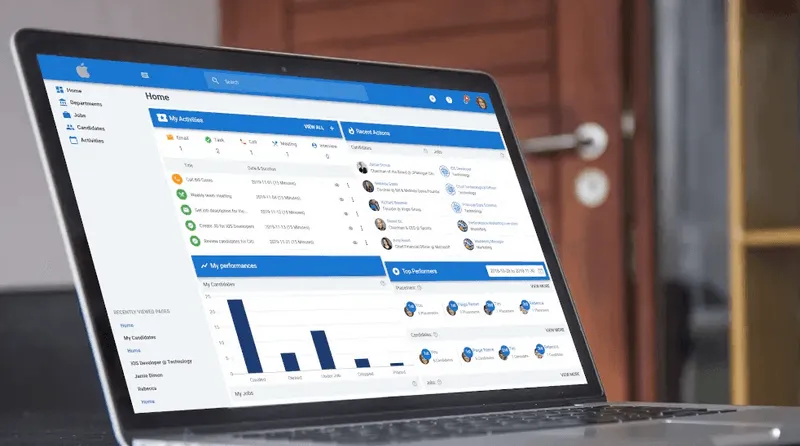
When recruiters spend hours cross-posting jobs, chasing stage updates across spreadsheets, and manually coordinating interview times, candidate drop-off increases and time-to-fill stretches. An Applicant Tracking System (ATS) solves this operational friction by automating recurring administrative tasks and centralizing pipeline management.
Modern ATS platforms like Manatal target these specific operational leaks to lower both time-to-fill and time-to-decision through the following mechanisms:
- Multi-Posting Automation: Distributes job openings to multiple major boards (e.g., LinkedIn, Indeed) in a single action, compressing overall time-to-fill.
- Centralized Visual Pipelines: Offers drag-and-drop tracking and shared candidate profiles to eliminate manual status-chasing, accelerating time-to-decision.
- Communications Integration: Syncs native mailboxes and calendars to automate scheduling and batch communications, reducing administrative overhead hours.
- Structured Scorecards: Standardizes candidate evaluation metrics to minimize internal debate and facilitate faster, data-driven hiring decisions.
- Data Analytics Reporting: Delivers automated tracking metrics to audit pipeline health and quantify recruitment workflow velocity.
Choosing an ATS for Efficiency
Evaluating an ATS requires testing how it executes real workflows under load. Follow these four concrete evaluation steps when selecting a system to eliminate operational friction:
1. Audit End-to-End Automation Depth
Focus exclusively on features that execute full tasks autonomously rather than basic digital record-keeping. During vendor demos, require the sales representative to demonstrate full-sequence execution.
- Action: Require the vendor to demonstrate how moving a candidate to a new stage (e.g., "Screening") triggers multi-channel candidate updates, sends self-scheduling calendar links, and assigns scorecards without any additional recruiter clicks.
2. Run a Live Sourcing and Matching Benchmark
Leverage existing database talent to maximize sourcing ROI and reduce advertising spend. Test how efficiently the platform surfaces candidate profiles you already own.
- Action: Provide the vendor with a complex past job description during a live session. Test whether the ATS's semantic search and AI matching engine proactively surface qualified past applicants from your existing database before you spend money on outbound sourcing or job ads.
3. Map Pre-Built Ecosystem Integrations
Maintain clean data flow between your hiring platform, calendar tools, and employee onboarding systems to eliminate operational latency.
- Action: Inventory your current tech stack (e.g., Google Workspace/Outlook, HRIS platforms, background check tools). Demand proof of native, pre-built API connectivity rather than relying on manual CSV exports or custom webhook setups.
4. Audit Pipeline Bottleneck Analytics
Isolate exact pipeline delays to make targeted, data-driven workflow improvements. Verify that the system provides granular, automated reporting out of the box.
- Action: Review the analytics dashboard to ensure it isolates stage-by-stage cycle times, specifically time-to-decision between interview rounds, rather than just high-level averages. Platforms like Manatal automatically track these pipeline velocity metrics in real time so you can spot and fix delays immediately.
Conclusion
Hiring efficiency means cutting administrative friction so recruiters spend their time evaluating candidate fit, not managing tasks. Manatal’s AI-powered ATS automates admin work, syncs schedules, and centralizes candidate pipelines. Organizations can start immediately by automating one hiring bottleneck, proving the time savings, and scaling from there.
Frequently Asked Questions
Q: Is there a hiring efficiency formula, and what's a good rate?
A: While no single universal metric exists, hiring efficiency is formally measured through the Recruiting Efficiency Ratio: total recruitment cost divided by the total first-year salaries of new hires, or by evaluating total cost-per-hire against overall time-to-fill. A strong benchmark keeps the efficiency ratio under 15% while cost-per-hire and time-to-decision decrease against your baseline without reducing quality-of-hire. Manatal’s analytics engine tracks these underlying cost, time, and pipeline metrics automatically so teams can monitor efficiency trends in real time.
Q: What is the hiring efficiency ratio?
A: The hiring efficiency ratio (or recruiting efficiency ratio) measures total recruitment expenditures relative to the economic value of acquired talent. It is calculated by dividing total hiring costs, including internal recruiter time, software, and advertising, by the total first-year annualized salaries of all new hires, expressed as a percentage. Manatal centralizes software costs, candidate sourcing data, and pipeline velocity into automated reporting dashboards to simplify this calculation.
Q: How can organizations improve hiring process efficiency?
A: Improving hiring process efficiency requires eliminating administrative friction, enforcing strict evaluation SLAs, and automating manual workflows. Organizations achieve this by locking evaluation scorecards prior to sourcing, capping selection sequences at three stages, and requiring hiring decisions within 24 hours of final interviews. Manatal’s AI-powered ATS supports this transition by automating candidate communications, calendar sync, and candidate tracking within a centralized pipeline.
Q: How can recruitment teams increase speed without sacrificing quality?
A: Maximizing hiring speed alongside efficiency requires eliminating operational latency between pipeline stages rather than shortening candidate evaluation. Teams accelerate velocity by using one-click multiposting across job boards, deploying AI semantic matching to shortlist applicants instantly, and implementing automated interview scheduling. Manatal combines these high-velocity drivers into a unified platform, compressing time-to-fill and time-to-decision while maintaining evaluation rigor.
Citations
.webp)







.webp)

.webp)


.webp)


