





The global recruitment software market was valued at $3.30 billion in 2025 is projected to reach $6.20 billion by 2032, representing a 9.4% CAGR as organizations increasingly invest in formalized hiring technologies. [1] For HR and talent acquisition leaders, the challenge is translating these operational improvements into the financial language that CFOs and executive stakeholders require. This guide provides the exact formula for calculating the ROI of recruitment software, the four metrics that deliver the most measurable financial value, and a structured framework for presenting the business case to finance leadership.
What Is the ROI of Recruitment Software?
The ROI of recruitment software measures the financial return a company generates from its investment in the software or applicant tracking system **relative to its cost. A positive ROI means the software generated more value through cost savings and productivity gains than it cost to implement.
The Core Recruitment ROI Formula
Calculating this requires transparency about your current expenses. Use this specific formula to build your business case.
ROI (%) = ((Total Financial Value Gained – Total Cost of Software) / Total Cost of Software) x 100
Total cost includes your annual subscription, one-time implementation fees, and the hours spent training your team. Value Gained is the sum of reduced external agency fees, lower job board spend, and reclaimed recruiter hours.
Example: If your recruitment software costs $15,000 per year and generates $60,000 in measurable value (through time savings, reduced agency fees, and faster time-to-fill), your ROI calculation looks like this:
ROI = (($60,000 – $15,000) / $15,000) x 100 = 300%
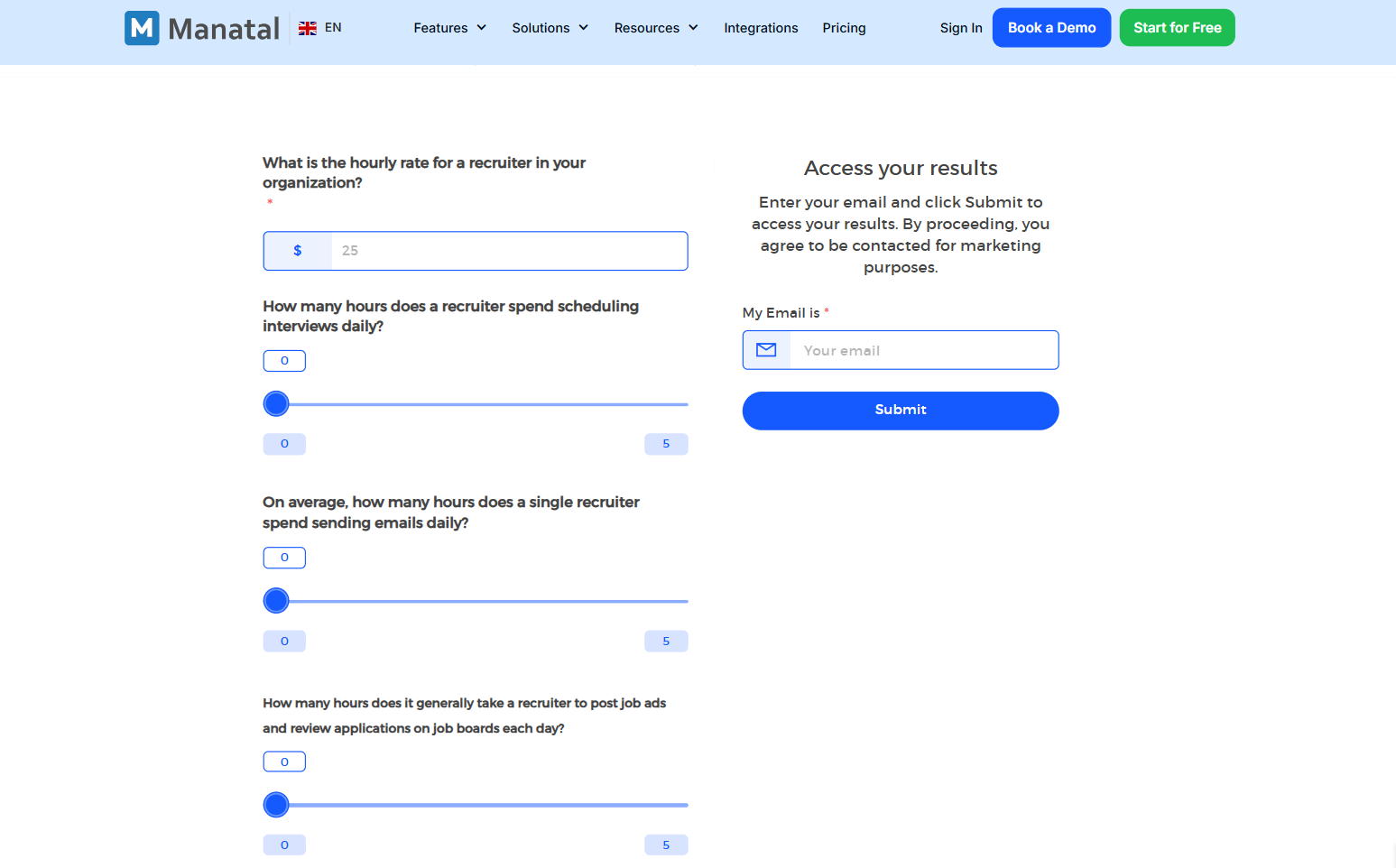
Tip: Use the Manatal ROI Calculator to calculate your potential recruitment ROI.
4 Metrics That Drive ROI of Recruitment Software
1. Cost-Per-Hire (CPH): Recruitment software reduces the cost-per-hire (CPH) by consolidating job board postings into a single platform. This move eliminates manual management costs. Internal teams reduce their reliance on expensive recruitment agencies by organizing and sourcing candidates through their own databases.
2. Time-to-Fill: Recruitment software can reduce time-to-fill by 40% and increase candidate satisfaction rates by 25% (LinkedIn Talent Solutions Report, 2024). These efficiencies directly translate into significant cost savings, which should be factored into the company's ROI calculations.
3. Recruiter Productivity: Recruiter productivity measures the time spent on administrative tasks versus the time spent on actual recruiting. The calculated value is:
Recruiter Productivity Value = (Hours Saved Per Week x 50 Weeks x Number of Recruiters) x Hourly Fully Loaded Cost
Manual recruiting involves time-consuming tasks such as resume parsing and job posting, which can be automated to save 10 to 15 hours per recruiter per week. For five recruiters, this automation could recover 2,500 hours annually, equating to $87,500 in productivity at $35/hour.
4. Quality of Hire: Quality of hire is crucial for accurate ROI calculations, as poor hiring decisions can be costly, up to 30% of an employee's first-year earnings, according to the U.S. Department of Labor. For senior roles, these costs can escalate to 50%-200% of annual compensation due to disrupted team dynamics and delayed projects. Recruitment software can help reduce bad hires by using AI-powered matching and standardized recruiting scorecards. Calculating current turnover costs and estimating a 10% reduction from structured hiring can significantly impact ROI models.
Building the Recruitment ROI Model
Here's how to structure your business case in one table. Apply your internal performance data to these formulas to prepare for your next budget review. Run this calculation with even conservative inputs, and the ROI on a modern ATS is measurable within the first 90 days.
Why Manual Tracking Reduces Recruitment ROI
Spreadsheets may seem cost-free, but in reality, they often create the highest hidden costs. Fragmented data leads to poor candidate experiences and the loss of valuable applicants who were not selected the first time. Without a centralized database, companies end up paying repeatedly to source the same candidates through agencies. Investing in recruitment software is not simply about buying a tool; it is about building the HR team's economic infrastructure, shifting hiring from a repetitive expense to a sustainable talent investment.
Manatal does more than improve your ROI. The platform features built-in reports and analytics dashboards that actively prove it. Using Manatal allows agencies and HR teams to automate resume parsing and candidate scoring through an AI engine. This capability directly reduces your Time-to-Fill metric and improves the "Total Value Gained" side of the ROI equation. Meanwhile, transparent and accessible pricing ensures your "total cost” remains predictable.
ROI of Recruitment Software for Agencies
The problem for most recruitment agencies is that the data lives in disconnected places: placement fees tracked in a spreadsheet, time-to-fill estimated from memory, and recruiter productivity invisible beyond raw placement counts. Without a centralized system that captures both revenue and operational metrics, the ROI calculation remains theoretical.
Manatal's Revenue Tracking feature allows agencies to log, manage, and report placement revenue directly within the platform. Agencies choose from three placement types when recording a deal: permanent, contract/temporary, or other.
For permanent placements, enter the candidate's offered salary and the agreed fee percentage. Manatal calculates the revenue automatically.
Revenue (Permanent) = Salary Offered x Fee %
Example: $100,000 salary x 20% fee = $20,000 revenue
To calculate the profitability of flexible staffing, we focus on the spread between client billing and consultant costs. Apply your internal performance data to these formulas:
- Gross Profit = Bill Rate – Pay Rate (Fully Burdened)
- Gross Margin % = (Gross Profit / Bill Rate) x 100
Revenue (Contract) = Bill Rate – Pay Gross Margin % = (Revenue / Bill Rate) x 100
Example: With a Bill Rate of $50,000 and a Pay Rate of $20,000, the result is $30,000 in Gross Profit at a 60% Gross Margin.
Each revenue record links directly to the job, client, and placement date. This means revenue reporting is always traceable to a specific search, recruiter, and client relationship.
Revenue Tracking in Manatal also supports ROI forecasting based on pipeline stage and expected closing date. Agencies can model expected revenue from active searches before placements close, giving leadership a forward-looking view of financial performance rather than a purely historical one.
Conclusion
Proving the value of a new ATS requires a shift from tracking simple activities to calculating actual financial gains. Using a clear recruitment ROI formula allows HR teams to present a business case that speaks the language of finance. Ultimately, consistent monitoring of recruitment ROI ensures that hiring remains a data-driven strategy that actively saves the company money while improving talent quality.
Frequently Asked Questions
Q: How does automation improve the ROI of recruitment software?
A: Automation reduces the time recruiters spend on administrative tasks like resume parsing. By reclaiming 10 to 15 hours per week per recruiter, companies can save tens of thousands of dollars in productivity costs annually.
Q: Why should I include the cost of bad hires in recruitment ROI?
A: Bad hires are expensive, costing up to 30% of an employee's first-year salary. Software reduces this risk through better matching, and even a small reduction in turnover significantly increases the total financial return.
Q: How does faster time to fill contribute to a positive recruitment ROI?
A: Every day a position remains open results in a vacancy cost for the business. Software speeds up the hiring process by 20% to 40%, directly reducing these daily losses and increasing the total value gained.
Q: Can agencies use this data to track their own performance?
A: Yes. Agencies can use recruitment software such as Manatal to track revenue from permanent and contract placements. This allows them to compare their software costs with the revenue generated to demonstrate that the technology is profitable.
Citation:
.webp)








.webp)

.webp)


.webp)


