





Fake candidates can create significant hiring risks, including wasted interview time, longer time-to-fill, and increased exposure to data security or payroll fraud risks. The rise of generative AI has also made it easier for fraudulent applicants to produce convincing resumes, fake credentials, and highly polished interview responses. [1] This guide breaks down exactly how to detect fake candidates at every stage of your hiring process, from application intake through technical assessment.
What Are Fake Candidates in Today’s Market?
The term "fake candidates" no longer refers only to someone who inflated a job title on their resume. Fake candidate activity in 2026 commonly falls into three broad categories.
- Exaggerations: Who lies about their qualifications and history, such as degrees that do not exist, companies listed that never employed them, and references that are either invented or coached friends.
- Proxies: Where someone else completes assessments or interviews for the candidate.
- AI/Deepfake Usage: Using AI-generated personas or manipulated identities used to bypass hiring verification processes.
How to Detect Fake Candidates During the Application Phase
Your first line of defense starts before you ever schedule an interview. These early-stage checks filter out the most obvious fake job candidates before they consume interviewer time.
- Verify educational credentials. To verify shortlisted or later-in-pipeline candidates’ credentials, contact institutions directly or use services like the National Student Clearinghouse or Digitary. Universities typically confirm records within 24-48 hours, and third-party services like Certn or HireRight can automate this process. AI-generated resumes might list fake credentials, so a single confirmation can identify false claims.
- Cross-reference employment dates. Compare the timeline on the resume against LinkedIn and any other public profiles. Fake candidates frequently list overlapping full-time roles or employment at companies that have no record of them.
- Flag mass-application patterns. If your applicant tracking system (ATS) shows the same candidate applying to 5 unrelated roles across your organization within 48 hours, that signals automated submission rather than genuine interest.
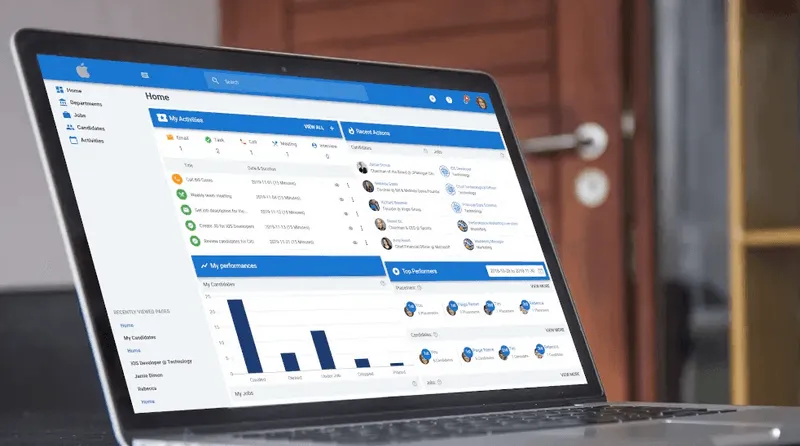
High-volume fraud is hard to catch through individual checks alone. Manatal’s Advanced Reports and Analytics solve this by analyzing pipeline data to flag anomalies that manual reviews might miss, such as sudden spikes in applicants, identical resume structures, or unusual screening drop-offs. Visualizing source data and pass rates turns fraud detection from a gut check into a data-driven strategy.
{{cta}}
How to Identify Fake Candidates in Video Interviews
Video interviews are the highest-risk touchpoint for proxy and deepfake fraud. Use these verification steps during every video screening.
- Require camera-on participation: Establish this as a non-negotiable policy communicated before the interview. Candidates who refuse or claim persistent "technical difficulties" with video warrant additional verification.
- Ask unscripted, role-specific questions: Scripted questions are easy to prepare for with a proxy. Insert spontaneous follow-ups that require the candidate to reference their own stated experience: "Walk me through how you specifically implemented the migration you mentioned in your previous role." Proxies stumble on details they did not personally live through.
- Document everything: Record the interview (with consent) and log observations in your ATS. If a candidate passes the video screen but raises concerns during a later stage, the recording becomes your verification artifact.
Manatal's AI Notetaker directly supports the process. Every observation from a video screen, behavioral inconsistencies, identity mismatches, and unanswered follow-up questions can be logged as a timestamped activity.
.png)
How to Identify Fake Candidates in Recruitment Assessments
Technical assessments and pre-employment skill assessments are a natural verification layer, but only if you secure them against proxy test-takers.
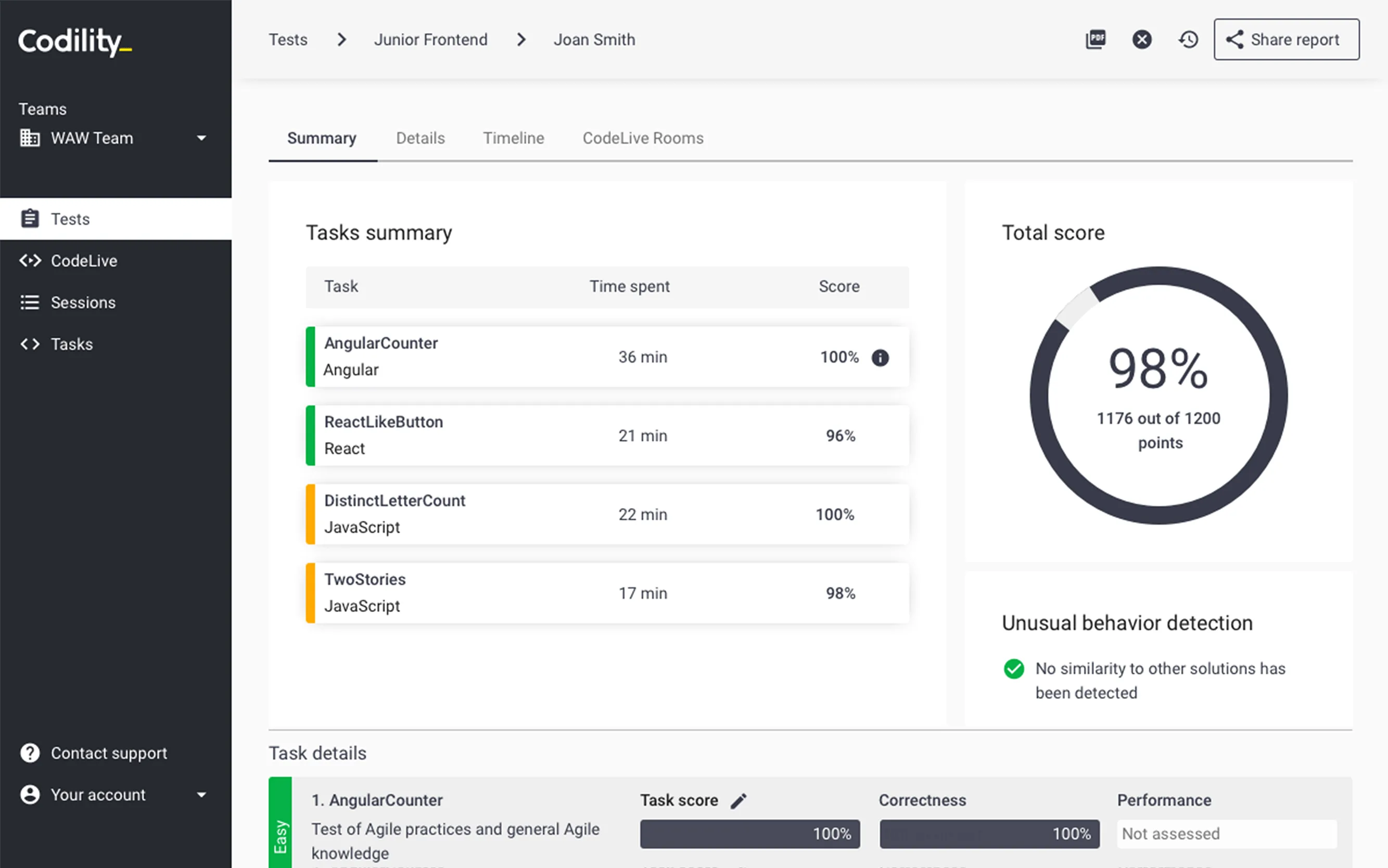
- Use proctored assessments: Most enterprise-grade assessment platforms (HackerRank, Codility, and TestGorilla) offer built-in live or AI-based proctoring. The setup typically flags tab-switching, unusual eye movement patterns, and multiple faces detected on screen. Proctoring does not eliminate cheating entirely.
- Randomize question pools: To counteract the vulnerability of static test banks in skills screening, it's recommended to create large question pools and randomize their delivery for each candidate. Platforms like Vervoe and Mercer Mettl can facilitate this by supporting dynamic question assignments. Regularly rotate and update question pools to prevent leaks, ensuring each candidate faces a unique set of questions both in order and content.
- Set time constraints: Abnormally fast completion times may indicate that a professional test-taker, rather than the actual candidate, completed the assessment. Track completion patterns across your candidate pool to establish baselines. Some assessment platforms can also automatically detect unusual completion behavior and flag suspicious activity.
Recruiters can integrate Manatal directly with specialized assessment platforms such as Codility or Testlify to automatically enforce advanced anti-cheating measures. These integrated tools utilize webcam monitoring, snapshot capturing, and screen-recording proctoring to ensure the person taking the test matches the candidate being interviewed, significantly raising the barrier for proxy networks.
The Cost of Hiring Fake Candidates
Failing to catch fake candidates creates measurable damage beyond a single bad hire.
- Direct financial loss: According to a widely cited estimate attributed to the U.S. Department of Labor, the cost of a bad hire can equal at least 30% of the employee’s first-year earnings. For a role with a $90,000 annual salary, that represents roughly $27,000 in direct and indirect costs, including compensation, benefits, onboarding, training, and replacement expenses. [2]
- Time-to-fill inflation: Every interview slot consumed by a fake candidate pushes your legitimate candidates further down the pipeline. If you conduct four rounds of interviews with a proxy who never intended to perform the job, you have lost weeks of recruiter capacity.
- Security exposure: Fake candidates who reach the onboarding stage gain access to internal systems, proprietary data, client information, and team communications. Payroll fraud operations exploit this window to extract sensitive data before the deception surfaces. Organizations can further strengthen their internal fraud prevention strategy by implementing layered identity verification, behavioral monitoring, and continuous fraud detection throughout the employee lifecycle.
- Agency reputation damage: If you run a recruitment agency and place a fake candidate with a client, the fallout extends beyond a single placement. Client trust erodes. Contract renewals stall. Your agency's reputation takes a hit that is significantly harder to repair than the original placement was to make.
Recruiter Red-Flag Checklist for Fake Candidates
This checklist is adapted from publicly available guidance on remote-worker fraud, identity misrepresentation, AI-assisted interview cheating, and interview integrity risks, including FBI advisories related to fraudulent remote IT workers and industry guidance from interview-integrity and assessment-security providers.
APPLICATION STAGE
- Limited or unverifiable professional presence relative to the seniority claimed (e.g., no LinkedIn, portfolio, GitHub, publications, conference history, or references where normally expected)
- Employment history contains organizations that cannot be independently verified through normal business or professional records
- The resume contains inconsistencies in dates, titles, technologies, or locations
SCREENING CALL STAGE
- Responses sound highly scripted and become inconsistent during follow-up questioning
- The candidate avoids reasonable identity-verification or onboarding procedures required for the role
- The candidate struggles to discuss specific past projects, teammates, technical trade-offs, or recent work decisions in detail
- The candidate cannot clearly explain a recent technical or operational decision they personally made
VIDEO INTERVIEW STAGE
- Possible visual or audio manipulation artifacts are observed (e.g., lip-sync mismatch, abnormal facial rendering, synthetic voice characteristics, unusual latency)
- The candidate repeatedly refuses standard live-interaction requests relevant to interview integrity (for example, brief profile-angle movement or live collaboration steps)
- The camera is disabled during stages that require live demonstration or interactive technical work without a reasonable explanation
- Signs of outside assistance are detected during a supposedly independent interview session
ASSESSMENT STAGE
- Assessment performance differs significantly from the candidate’s demonstrated live problem-solving ability
- Assessment completion time appears implausibly short relative to complexity
- Coding style, architecture decisions, or communication patterns differ substantially between asynchronous and live exercises
- The candidate cannot adequately explain or defend their submitted solution during follow-up review
Conclusion
Apply the red-flag checklist from this guide to your next candidate intake batch and build automated enrichment into your standard screening workflow. Combine your recruiter instincts with automated verification tools that work at scale. Manatal's Candidate Enrichment, AI Recommendations, and AI Interviewer handle the time-consuming cross-referencing and scoring that manual processes cannot sustain across hundreds of applicants.
Start for free and see how automated candidate verification fits into your hiring workflow.
Frequently Asked Questions
Q: Can AI-Generated Resumes Be Reliably Detected?
A: No single detection method is foolproof, but cross-referencing resume claims against real-world data significantly narrows the gap. Manatal's Candidate Enrichment automatically checks candidate information against 20+ public and social platforms, surfacing inconsistencies that a standalone resume review would miss.
Q: What Should I Do if I Suspect Proxy Interviewing?
A: Ask unscripted, experience-specific follow-up questions that require firsthand knowledge. Record the interview (with consent) and compare the candidate's live responses against their resume claims. Manatal's AI Interviewer standardizes this process by delivering a consistent set of questions to every candidate, making behavioral discrepancies easier to identify across your pipeline.
Q: How Do Fake Candidates Affect Recruitment Agencies?
A: Placing a fake candidate with a client risks contract termination, financial liability, and long-term reputation damage. Manatal's Recruitment CRM tracks every candidate interaction and placement, giving you a documented audit trail that protects your agency if a placement is later questioned.
Q: Is Identity Verification During Hiring Legally Compliant?
A: Verification methods must comply with local employment law, data privacy regulations (such as GDPR), and anti-discrimination statutes. Manatal's ATS includes built-in compliance features and data privacy controls that help you run verification processes within regulatory boundaries.
Q: How Can I Screen High Volumes of Candidates Without Slowing Down My Pipeline?
A: Automation is the only scalable answer. Manatal's AI recommendations automatically score every candidate against extracted job requirements, flagging mismatches and outlier profiles before they reach your interview calendar, so you can spend your time on verified, qualified candidates.
Citation
.webp)






.webp)

.webp)


.webp)


