

Unplanned, reactive hiring leads to budget overruns, extended time-to-fill, and misaligned business goals. According to McKinsey’s HR Monitor 2025, only 12% of US organizations conduct strategic workforce planning with a three- to five-year focus, while operational workforce planning remains far more common across the countries surveyed. [1] A comprehensive talent acquisition plan template bridges this gap by turning high-level business targets into a structured roadmap that assigns accountability, sets realistic hiring timelines, and tracks progress across every department.
What a Talent Acquisition Plan Template Is
A talent acquisition plan template is a functional workbook that converts a company's headcount forecast into an operational schedule. It maps out each planned hire by assigning explicit deadlines, resource allocations, recruitment owners, and target metrics for recruiting teams and hiring managers.
While a talent acquisition strategy defines overall philosophies and employer branding, the plan template schedules, budgets, and executes that strategy on a role-by-role basis. Furthermore, while general talent acquisition concepts cover the entire recruitment discipline, this document focuses strictly on the operational tracking of planned hires.
Talent Acquisition Plan vs. Strategic Workforce Planning vs. Hiring Plan
Download Talent Acquisition Plan Template >> Click here
- Strategic Workforce Planning: Analyzes long-term business goals, projected market shifts, and organizational skill gaps to determine future supply and demand. For organizations managing internal mobility and leadership continuity, this process often connects directly to succession planning.
- Hiring Plan: Translates the workforce forecast into a simple list of required headcount, target start dates, and approved compensation bands per department.
- Talent Acquisition Plan: Expands the hiring plan by adding the specific execution strategy for every role, including assigned recruiters, sourcing channels, build-vs-buy decisions, budget line items, and time-to-fill targets.
How to Build Your Talent Acquisition Plan, Step by Step
1. Extract Business Plan Inputs
Gather organizational growth targets, projected revenue milestones, new product rollout dates, and expected departmental expansion plans. Translate these strategic milestones into specific operational capabilities, identifying exactly which skills and capacity levels the business needs to achieve its objectives.
2. Build the Headcount Forecast
Compare existing staff counts against projected capacity requirements across each role family. Calculate expected turnover using rolling 12-month attrition rates specific to individual departments or job families, rather than applying a single company-wide average.
How to do it: Use Manatal’s reporting and analytics features to review historical hiring data, time-to-fill, pipeline activity, and other available recruitment metrics when building department-level forecasts.
{{cta}}
3. Prioritize Roles into Strategic Tiers
Categorize every requested role into distinct priority levels: business-critical revenue drivers (Tier 1), core operational growth (Tier 2), or non-essential expansion hires (Tier 3). Explicitly sequencing these roles ensures that talent acquisition resources and recruitment budgets focus on high-impact hires first.
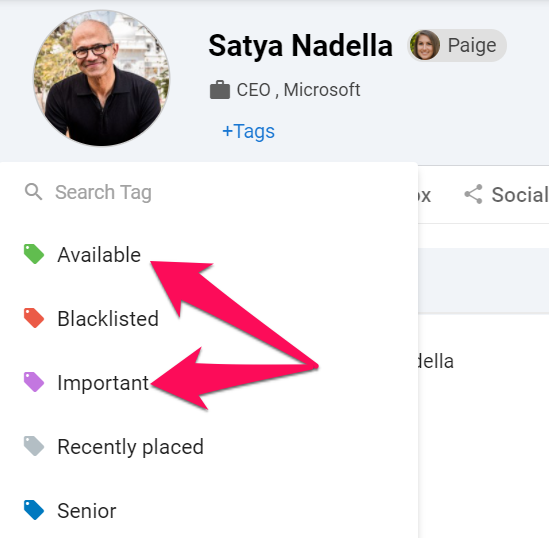
How to do it: Create custom tags or priority fields (e.g., Tier 1 - Critical, Tier 2 - Operational, Tier 3 - Expansion) within Manatal to categorize requisition requests and organize recruiter dashboard views by business priority.
4. Evaluate Build vs. Buy vs. Borrow Options
Determine the acquisition path for each line item in the plan rather than defaulting to external recruitment. According to SHRM’s 2025 Talent Trends research, 76% of organizations that removed college degree requirements for certain positions successfully hired at least one candidate who would have previously been considered unqualified. Choose whether to upskill existing staff (build), recruit new permanent talent (buy), or engage temporary contractors (borrow). [4]
How to do it:
- Build: Search existing employees within Manatal using Boolean Search & AI Matching to find internal candidates ready for upskilling.
- Buy/Borrow: Adjust candidate matching settings in Manatal to lower rigid requirements (e.g., degree requirements) and manage both permanent and temporary contractor pools in a single talent database.
5. Assign Acquisition Parameters to Each Role
Fill in the operational fields for every approved hire within the talent acquisition plan template. Define the primary sourcing channels, assign the hiring manager and recruiter, allocate the dedicated budget line, and set firm targets for time-to-fill and start dates.
How to do it: Set up jobs in Manatal with the appropriate recruiters, hiring managers, target dates, and relevant custom fields or reporting metrics.
6. Establish Governance and Cadence
Identify a single owner, typically the Head of Talent Acquisition or VP of HR, to maintain the document. Set up a quarterly review process with finance and department heads to adjust hiring schedules, realign budgets, and update role requirements based on real-time business performance.
Starter Tool Stack and Workflow
Operating a talent acquisition plan requires connecting workforce planning inputs to daily recruitment workflows. A standard stack uses a centralized spreadsheet for planning, an HRIS for baseline headcount data, external networks like LinkedIn or Indeed for sourcing, and an Applicant Tracking System (ATS) to manage applicant pipelines.
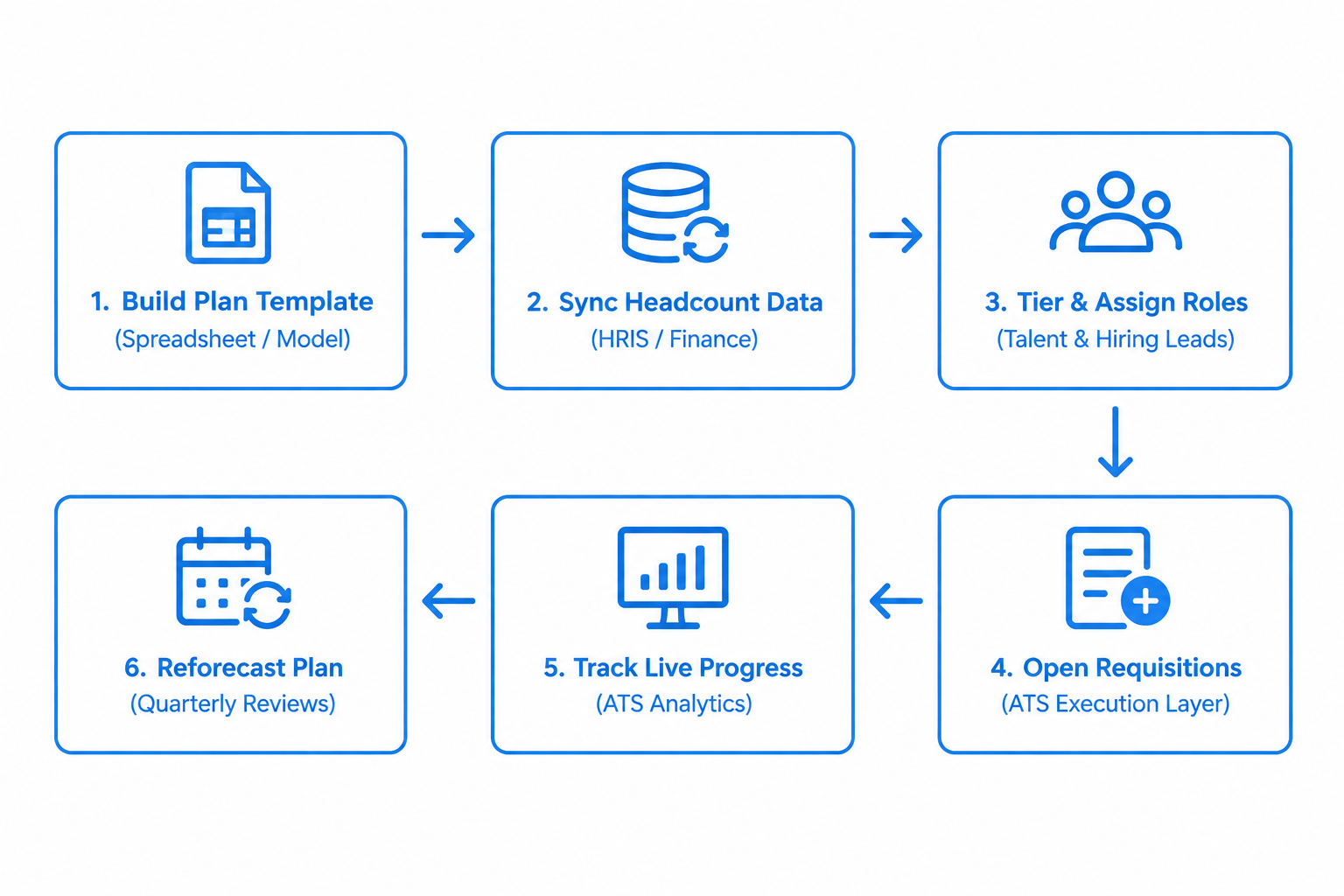
- Build the Plan Structure: Set up the template columns inside a spreadsheet (Google Sheets or Excel) to serve as the master record.
- Import Headcount Data: Pull active headcount, current vacancies, and historical attrition metrics directly from your HRIS.
- Tier and Assign Accountabilities: Conduct sign-off meetings with department heads and finance to finalize priority tiers, target start dates, and assigned budgets.
- Open Requisitions in ATS: Open corresponding requisitions inside your ATS as each planned hire approaches its target start window.
- Track Execution Progress: Monitor candidate pipeline movement and cycle times against the targets set in the master plan.
- Run Quarterly Reforecasting: Update the workbook every quarter to reflect filled roles, shifting business needs, and budget adjustments.
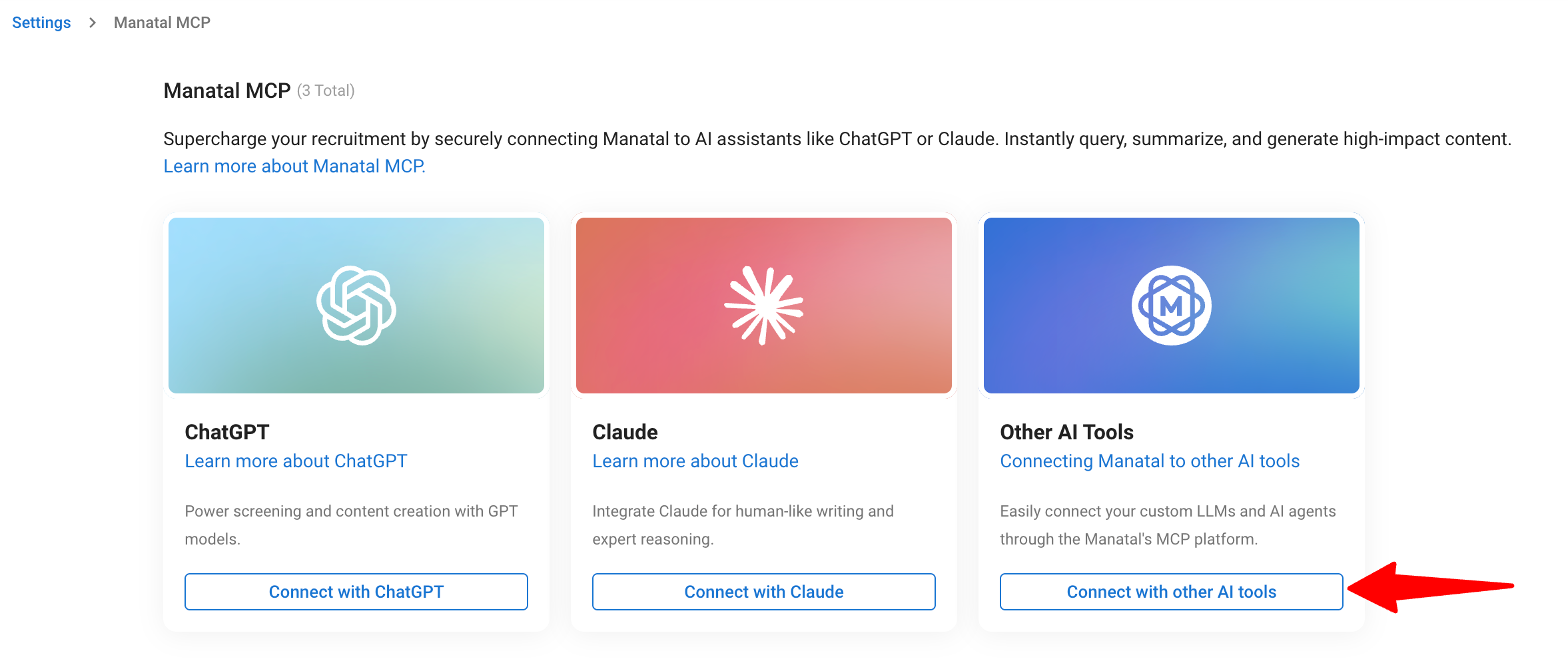
While a static spreadsheet establishes the initial template, teams often struggle to evaluate live recruitment metrics against static baseline projections. Manatal’s AI Data Chat, or Manatal MCP Server, can connect recruitment data to AI tools such as ChatGPT, Claude, and Gemini, allowing teams to query recruitment information using natural language.
How to Measure and Reforecast the Plan
Maintaining an effective talent acquisition plan requires tracking key operational metrics directly against planned benchmarks. Evaluating live hiring data against initial plan assumptions allows teams to adjust candidate sourcing strategies before delays affect business operations.
- Time-to-Fill vs. Target: Measures the difference between planned time-to-fill benchmarks and actual days taken to accept an offer.
- Cost-per-Hire vs. Budget: Compares total recruitment spend per role against the budget line item allocated in the template.
- Pipeline Coverage vs. Planned Headcount: Tracks the volume of qualified candidates in active interview stages relative to upcoming hiring targets.
- Plan Attainment: Measures the percentage of planned roles filled on or before their target start dates.
Conclusion
A talent acquisition plan must adapt to organizational changes. When business priorities shift, unexpected turnover occurs, or hiring timelines stretch, update the workbook during the quarterly reforecast loop. Adjust target start dates, shift recruitment budgets toward bottlenecked Tier 1 roles, and re-evaluate build-vs-buy decisions based on pipeline performance.
Ready to streamline your recruitment process and track your hiring goals effectively? Start for Free with Manatal today.
Frequently Asked Questions
Q: What is the difference between a talent acquisition plan and a talent acquisition strategy?
A: A talent acquisition strategy establishes the overarching vision, employer branding goals, and sourcing philosophies for the organization, while a talent acquisition plan acts as an operational workbook that schedules, budgets, and assigns specific hiring tasks on a role-by-role basis. For more context on long-term strategy design, refer to our guide on talent acquisition strategy.
Q: What should a talent acquisition plan template include?
A: An actionable template should include essential fields such as job title, department, priority tier, required headcount, target start date, hiring reason, hiring manager, assigned recruiter, sourcing channels, build-vs-buy decision, budget line, target time-to-fill, and live status.
Q: What is strategic workforce planning, and how does it connect to your hiring plan?
A: Strategic workforce planning evaluates long-term business goals and market trends to forecast future talent demand and skill shortages, producing the high-level headcount targets that a hiring plan translates into scheduled open requisitions. Organizations are looking to integrate internal talent pipelines into this process.
Q: What is the 80/20 rule in recruiting?
A: The 80/20 rule in recruiting suggests that roughly 80% of hiring outcomes and business impact stem from 20% of open roles or sourcing channels, underscoring the importance of tiering roles in a talent acquisition plan to prioritize business-critical positions.
Q: What formats can a talent acquisition plan template come in?
A: A talent acquisition plan template is typically built in dynamic spreadsheet formats such as Excel or Google Sheets for active management or converted to Word and PDF formats for executive reviews. Once planned roles are approved for sourcing, recruiting teams execute and track candidates using dedicated ATS software like Manatal.
Citations: