





According to Randstad Enterprise's 2025 Talent Trends research, 84% of talent leaders are prioritizing creating value for their organizations over cost savings, up from 77% in 2023. [1] That shift reflects a hard-won lesson: seat-by-seat hiring can't keep pace with growth. A talent acquisition strategy gives your team a long-term plan to attract, source, evaluate, and hire the right people before the req opens. This guide breaks down what that strategy is, how it differs from recruitment, and how to build one step by step with an actual tech stack and workflow.
What Is a Talent Acquisition Strategy?
A talent acquisition strategy is a long-term, business-aligned plan to source, attract, hire, and retain the right people. It builds around pipelines rather than one-off vacancies. The strategy connects your hiring goals to your company's growth plan, defines what talent you need, and creates systems to engage candidates before positions go live.
Core elements include the following:
- Workforce planning aligned to 1-5 year business objectives
- Target talent profiles tied to actual skill gaps
- Employer positioning and employee value proposition (EVP)
- Proactive talent pipelines for recurring role families
- Standardized decision-making processes
- A defined metric set with review cadence
How to Build a Talent Acquisition Strategy
Every company's strategy will look different, but the build sequence follows a consistent logic: start with the business, work through the talent market, define your positioning, create the pipeline infrastructure, standardize decisions, and instrument everything with metrics.
1. Align Hiring With Business Goals and Workforce Planning
Define hiring targets directly with leadership to align business objectives with a structured recruitment plan. Translate these requirements into custom recruitment workflows that support long-term headcount growth.
- Use Google Sheets or Notion to build a basic workforce capacity planner that forecasts headcount costs, maps skill gaps, and tracks department hiring timelines against quarterly company OKRs.
- Use Manatal Job Requisitions Management: Create, review, and approve job requests connected directly to workforce budgets, headcounts, and hiring target dates.
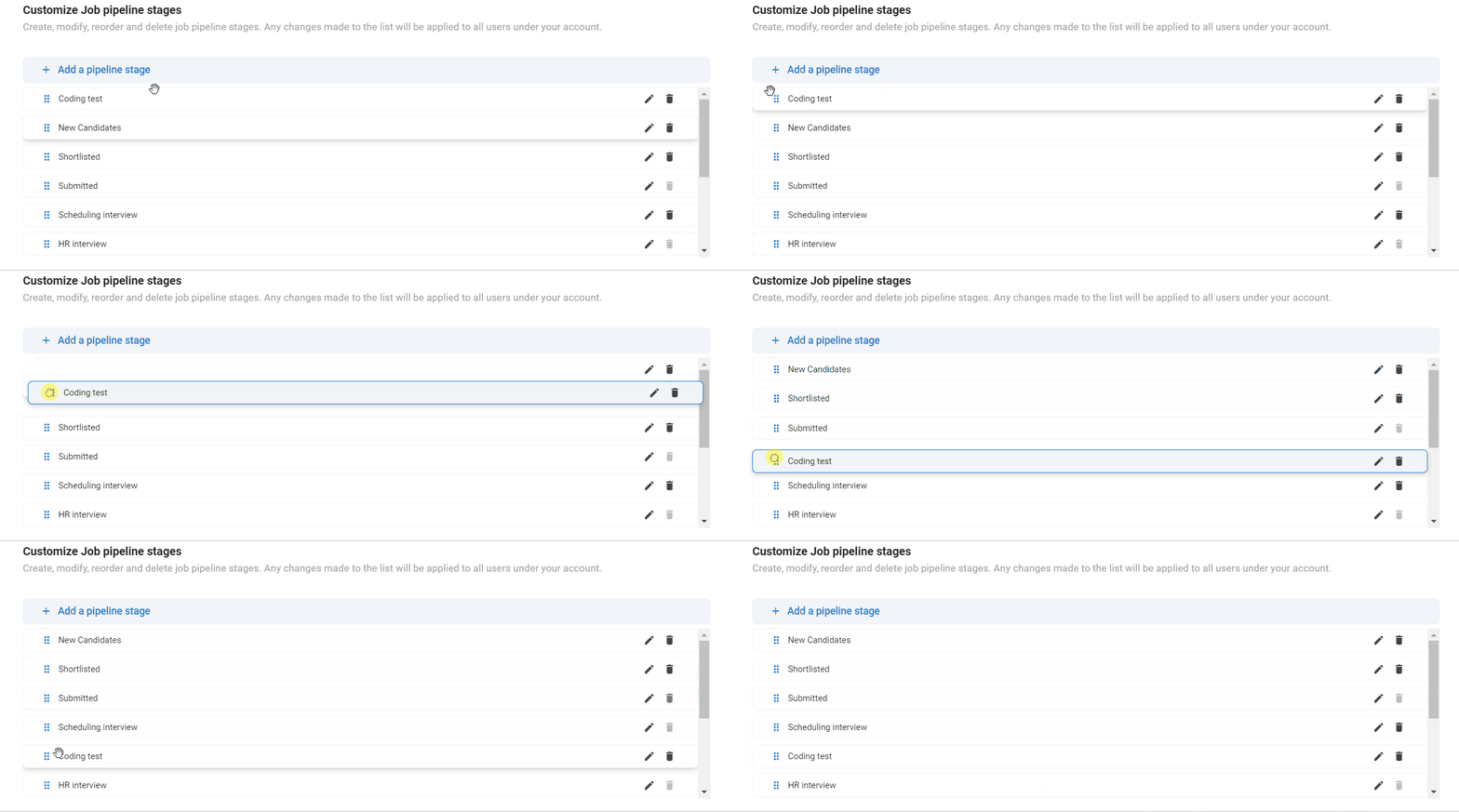
- Build and customize job pipeline stages for distinct role families, accommodating complex recruitment steps like technical assessments or executive panel rounds.
{{cta}}
2. Assess the Talent Market
Analyze target market talent availability and salary benchmarks prior to starting your candidate search. Evaluate candidate skill distribution and competitor hiring activity to adjust your sourcing strategy accordingly.
- Free Salary Calculators (e.g., Glassdoor, Payscale): Search title demand volume and check baseline local compensation rates to establish competitive compensation packages.
3. Define Target Talent Profiles and Employer Positioning
Translate business needs into specific candidate profiles. Document the skills, experience levels, and cultural attributes that predict success in each role family. Then define your EVP: what your company offers that competitors don't. This might be growth opportunities, mission alignment, compensation structure, flexibility, or a specific team culture. Your EVP anchors every candidate communication and job posting.
>> For deeper guidance on building this foundation, see employer branding best practices.
- Canva Free Tier: Design brand assets, social media hiring banners, and culture graphics to communicate your Employer Value Proposition (EVP).
- Manatal Career Page Builder: Design and publish a fully branded, multi-language career site on your own domain without developer assistance, providing a candidate application point.
4. Build Proactive Talent Pipelines Before Roles Open
Build and segment candidate talent pools continuously before actual hiring needs arise. Engage potential candidates across multiple sourcing channels and structured referral programs to keep your pipeline active.
- Mailchimp Free Tier or Gmail Templates: Draft and schedule email outreach to build warm talent pools and maintain contact with past applicants.
- Google Forms: Collect employee referrals internally using a simple intake form.
- Manatal Multichannel Job Posting: Broadcast job ads to 2,500+ free and premium job channels simultaneously to capture inbound talent streams.
- Referral Management System: Track employee referrals automatically and track referred candidates and referrers
Free resource: Employee Referral Program Email Template
5. Standardize Hiring Decision
Establish structured evaluation rubrics and standardized interview questions across all hiring teams. Align recruiters and hiring managers on clear candidate criteria to eliminate bias and streamline decisions.
- Google Docs or Typeform: Create structured recruiting scorecards and standardized rubric templates for interviewers to fill out after candidate calls.
- ChatGPT or Claude (Free Versions): Generate standardized behavioral interview questions based on specific job descriptions.
- Manatal Candidate Scorecards & Evaluation Forms: Implement structured evaluation forms directly within candidate profiles so interviewers rate candidates against uniform criteria.
- Manatal AI Recommendation: Score and rank candidates against job-specific criteria to help recruiters prioritize profiles for review.
6. Define Recruitment Metrics and Review Cadence
Monitor recruitment key performance indicators continuously to measure hiring efficiency and quality. Review performance data on a quarterly basis to refine your talent acquisition tactics over time.
- Excel Analytics Templates: Calculate average time-to-hire and cost-per-hire using standard spreadsheet formulas.
- Manatal Report & Analytics: Access dashboards detailing critical metrics, including source performance, pipeline conversion velocity, and team hiring performance.
How to Measure Talent Acquisition Strategy
Data moves a strategy from a document to an operating system. Track these talent acquisition metrics and tie each to a decision it should drive.
Quality of hire
- What It Measures: Performance and retention of new hires at 6-12 months
- Decision It Drives: Validates whether your sourcing and screening criteria predict success
- What It Measures: Days from job requisition/opening to offer acceptance
- Decision It Drives: Flags process bottlenecks and workforce-planning risks
- What It Measures: Days from candidate application or sourcing to offer acceptance
- Decision It Drives: Measures how quickly candidates move through the hiring process
- What It Measures: Percentage of offers accepted
- Decision It Drives: Signals competitiveness of your EVP and compensation
Application completion rate
- What It Measures: Percentage of started applications that submit
- Decision It Drives: Identifies friction in your application process
- What It Measures: Which channels produce your hires
- Decision It Drives: Guides sourcing investment and job-board spend
Pipeline coverage
- What It Measures: Qualified candidates per open role
- Decision It Drives: Predicts your ability to fill roles on time
Hiring-manager satisfaction
- What It Measures: Survey scores from hiring managers
- Decision It Drives: Surfaces collaboration and process issues
New-hire retention
- What It Measures: Percentage of new hires still employed at 6-12 months
- Decision It Drives: Validates fit assessment during hiring
An ATS can centralize recruitment data and reduce the need for manual spreadsheet reporting. Recruitment dashboards can help teams monitor pipeline and hiring metrics in one place.
Build a Talent Acquisition Tech Stack
Most guides tell you what a strategy should contain. Few show you how to operate it. Here's a practical build sequence with specific tools and human checkpoints.
Starter Talent Acquisition Tech Stack
- Applicant tracking system (ATS): Use a centralized recruitment platform to manage candidate pipelines, maintain talent pools, and support ongoing relationships with potential candidates.
- Job boards for reach: Indeed and LinkedIn for broad distribution; niche boards for specialized roles.
- Assessment and interview tools: A skills-assessment platform and video interview software (as categories) to screen at scale.
Talent Acquisition Implementation Workflow
- Import your workforce plan. Load open and anticipated roles into your ATS. Tag by priority and business unit so the system reflects your actual hiring plan.
- Set up target-profile templates. Create scorecard-based pipelines for each role family. Document required skills, interview questions, and evaluation criteria.
- Turn on multichannel sourcing. Connect job boards and social channels. Start capturing passive candidates into talent pools for roles you'll need later.
- Configure structured interviews. Build scorecards and define approvers so decisions stay consistent and documented. Human checkpoint: final hiring decisions and offers remain human-owned.
- Automate candidate communications. Schedule follow-ups and interview invitations to protect the candidate experience without manual overhead.
- Wire up reporting. Configure dashboards for your metric set. Set a quarterly cadence for strategy reviews to adjust based on results.
Conclusion
A reactive hiring function keeps you perpetually behind. A talent acquisition strategy puts you ahead of demand, with warm pipelines and proven processes ready when roles open. Manatal helps HR teams and recruiters move from reactive hiring to proactive talent acquisition. With AI-powered sourcing, talent pool management, and built-in analytics, you get the infrastructure to operate your strategy, not just document it.
Frequently Asked Questions
Q: What are the 4 pillars of talent acquisition?
A: The four pillars are acquisition, development, engagement, and retention. Acquisition covers sourcing and hiring. Development builds skills in your workforce. Engagement keeps employees connected to the mission. Retention ensures you don't lose the talent you worked to attract.
Q: What are the 5 C's of talent?
A: The 5 C's are character, competence, commitment, compatibility, and contribution. These dimensions help evaluate candidates beyond technical skills, assessing whether someone will thrive in your specific environment and add value over time.
Q: How often should you review and update your talent acquisition strategy?
A: Quarterly reviews work for most organizations. This cadence lets you adjust tactics based on metric trends without overreacting to short-term noise. Major strategy overhauls typically happen annually, aligned to workforce planning cycles. Manatal simplifies this review process by tracking recruitment analytics and custom pipeline velocity directly within its reporting dashboards.
Q: What does a talent acquisition team actually do?
A: A talent acquisition team manages the end-to-end process of building and executing hiring strategy. Daily work includes workforce planning, sourcing candidates, managing pipelines, coordinating interviews, analyzing data, and optimizing employer brand. Software like Manatal automates these routine operations through centralized candidate databases, multi-channel job posting, and automated workflows, enabling teams to focus on strategic hiring goals.
Citation:
.webp)







.webp)

.webp)


.webp)


