





The global average time to hire has risen to 44 days, up from 31 days in 2023. [1] This increase indicates that hiring is becoming more complex. It can make it harder for companies to secure talent quickly. Maintaining a straightforward and efficient process could help businesses hire faster. This article gives you the real numbers of time to hire by industry, seniority, and role type. Then it shows you why the gaps exist and what to do about your own talent pipeline.
Time to Hire vs. Time to Fill
In recruitment, it is important to distinguish between two key metrics: Time to fill vs. Time to hire
- Time to Fill = the total time from when a job requisition is approved to offer acceptance.
- Time to Hire = the time it takes for a candidate to progress from entering your pipeline to accepting the offer.
Recent recruiting benchmarks show that hiring timelines vary significantly by organization, industry, and role. SHRM reports a median time to fill of 39 calendar days for nonexecutive positions in 2026, while more specialized or senior roles often require substantially longer hiring cycles. [2] If your time to fill is high but time to hire is low, your sourcing is the bottleneck. If your time to hire is high, your interview process may contain inefficiencies.
You cannot fix a slow pipeline until you know where the days are disappearing. Using an applicant tracking system like Manatal Reports & Analytics gives you this visibility. The platform tracks time to hire across more than 20 key performance indicators on real-time dashboards. You can segment performance by job, recruiter, or source to see exactly which pipeline stage slows the process without pulling manual spreadsheets.
{{cta}}
Average Time to Hire by Industry
Different sectors face different hiring constraints. High-volume roles fill quickly. Specialized roles require extensive vetting. Data from Genius highlights the clear gaps between major sectors:
Time to Hire by Seniority
Regardless of the industry, role seniority acts as a major multiplier for recruiters. According to data reported by The Resource Company, the time to hire scales significantly with the level of the role.
Factors That Extend Time to Hire
Reducing time to hire starts with understanding what slows the hiring process down. While talent shortages can play a role, research shows that internal recruiting workflows and decision-making often have an even greater impact on hiring speed [3]
- A limited candidate pool increases sourcing time because recruiters require more effort to identify qualified applicants. SHRM identifies low applicant volume as one of the most common recruiting challenges organizations face today.
- Too many interview stages create scheduling bottlenecks and extend decision timelines, especially when multiple stakeholders are involved. Gartner notes that interview scheduling delays and inconsistent interviewer feedback are major sources of friction in hiring. [4]
- Unclear job descriptions attract mismatched applicants, forcing recruiters to spend more time screening resumes and restarting searches. SHRM recommends aligning job requirements with hiring managers before opening a role.
- Slow internal approvals for interview feedback, headcount, or offer approvals frequently delay hiring decisions, even when qualified candidates are ready to move forward.
- Strict location or qualification requirements reduce the available talent pool, making specialized positions more difficult and time-consuming to fill.
How to Reduce Your Time to Hire by Industry
True hiring efficiency is about cutting administrative friction so recruiters can focus on evaluating candidate fit rather than managing tasks. With Manatal’s AI-powered ATS, you can automate admin work, sync schedules, and centralize your pipeline. To get started, choose one bottleneck, prove the time savings, and scale from there.
Step 1. Audit Your Pipeline & Pinpoint Bottlenecks
To target that first bottleneck, you must first locate exactly where your hiring process stalls.
- Map your recruitment funnel: Break your hiring process into clear stages.
- Spot the bottlenecks: Measure the average days a candidate spends in each stage using your ATS analytics. If scheduling takes 7 days but interviewing takes 2, scheduling is your bottleneck.
- Fix systemic delays: If offer approvals take too long, implement pre-approved salary bands and digital contract templates to cut out the red tape.

Metrics to Track:
- Stage-to-Stage Velocity: The average number of days a candidate spends in a specific stage. Target: Less than 3 days per stage transition.
- Offer Approval Time: Time taken from the moment a hiring manager decides to hire to the actual offer generation. Target: Less than 24–48 hours.
Step 2: Activate the Talent Reservoir
Stop waiting for job boards to deliver applicants. Cultivate an active pool of talent beforehand.
- Mine past final-round talent: Use your recruitment CRM or ATS to tag high-quality candidates who made it to the final rounds in previous searches. Set up automated email sequences to check in with them periodically.
- Headhunt passive talent early: Build a "warm list" of qualified professionals on LinkedIn before a role opens up.
- Gamify employee referrals: Launch a streamlined internal referral program. Referred candidates usually skip long sourcing phases and move straight to screening.
Metrics to Track:
- Sourcing Channel Effectiveness: The percentage of hires originating from your existing database or referrals versus cold job ads. Target: Greater than 30% of hires coming from internal pipelines/referrals.
- Time-to-Submittal for Pipeline Candidates: How fast a pre-pipelined candidate is introduced to a hiring manager compared to a fresh applicant. Target: Less than 48 hours from role activation.
Step 3: Fast-Track Early Screening
The initial review phase often wastes the most time. Standardize it to move people through faster.
- Deploy objective pre-employment skills assessment: Filter out unqualified applicants immediately by using automated tools like Criteria (for general aptitude) or Codility (for technical roles).
- Adopt structured recruiting scorecards: Create a standard evaluation rubric for recruiters and hiring managers. Base decisions on concrete criteria rather than gut feelings.
- Weed out manual scheduling: Connect tools like Calendly to eliminate back-and-forth emails. Consider using Manatal AI interviewer to manage early-stage screening through asynchronous video interviews. This removes the need for manual scheduling and coordination.
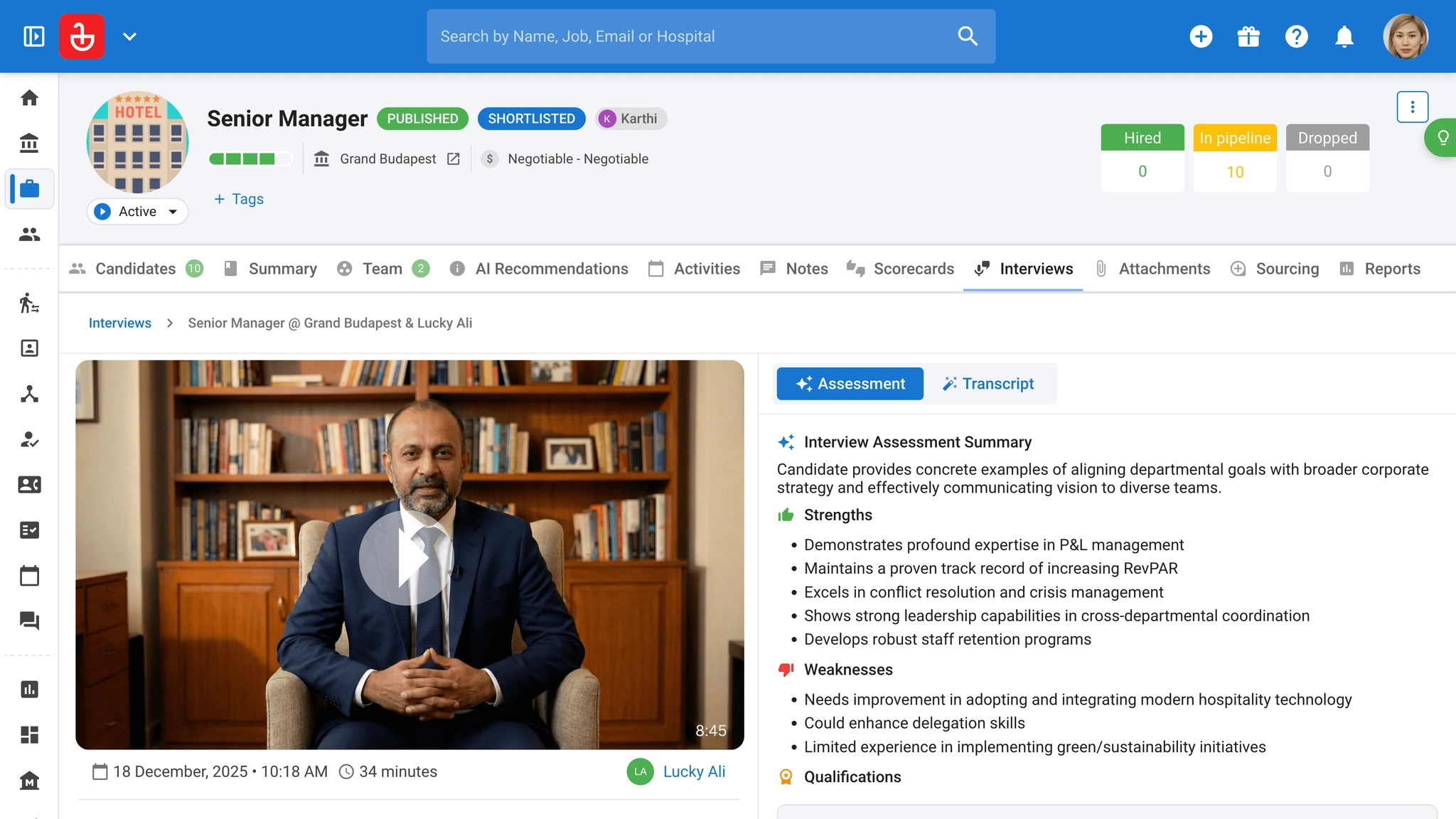
Metrics to Track:
- Application-to-Screen Time: The total days between a candidate submitting an application and completing their initial screening. Target: Less than 4 days.
- Screen-to-Interview Conversion Rate: The percentage of screened candidates moving to formal interviews. Target: 20–30% (A higher rate indicates highly accurate early screening filters).
Step 4: Shorten Interview Cycles and Enforce SLAs
Too many interview rounds kill candidate momentum. Keep the process lean.
- Enforce a hard cap: Limit standard business and operational roles to a maximum of two structured interview rounds.
- Lock in SLA commitments: Hold hiring managers accountable. Write "Time-to-Hire" speed targets directly into your internal agreements. Mandate that candidate feedback should be submitted within 24 hours of an interview.
- Book debriefs in advance: Block out 15 minutes on the hiring manager's calendar immediately following the interview to make an active go/no-go decision.
Metrics to Track:
- Hiring Manager Feedback SLA: The average time it takes for a manager to submit a scorecard after an interview. Target: Less than 24 hours.
- Interview Loop Duration: Total calendar days from the first interview to the final interview. Target: Less than 7 business days.
Step 5: Treat Candidate Experience as a Speed Strategy
Candidates move faster when the process feels seamless and engaging.
- Establish a 24-hour response rule: Commit to answering candidate inquiries within one business day.
- Optimize for mobile: Ensure application forms are short, straightforward, and easy to complete on a smartphone.
- Automate touchpoints: Use chatbots for recruiting or SMS reminders to keep candidates updated on their status automatically.
Metrics to Track:
- Offer Acceptance Rate (OAR): The percentage of extended job offers that are accepted. Target: Greater than 80-85%.
- Candidate Drop-out Rate: The percentage of qualified candidates who voluntarily withdraw from your process. Target: Less than 10%.
Conclusion
A generic national benchmark provides a broad overview. You should base your recruitment goals on the average time to hire by industry to keep your expectations realistic and your targets achievable. Speed is a direct byproduct of knowing where your days actually go. Use the concrete data in this time to hire by industry guide to audit your internal pipelines, remove unnecessary interview steps, and eliminate corporate friction.
Start a 14-day free trial with Manatal to track your hiring metrics and optimize your pipeline today.
Frequently Asked Questions
Q: What is the average time to hire by industry?
A: The average hiring time varies significantly by sector and role type, ranging from 17 days for entry-level roles in consumer goods to 36 days for specialist positions in the charity & non-profit sector. Across most industries, the general average time to hire typically hovers between 17 and 32 days depending on the technical complexity of the position. An applicant tracking system like Manatal helps companies monitor these recruitment metrics to maintain performance well below these industry benchmarks.
Q: Which industries have the fastest and slowest time to hire?
A: According to recent data, Consumer Goods and Health Care feature the fastest hiring tracks, securing entry-level and support staff in just 17 to 19 days. Conversely, the Financial Services and Energy & Utility sectors experience the slowest timelines, taking up to 30 to 32 days for technical and specialist hires due to multi-layered evaluations. The charity & nonprofit sector marks the longest cycle, averaging 36 days for experts. Manatal optimizes both high-volume and complex hiring processes by utilizing AI screenings for speedy rollouts and automated candidate pipelines for long-term engagements.
Q: How is time to hire calculated?
A: Time to hire is calculated by taking the date a candidate formally accepts your job offer and subtracting the exact date they first entered your recruitment pipeline (whether through a direct application, sourcing, or a referral).
Q: What is a good time to hire in 2026?
A: A good time to hire means consistently beating your specific industry’s current benchmark. In 2026, top-performing companies aim to secure entry-level talent in under 18–20 days for competitive sectors like consumer goods, health care, and technology, while keeping complex technical or specialist hiring cycles below 24–26 days.
Q: How can I reduce my time to hire?
A: To reduce hiring time, audit your recruitment funnel to identify operational bottlenecks, such as delayed interview feedback or slow candidate screening. Limit interview panels to essential structured rounds and replace manual resume reviews with automated parsing. Employing an ATS like Manatal allows you to automate candidate communication, enable collaborative hiring manager feedback, and utilize AI to match top talent to open roles instantly.
Citation.
.webp)







.webp)

.webp)


.webp)


